Automatic Stormwater Samplers
Automatic Stormwater Samplers
Monitoring stormwater runoff is a critical requirement for industrial facilities, municipal wastewater treatment plants, and construction sites. To comply with environmental regulations such as the National Pollutant Discharge Elimination System (NPDES) or local water quality standards, engineers must collect representative samples during rain events. Automatic stormwater samplers are the primary tools used to automate this process, ensuring that data is collected accurately, even during unpredictable weather conditions or outside of standard working hours.
This guide explores the technical principles, selection criteria, and installation best practices for automatic stormwater samplers, with a focus on how these systems integrate with level and flow measurement technologies.
Measurement Principles and Triggering Mechanisms
Before selecting a sampler, it is essential to understand how the device determines when and how much to sample. Automatic stormwater samplers do not operate in isolation; they rely on inputs from external sensors to trigger a sampling cycle. There are three primary modes of operation:
1. Time-Proportional Sampling
In this mode, the sampler is programmed to take a specific volume of water at fixed time intervals (e.g., every 15 minutes). While simple to set up, this method does not account for changes in flow rate. It is best suited for sites where the flow is relatively constant, which is rarely the case in stormwater applications.
2. Flow-Proportional Sampling
This is the industry standard for stormwater monitoring. The sampler interfaces with a flow meter—often utilizing a primary device like a flume or weir combined with an ultrasonic or radar level sensor. The sampler takes a sample after a specific volume of water has passed (e.g., every 1,000 liters). This ensures that the final composite sample is representative of the entire storm event, weighting the sample based on the volume of runoff.
3. Event-Triggered (First Flush) Sampling
Stormwater regulations often require the capture of the "first flush," which is the initial runoff of a rain event that typically contains the highest concentration of pollutants. In this scenario, a level switch or a rain gauge sends a signal to the sampler to begin a cycle as soon as a threshold (e.g., 2.5 mm of rain or a specific water level in a channel) is reached.
To ensure these triggers are accurate, industrial-grade sensors from the Main Page of instrumentation providers are often integrated into the system to provide the necessary level and flow data.
Key Components of Automatic Samplers
An automatic stormwater sampler consists of several core components that must be matched to the specific application environment.
The Pump System
Most modern samplers use one of two pump types:
* Peristaltic Pumps: These are the most common. A rotating roller compresses a flexible tube to create a vacuum, drawing the sample up. They are excellent for preventing cross-contamination because the liquid only touches the tubing. However, they have a limited vertical lift (typically 7 to 8.5 meters).
* Vacuum/Pressure Pumps: These use a vacuum pump to draw the sample into a chamber and then pressure to discharge it into the bottle. They are often faster and can handle higher vertical lifts but are more complex to maintain.
Controller and Data Logger
The controller is the "brain" of the unit. It manages the sampling program, stores data logs of when samples were taken, and interfaces with external sensors. In remote locations, controllers are often equipped with telemetry (4G/5G) to send alerts to operators when a sampling event has begun.
Sample Containers
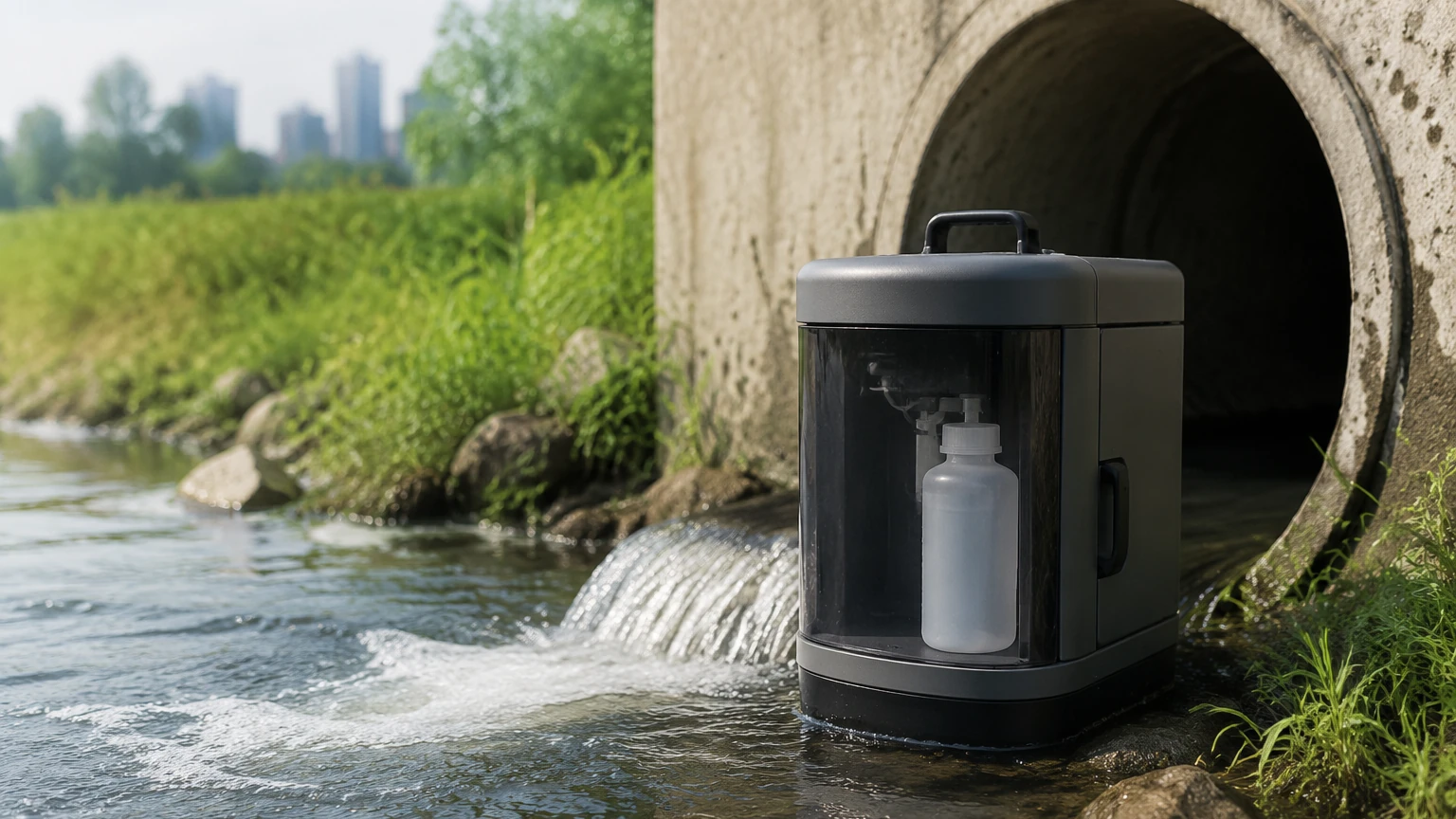
Depending on the laboratory analysis required, samplers can be configured with a single large composite bottle (e.g., 10 or 20 liters) or multiple smaller bottles (e.g., 24 x 1-liter bottles) for discrete sampling over time. Bottle materials are typically Polyethylene (PE) for general pollutants or Glass for organic compounds and pesticides.
Practical Selection Table
Choosing the right configuration depends on the site's physical constraints and the regulatory requirements.
| Feature | Portable Sampler | Stationary (Refrigerated) Sampler |
| :— | :— | :— |
| Primary Use | Short-term studies, remote sites | Permanent outfall monitoring |
| Power Source | 12V DC Battery / Solar | 120V/240V AC |
| Sample Preservation | Ice/Insulation | Active Refrigeration (4°C) |
| Weight | 15 kg – 25 kg (empty) | 70 kg – 100 kg |
| Durability | High (NEMA 4X/6) | High (Stainless Steel/GRP) |
| Typical Application | Construction sites, manholes | Industrial effluent, WWTP |
Installation Considerations
Proper installation is as important as the device selection itself. If the intake is poorly positioned, the data will be invalid regardless of the sampler's quality.
1. Intake Placement: The suction line intake should be placed in the main flow of the channel, away from the bottom to avoid sucking up heavy silt, but low enough to ensure it remains submerged during the sampling cycle. In shallow flows, a "low-profile" intake strainer is recommended.
2. Suction Line Slope: The tubing should have a continuous downward slope from the sampler to the source. This allows the line to drain completely during the pre-sample and post-sample purges, preventing cross-contamination and freezing in cold climates.
3. Vertical Lift: Always calculate the "head" or vertical distance between the water surface and the sampler pump. Most peristaltic pumps lose efficiency significantly as they approach their maximum lift (approx. 8.5 meters). If the lift is too high, the line velocity may drop below the required 0.6 m/s (2 ft/s) needed to keep suspended solids in the sample.
4. Power Supply: For remote stormwater sites, solar panels are often required. Ensure the battery capacity is sufficient to power both the sampler and the associated level/flow sensors for at least 72 hours of operation during cloudy weather.
Limitations and Common Risks
While automatic stormwater samplers are highly reliable, engineers should be aware of several common failure points:
* Clogging: Stormwater often carries debris. Using a proper stainless steel strainer on the intake line is essential to prevent large particles from blocking the pump tubing.
* Sample Degradation: Many environmental parameters (like BOD or certain bacteria) require the sample to be kept at 4°C. In portable samplers using ice, the ice may melt before the operator can retrieve the bottles, leading to compromised data.
* Cross-Contamination: If the pump does not perform a sufficient "air purge" before and after each sample, residual liquid from the previous cycle can contaminate the current sample. Regular tubing replacement is necessary to maintain integrity.
* Sensor Calibration: If the triggering level sensor is out of calibration, the sampler may trigger too late (missing the first flush) or not at all. It is vital to use high-quality radar or ultrasonic level meters that offer stable performance in varying temperatures.
Frequently Asked Questions (FAQs)
Q: How often should the pump tubing be replaced?
A: For peristaltic pumps, tubing should generally be replaced every 500 to 1,000 sample cycles, or annually, whichever comes first. Visible wear or cracking is an immediate sign that replacement is needed.
Q: Can I use a sampler to measure flow?
A: Most samplers do not measure flow themselves; they receive a signal from an external flow meter. However, some advanced controllers can be programmed with flow formulas (like Manning's equation) if they are connected to a level sensor.
Q: What is the maximum length for a suction line?
A: While some pumps can pull from 30 meters away horizontally, the longer the line, the greater the risk of sample bias and the harder the pump must work. It is best to keep the suction line as short and straight as possible.
Q: How do I ensure my sampler is compliant with EPA standards?
A: Ensure the sampler maintains a minimum line velocity of 0.6 m/s to keep solids in suspension and that it has a cooling mechanism (ice or refrigeration) to maintain samples at the required temperature until collection.
Conclusion and Next Steps
Automatic stormwater samplers are indispensable for modern environmental management. By understanding the relationship between water level, flow, and sampling triggers, facilities can ensure they remain in compliance while gathering high-quality data for engineering decisions.
Successful monitoring starts with accurate instrumentation. When designing a stormwater monitoring station, the integration of reliable level measurement is the first step. For technical specifications on the sensors required to trigger and manage these systems, engineers should Review product options and application support to find the right balance of accuracy and durability for their specific site conditions. Confirming the vertical lift, power availability, and required bottle configuration before procurement will prevent costly field adjustments and ensure the success of the monitoring program.