Thermowell Stainless
Thermowell Stainless
In industrial process control, the protection of temperature-sensing elements is as critical as the measurement itself. A thermowell is a cylindrical fitting designed to protect temperature sensors, such as thermocouples, RTDs (Resistance Temperature Detectors), and bimetal thermometers, from the harsh conditions of a process media. Among the various materials available, stainless steel stands as the industry standard due to its versatility, mechanical strength, and corrosion resistance. This guide explores the technical nuances of thermowell stainless selection, design, and application within modern industrial environments.
Fundamental Principles of Thermowell Operation
A thermowell acts as a pressure-tight barrier between the process fluid and the sensing instrument. Its primary function is twofold: to protect the sensor from corrosion, high pressures, and high-velocity fluid flow, and to allow for the removal of the sensor for calibration or replacement without depressurizing the system or draining the vessel.
Heat Transfer and Thermal Lag
The operation of a thermowell relies on thermal conduction. Heat from the process fluid must pass through the thermowell wall and the internal air gap (or heat-conductive paste) to reach the sensor. This process inherently introduces "thermal lag," a delay in the sensor's response to temperature changes.
To minimize this lag, engineers must balance the wall thickness of the thermowell. While a thicker wall provides greater mechanical strength against high pressures, it increases the thermal mass and slows the response time. Conversely, a thinner wall improves response time but may fail under mechanical stress. High-quality thermowell stainless designs utilize precision machining to ensure optimal wall thickness and internal bore tolerances, facilitating efficient heat transfer while maintaining structural integrity.
Stainless Steel Material Comparison for Thermowells
Selecting the correct grade of stainless steel is the most critical decision in thermowell specification. The choice depends on the chemical composition of the process media, the operating temperature, and the required longevity of the instrument.
Common Stainless Steel Grades
1. 304 Stainless Steel: The most basic grade, suitable for general-purpose applications where corrosion is minimal. It offers good heat resistance but is susceptible to chloride-induced pitting.
2. 316/316L Stainless Steel: The industry workhorse. The addition of molybdenum provides superior resistance to chlorides and organic acids. The "L" variant (low carbon) is essential for welded thermowells to prevent intergranular corrosion in the heat-affected zone.
3. 310 Stainless Steel: A high-chromium, high-nickel grade designed for high-temperature oxidation resistance, often used in furnaces and heat treatment applications up to 1,100°C (2,012°F).
4. 321 Stainless Steel: Similar to 304 but stabilized with titanium. This prevents carbide precipitation during welding and is ideal for high-temperature service in the range of 425°C to 815°C (800°F to 1,500°F).
Selection Table: Stainless Steel Grades vs. Process Environments
| Material Grade | Corrosion Resistance | Max Temp (Approx.) | Typical Applications |
| :— | :— | :— | :— |
| SS304 | Moderate | 800°C (1,472°F) | Potable water, dry air, HVAC systems |
| SS316L | High (Chlorides) | 850°C (1,562°F) | Chemical processing, marine, food & beverage |
| SS310 | Very High (Oxidation) | 1,100°C (2,012°F) | Kilns, combustion chambers, flue gas |
| SS321 | High (Intergranular) | 815°C (1,500°F) | Exhaust manifolds, high-temp steam lines |
| SS410 | Moderate (Hardness) | 700°C (1,292°F) | High-pressure steam, oil refining (hardened) |
Design and Construction Types
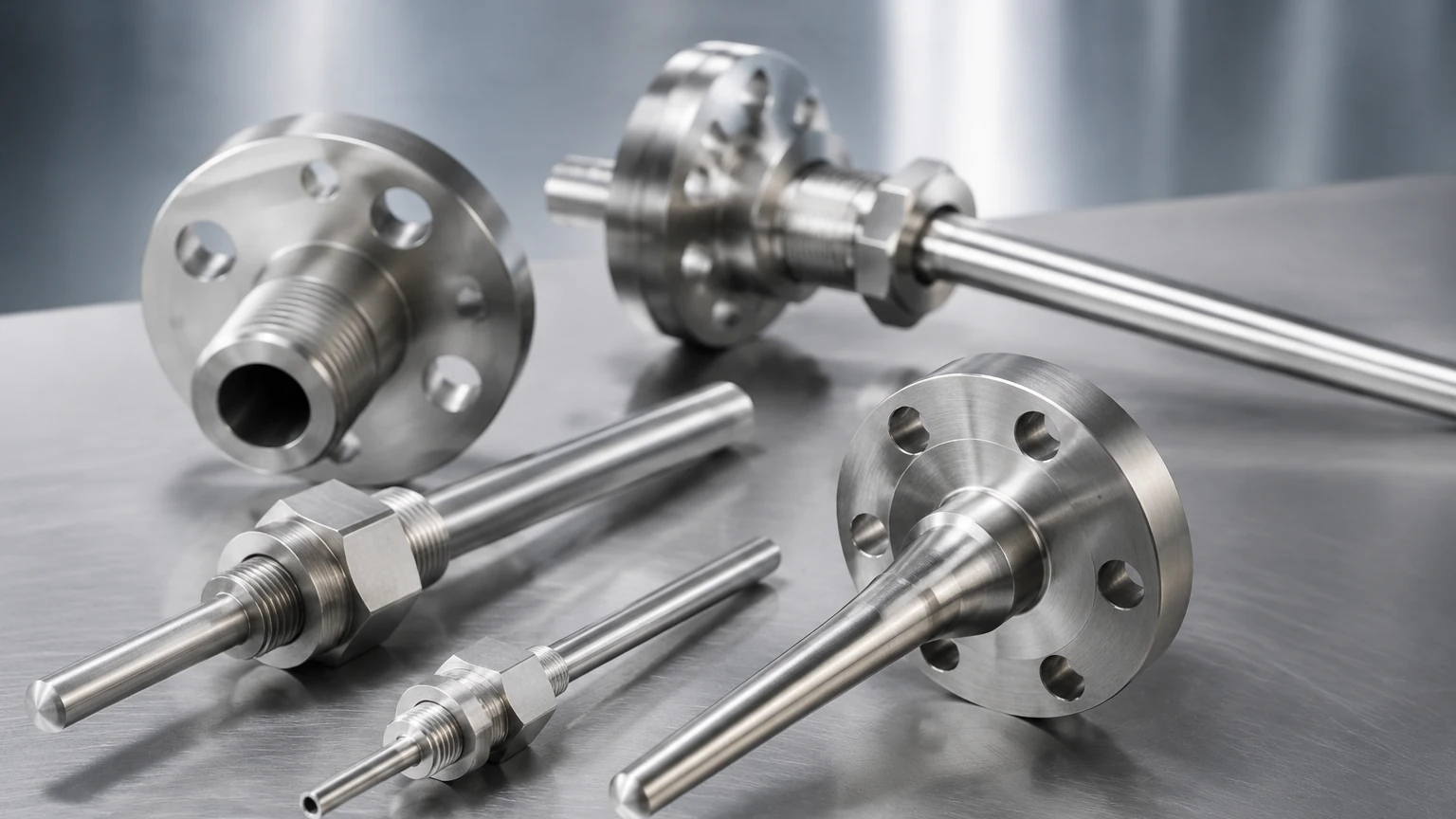
Thermowell stainless components are categorized by their connection to the process and their shank profile. The choice of design affects how the well handles fluid dynamics and pressure.
Shank Profiles
* Straight: The diameter is uniform along the entire insertion length. These are easy to manufacture and provide consistent strength.
* Stepped: The diameter is reduced at the tip (e.g., from 19 mm to 12.7 mm). This reduces the thermal mass at the sensing point, significantly improving response time without compromising the strength at the process connection.
* Tapered: The diameter gradually decreases from the base to the tip. This design offers the highest strength-to-weight ratio and is the preferred choice for high-velocity flow applications, as it resists vibration more effectively than straight shanks.
Process Connections
* Threaded: Screwed directly into a pipe NPT or BSP thread. These are cost-effective but generally limited to lower-pressure applications (under 70 bar / 1,000 psi).
* Flanged: Bolted to a mating flange on the vessel or pipe. This is the standard for high-pressure, high-temperature, and hazardous chemical environments. Flanged thermowells allow for easier inspection and cleaning.
* Socket Weld / Weld-in: Permanently welded into the system. These provide the highest pressure seal integrity but are difficult to replace if the well itself fails.
Wake Frequency and Mechanical Integrity
One of the most overlooked aspects of thermowell stainless selection is the impact of fluid velocity. As fluid flows past a thermowell, it creates wake vortices (Von Karman vortices). If the frequency of these vortices matches the natural frequency of the thermowell, resonance occurs. This can lead to catastrophic mechanical failure through fatigue, often snapping the thermowell at the process connection.
Engineers must perform a Wake Frequency Calculation according to the ASME PTC 19.3 TW standard. This calculation considers:
* Fluid density and velocity.
* The thermowell's material properties (Elastic Modulus).
* The dimensions (bore, tip diameter, root diameter, and insertion length).
* The operating pressure and temperature.
If a thermowell fails the calculation, the insertion length must be shortened, the root diameter increased, or a velocity collar (support ring) must be utilized. For complex projects requiring both temperature and level monitoring, it is advisable to consult a professional manufacturer. You can Review product options and application support on our main page to ensure your instrumentation suite meets these rigorous safety standards.
Installation and Placement Guidelines
Correct installation is essential for accurate measurement and the longevity of the thermowell stainless assembly.
Insertion Depth
The rule of thumb for insertion depth is to ensure the sensing tip is located in the middle third of the pipe diameter. For pipes, the insertion length ($U$ length) should ideally be at least 10 times the diameter of the thermowell tip to minimize heat conduction errors through the wall to the ambient environment. In smaller pipes, the thermowell should be installed at an elbow or a tee, pointing against the flow, to maximize the immersion length.
Orientation
* Against Flow: In small-diameter piping, installing the thermowell at a 45-degree angle or in an elbow (pointing upstream) ensures the sensor is fully immersed in the moving fluid.
* Perpendicular: Standard for large tanks and large-diameter pipes where flow velocity is moderate.
Sealing and Insulation
Always use appropriate gaskets for flanged connections and high-quality thread sealant for NPT connections. Furthermore, the portion of the thermowell extending outside the pipe (the lag length) should be insulated along with the pipe to prevent "stem conduction error," where the outside temperature influences the sensor reading.
Integration with Level Measurement Systems
While thermowells are temperature-specific, they play a vital role in integrated level measurement systems. In many industrial processes, level and temperature are interdependent variables.
1. Hydrostatic Level Transmitters: The density of a liquid changes with temperature. To maintain accuracy in hydrostatic level measurement, a temperature sensor (protected by a stainless thermowell) provides the data necessary for the PLC to calculate the temperature-compensated density.
2. Ultrasonic Level Sensors: The speed of sound in air or gas varies with temperature. Accurate ultrasonic level readings require a temperature probe to adjust the time-of-flight calculation.
3. Radar Level Meters: While radar is less affected by temperature than ultrasonic, high-temperature applications require specialized mounting. In some cases, the vessel temperature must be monitored to ensure it does not exceed the radar's antenna rating.
By ensuring the thermowell stainless components are correctly specified, operators protect the sensors that provide the critical compensation data for these level measurement technologies.
Limitations and Maintenance
Despite the durability of stainless steel, thermowells are not indestructible.
* Corrosion Pitting: Even 316L can fail in stagnant, high-chloride environments. Regular inspection for pitting or thinning of the wall is necessary.
* Erosion: In slurries or fluids with suspended solids, the leading edge of the thermowell can erode over time. Hardened coatings or specialized alloys may be required if stainless steel wears too quickly.
* Thermal Lag: In processes with rapid temperature fluctuations, a heavy-duty thermowell may be too slow. In these cases, a stepped-down tip or a direct-immersion sensor (if pressure allows) might be required.
Maintenance Checklist:
* Inspect for physical deformation or bending.
* Check for signs of stress corrosion cracking (SCC) near the process connection.
* Verify the integrity of the internal bore; moisture or debris inside the well can cause sensor failure or inaccurate readings.
Frequently Asked Questions (FAQs)
Q: Can I use 304 stainless steel for chemical processing?
A: It is generally not recommended. 316L is the minimum standard for most chemical applications due to its molybdenum content, which protects against acid and chloride corrosion.
Q: What is the difference between a thermowell and a protection tube?
A: A thermowell is machined from solid bar stock and is designed for high-pressure applications. A protection tube is usually made from welded pipe or ceramic and is used in low-pressure, high-temperature applications like furnace flues.
Q: How often should I replace a thermowell?
A: There is no fixed schedule. Lifespan depends on the media. In non-corrosive water service, they can last decades. In abrasive or corrosive service, they should be inspected annually during plant shutdowns.
Q: Does the finish of the stainless steel matter?
A: Yes. In food, beverage, and pharmaceutical industries, a sanitary finish (measured in Ra) is required to prevent bacterial growth and ensure the equipment can be cleaned-in-place (CIP).
For engineers and procurement specialists looking to integrate these components into a broader automation strategy, visiting the Main Page of a dedicated manufacturer like Welk provides access to comprehensive technical specifications and expert consultation for both level and temperature instrumentation needs.