Automatic Water Quality Monitoring System
Automatic Water Quality Monitoring System
In modern industrial processes, the implementation of an automatic water quality monitoring system has transitioned from a regulatory requirement to a core operational necessity. These systems provide real-time, continuous data on physical, chemical, and biological parameters, allowing for immediate response to process upsets and ensuring compliance with environmental discharge standards. For engineers and facility managers in sectors such as wastewater treatment, chemical processing, and oil and gas, understanding the integration of various sensor technologies—including precision level measurement—is critical for building a robust monitoring infrastructure.
An effective automatic water quality monitoring system typically consists of a sample delivery module, a sensing and analysis module, a data acquisition and control unit, and a remote communication interface. While much attention is often paid to chemical sensors, the physical parameters of the liquid, specifically its level and flow rate, are foundational to interpreting quality data. Without accurate level data, calculating total pollutant loads or managing chemical dosing becomes impossible.
Measurement Principles in Water Quality Monitoring
To select the right components for a monitoring system, it is essential to understand the physics behind the primary measurement technologies. In an integrated system, level measurement serves as the trigger and context for quality analysis.
Radar Level Measurement (Non-Contact)
Radar level meters, such as high-frequency 80GHz units, operate on the Frequency Modulated Continuous Wave (FMCW) principle. The instrument emits a continuous microwave signal with a varying frequency. The signal reflects off the liquid surface and is received by the antenna. The difference in frequency between the emitted and received signal is proportional to the distance. This technology is highly valued in water quality monitoring because it is unaffected by temperature fluctuations, pressure changes, or the presence of vapors and dust.
Ultrasonic Level Measurement
Ultrasonic sensors use the time-of-flight principle. The transducer emits an ultrasonic pulse that travels through the air, hits the liquid surface, and returns. By measuring the time taken for the echo to return and knowing the speed of sound in air, the distance to the liquid is calculated. While cost-effective, these sensors are sensitive to air temperature gradients and surface foam, which can attenuate the signal.
Hydrostatic Level Measurement
Hydrostatic transmitters measure the pressure exerted by the liquid column at a specific depth. Based on the principle that $P = \rho gh$ (where $P$ is pressure, $\rho$ is density, $g$ is gravity, and $h$ is height), the sensor converts the weight of the water above it into a level reading. This is a contact-based method often used in deep wells or reservoirs where surface access is limited.
Water Quality Parameter Sensing
Beyond level, the system integrates electrochemical and optical sensors:
* pH/ORP: Measured via glass electrode potentiometry.
* Dissolved Oxygen (DO): Often measured using optical fluorescence quenching, which is more stable than traditional Clark cells.
* Turbidity: Measured via nephelometry (90-degree light scattering).
* Conductivity: Measured through contact electrodes or inductive (toroidal) sensors to determine total dissolved solids (TDS).
The Role of Level Measurement in Quality Systems
In an automatic water quality monitoring system, level measurement is not a standalone metric; it is an enabling parameter. For instance, in an open-channel wastewater monitoring station, a level meter (typically ultrasonic or radar) measures the head over a flume or weir. This level data is converted into a flow rate. The system's central controller then uses this flow rate to perform "flow-proportional sampling."
Flow-proportional sampling ensures that the water quality data collected is representative of the total volume of effluent. If a facility only monitors concentration (e.g., mg/L of COD) without knowing the flow volume, it cannot report the total mass of pollutants discharged. Furthermore, accurate level measurement in chemical storage tanks is essential for the automated dosing of neutralizers or flocculants based on the real-time quality readings. For those designing these integrated loops, you can Review product options and application support to ensure the level sensors match the chemical compatibility of the monitored medium.
Practical Selection Table for System Components
Choosing the right technology depends on the specific environment of the monitoring station. The following table compares level measurement technologies commonly integrated into water quality systems.
| Technology | Suitability for Wastewater | Chemical Resistance | Accuracy | Maintenance Requirements |
| :— | :— | :— | :— | :— |
| 80GHz Radar | Excellent (Non-contact) | High (PTFE Antennas) | ±1 mm | Very Low |
| Ultrasonic | Good (If foam is absent) | Moderate | ±0.25% of range | Moderate (Sensor cleaning) |
| Hydrostatic | Fair (Risk of clogging) | Depends on cable/diaphragm | ±0.1% to 0.5% | High (Probe cleaning) |
| Magnetic Gauge | Excellent for tanks | High | ±5 mm | Low |
Installation Considerations and Best Practices
The reliability of an automatic water quality monitoring system is often determined by the quality of its installation. Even the most expensive sensors will fail if positioned incorrectly.
Sensor Positioning
For level sensors, avoid mounting directly over a fill pipe or in an area with heavy turbulence. If monitoring in a fast-flowing channel, a stilling well may be required to provide a calm surface for radar or ultrasonic signals. For quality sensors (pH, DO, Turbidity), the probes must be submerged at a depth where they are always in contact with the process liquid but not so deep that they sit in accumulated sludge at the bottom of the tank.
Signal Integrity and Integration
Industrial monitoring systems typically use 4-20mA HART or RS485 Modbus RTU protocols. When installing an automatic water quality monitoring system, ensure that signal cables are shielded and separated from high-voltage power lines to prevent electromagnetic interference. In remote locations, the system may require a low-power RTU (Remote Terminal Unit) that can transmit data via 4G/5G or LoRaWAN to a centralized SCADA system.
Environmental Protection
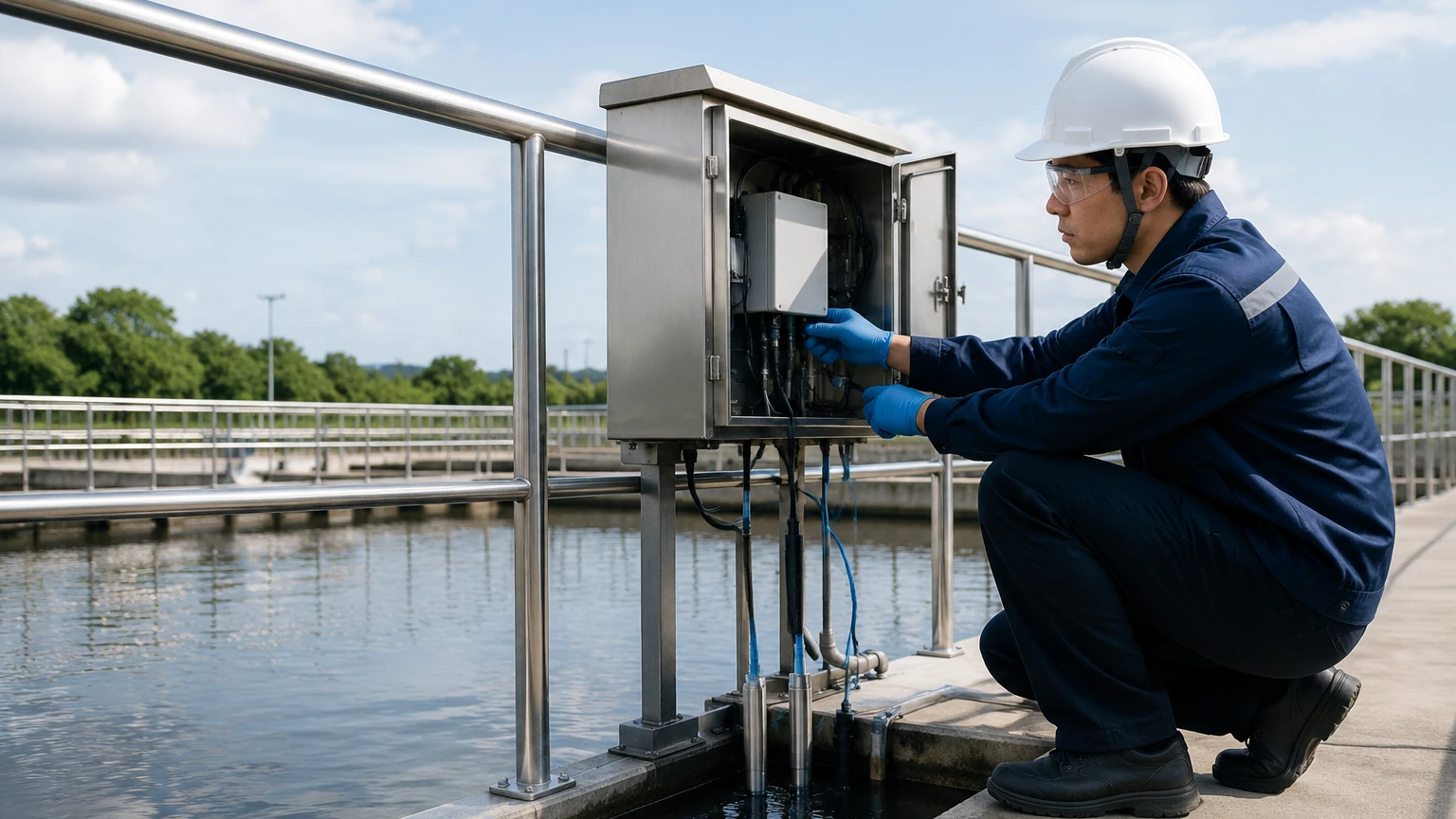
Monitoring stations are often located outdoors. Sensors should have an IP68 rating, and the main control cabinet should be climate-controlled if temperatures exceed 40°C or drop below -20°C. For level meters used in chemical tanks, ensure the wetted materials (such as PVDF or Stainless Steel) are compatible with the specific acids or bases being monitored.
Common Risks and Limitations
While automation reduces the need for manual sampling, it introduces new risks that must be managed:
1. Biofouling: In water treatment applications, biological growth on sensor faces is common. This can lead to "signal drift" in pH and DO sensors or false echoes in ultrasonic level meters. Automated cleaning systems (using compressed air or water jets) are highly recommended.
2. Calibration Drift: All water quality sensors drift over time. A robust maintenance schedule must include monthly or quarterly calibration against standard solutions.
3. Power Supply Instability: Fluctuations in power can cause data gaps. Using a UPS (Uninterruptible Power Supply) or solar-plus-battery system for remote sites is standard practice.
4. Surface Conditions: For non-contact level measurement, heavy foam can absorb ultrasonic pulses, leading to a "lost echo" error. In such cases, switching to a high-frequency radar or a hydrostatic transmitter is necessary.
Frequently Asked Questions (FAQ)
Q: How often does an automatic water quality monitoring system need maintenance?
A: While it varies by application, a general rule is a weekly visual check and a monthly calibration of chemical sensors. Level meters typically require less frequent maintenance, often only once or twice a year if they are non-contact models.
Q: Can these systems be used in hazardous (Ex) zones?
A: Yes. Most industrial level transmitters and quality sensors are available with ATEX or IECEx certifications for use in explosive atmospheres, common in oil and gas or chemical storage areas.
Q: What is the benefit of 80GHz radar over 26GHz radar for water level?
A: 80GHz radar has a much narrower beam angle, which allows it to avoid interference from internal tank structures, pipes, or narrow manways, providing a much cleaner signal in complex environments.
Q: Is it possible to monitor water quality without a level sensor?
A: While you can measure concentrations, you cannot calculate total discharge volume or mass loading without level/flow data. For most industrial discharge permits, level measurement is a mandatory component of the monitoring station.
Information Confirmation for Project Planning
Before finalizing the design of an automatic water quality monitoring system, engineers should confirm the following data points:
* Chemical Composition: Identify all chemicals present to ensure sensor material compatibility.
* Measurement Range: Define the minimum and maximum expected levels and concentrations to avoid sensor saturation.
* Tank/Channel Geometry: Provide drawings of the installation site to identify potential obstructions for level sensors.
* Data Requirements: Determine if the system needs to integrate with an existing PLC or if it requires a standalone cloud-based dashboard.
By carefully selecting measurement technologies—from the precision of a radar level meter to the sensitivity of an optical DO probe—facilities can ensure their automatic water quality monitoring system provides the accurate, real-time data necessary for modern industrial excellence.