Cargo Monitoring System
Cargo Monitoring System
In modern industrial logistics and process engineering, a cargo monitoring system serves as the critical interface between physical inventory and digital management. Whether managing bulk liquids in chemical storage facilities, fuel in marine tankers, or dry solids in industrial silos, the ability to accurately track volume, level, and temperature is essential for operational safety and economic efficiency. These systems integrate various sensing technologies with data processing units to provide real-time visibility into the status of stored materials.
For engineers and facility managers, selecting the right instrumentation for a cargo monitoring system requires a deep understanding of the underlying measurement principles. This guide explores the primary technologies used in level measurement, their application in cargo monitoring, and the technical criteria necessary for successful deployment.
Core Measurement Principles in Cargo Monitoring
A robust cargo monitoring system relies on one or more level measurement technologies, each operating on distinct physical principles. Understanding these principles is the first step in ensuring system reliability.
1. Radar Level Measurement (Non-Contact and Guided)
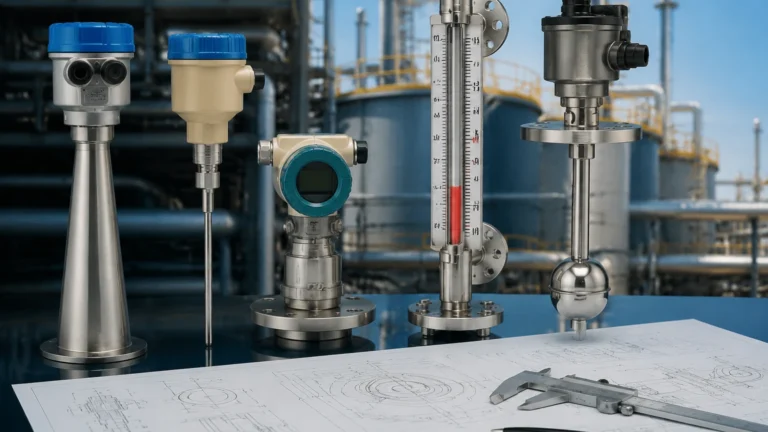
Radar technology is widely considered the gold standard for high-accuracy cargo monitoring. It operates on the Time of Flight (ToF) principle. The sensor emits a high-frequency microwave signal (often in the 26GHz or 80GHz range) toward the surface of the cargo. The signal reflects off the material and returns to the sensor.
* Non-Contact Radar: The sensor is mounted at the top of the tank and does not touch the media. This is ideal for corrosive or hygienic applications. 80GHz radar, in particular, offers a narrow beam angle, which minimizes interference from internal tank structures like agitators or heating coils.
* Guided Wave Radar (GWR): The microwave signal travels along a probe (cable or rod) immersed in the media. This is highly effective for low-dielectric liquids or applications with heavy foam, as the probe guides the signal directly to the surface.
2. Ultrasonic Level Sensors
Ultrasonic sensors also use the ToF principle but utilize sound waves instead of electromagnetic waves. The sensor emits an ultrasonic pulse that reflects off the surface of the cargo. The time taken for the echo to return is proportional to the distance.
These sensors are cost-effective for water-based liquids and simple storage applications. However, they are sensitive to environmental factors such as air temperature, pressure changes, and the presence of heavy vapors or dust, which can attenuate the sound signal.
3. Hydrostatic Level Transmitters
Hydrostatic measurement is based on the principle that the pressure at the bottom of a vessel is directly proportional to the height of the liquid column above it ($P = \rho gh$). By measuring the liquid head pressure and knowing the density of the cargo, the system calculates the level.
This method is highly reliable for vented tanks and deep wells. In pressurized tanks, a differential pressure (DP) approach is required, measuring both the liquid pressure at the bottom and the gas pressure at the top to isolate the liquid level.
4. Magnetic Level Gauges
Magnetic level gauges provide both local visual indication and remote electronic monitoring. A float containing a permanent magnet moves with the liquid level inside a bypass chamber. Outside the chamber, magnetized flaps flip to show the level. For integration into a digital cargo monitoring system, a reed chain or magnetostrictive transmitter is attached to the chamber to provide a 4-20mA or digital output.
Key Components of an Integrated System
A comprehensive cargo monitoring system is more than just a collection of sensors. It is an integrated architecture consisting of:
* Primary Sensors: The radar, ultrasonic, or hydrostatic units that gather raw level data.
* Temperature Probes: Multi-point temperature sensors are often included because liquid volume expands and contracts with temperature. Accurate volume calculation (standardized to 15°C or 60°F) requires precise temperature data.
* Signal Converters and Gateways: These units translate analog signals (like 4-20mA) or digital protocols (like HART, Modbus, or Profibus) into a format compatible with the central control system.
* Monitoring Software: The user interface where operators view tank levels, set alarms for high/low conditions, and generate inventory reports.
Practical Selection Criteria
Choosing the appropriate technology for a cargo monitoring system depends on the specific characteristics of the cargo and the storage environment. The following table provides a general comparison of common technologies used in industrial applications.
Technology Comparison Table
| Technology | Accuracy | Media Suitability | Max Range (Typical) | Key Advantage |
| :— | :— | :— | :— | :— |
| 80GHz Radar | ±1 mm | Liquids, Solids, Corrosives | 120 m (393 ft) | Non-contact, unaffected by vapors |
| Guided Wave Radar | ±2 mm | Liquids, Interfaces, Foam | 75 m (246 ft) | Reliable in turbulent surfaces |
| Ultrasonic | ±0.25% FS | Water, Wastewater, Chemicals | 30 m (98 ft) | Cost-effective, easy installation |
| Hydrostatic | ±0.1% to 0.5% | Fuel, Oil, Water | 200 m (656 ft) | Simple, proven technology |
| Magnetic Gauge | ±5 mm | Clean Liquids, LPG | 6 m (20 ft) | No power needed for visual check |
Installation Considerations for Cargo Monitoring
Proper installation is critical to the performance of any cargo monitoring system. Even the most advanced radar sensor will fail if positioned incorrectly.
1. Nozzle Geometry: For radar and ultrasonic sensors, the mounting nozzle should be as short and wide as possible. If the nozzle is too narrow or long, the signal may reflect off the nozzle walls (ringing), creating a "dead zone" or false high-level reading.
2. Avoid Obstructions: Sensors should be positioned away from inlet pipes, ladders, and agitators. If obstructions are unavoidable, many modern sensors offer "false echo suppression" software to mask these reflections.
3. The Dead Zone (Blocking Distance): Every non-contact sensor has a minimum distance it cannot measure (usually 100mm to 500mm / 4in to 20in from the sensor face). Ensure the sensor is mounted high enough that the maximum cargo level does not enter this zone.
4. Stilling Wells: In applications with heavy turbulence or surface foam, installing a radar or float sensor inside a stilling well (a vertical pipe) can provide a calm surface for accurate measurement.

Limitations and Common Risks
While modern systems are highly advanced, certain conditions can still pose risks to measurement accuracy:
* Vapor and Gas Layers: In high-pressure chemical tanks, gas layers can change the speed of sound, affecting ultrasonic sensors. Radar is generally immune to this but can be affected by extremely high dielectric constant gases at very high pressures.
* Build-up and Coating: For contact-based technologies like Guided Wave Radar or Hydrostatic probes, sticky or viscous cargo can build up on the sensor. This may require periodic cleaning or the use of non-contact radar with a flush-mounted antenna.
* Foam: Heavy, dense foam can absorb radar and ultrasonic signals. In these cases, Guided Wave Radar or Hydrostatic transmitters are often the preferred solution.
Frequently Asked Questions (FAQ)
Q: How often should a cargo monitoring system be calibrated?
A: Calibration frequency depends on the industry and the criticality of the data. For custody transfer (where the measurement determines payment), annual calibration is standard. For general process monitoring, a biennial check is often sufficient.
Q: Can one system monitor different types of cargo?
A: Yes, but the sensors must be compatible with all potential media. For example, a sensor used for water may not be suitable for a corrosive acid unless it has a PTFE or PVDF coating.
Q: Is wireless cargo monitoring reliable?
A: Wireless protocols like WirelessHART are increasingly common and highly reliable for remote tank farms where cabling costs are prohibitive. However, they require a clear line of sight or a robust mesh network to ensure data integrity.
Implementing a Reliable Solution
When designing or upgrading a cargo monitoring system, it is essential to partner with a manufacturer that provides a diverse range of technologies. Because no single measurement principle fits every application, a consultative approach is necessary to match the sensor to the specific gravity, dielectric constant, and temperature profile of the cargo.
For engineers looking to explore specific hardware options, including radar, ultrasonic, and hydrostatic solutions, you can Review product options and application support on our Main Page to find the right fit for your facility's requirements. Confirming the chemical compatibility of wetted parts and the required communication protocols (such as 4-20mA HART or RS485) before procurement will ensure a seamless integration into your existing automation framework.
By prioritizing measurement principles and following rigorous installation standards, industrial operators can achieve a cargo monitoring system that reduces waste, prevents overfills, and provides the data necessary for optimized supply chain management.