Controlel
Controlel
In the landscape of industrial automation, the term "controlel"—referring to the integrated control of liquid and solid levels—represents a critical intersection of sensing technology and process management. For industries ranging from wastewater treatment to chemical processing, maintaining precise level control is not merely a matter of inventory management; it is a fundamental requirement for operational safety, environmental compliance, and process efficiency. Welk, as a professional manufacturer of industrial level measurement instruments, provides the hardware and technical expertise necessary to implement robust level control systems across diverse applications.
Effective level control requires a deep understanding of how measurement data is translated into actionable control signals. This guide explores the principles of level measurement, the selection of appropriate technologies, and the practical considerations for integrating these sensors into a comprehensive control architecture.
Fundamental Principles of Level Measurement
Before implementing a control strategy, engineers must select a measurement principle that aligns with the physical properties of the medium and the environmental conditions of the vessel. Level measurement technologies generally fall into two categories: continuous measurement and point level detection.
Radar Level Measurement (Time-of-Flight)
Radar level meters utilize high-frequency electromagnetic waves (typically in the 26GHz or 80GHz range). The sensor emits a signal that travels to the surface of the medium, reflects, and returns to the receiver. The distance is calculated based on the time-of-flight. Radar is highly valued in "controlel" applications because it is non-contact and unaffected by changes in temperature, pressure, or the presence of vapors and dust.
Ultrasonic Level Sensing
Similar to radar, ultrasonic sensors use time-of-flight but rely on sound waves. A transducer emits an ultrasonic pulse that bounces off the surface of the liquid or solid. While cost-effective and reliable for many water treatment applications, ultrasonic waves are sensitive to air temperature fluctuations and can be attenuated by heavy foam or vacuum conditions.
Hydrostatic Pressure Measurement
This principle relies on the relationship between the height of a liquid column and the pressure it exerts at the base of the tank ($P = \rho gh$). Hydrostatic level transmitters are submerged or mounted at the bottom of a vessel. They are particularly effective for vented tanks and deep wells where top-down mounting is impractical.
Magnetic Level Gauges
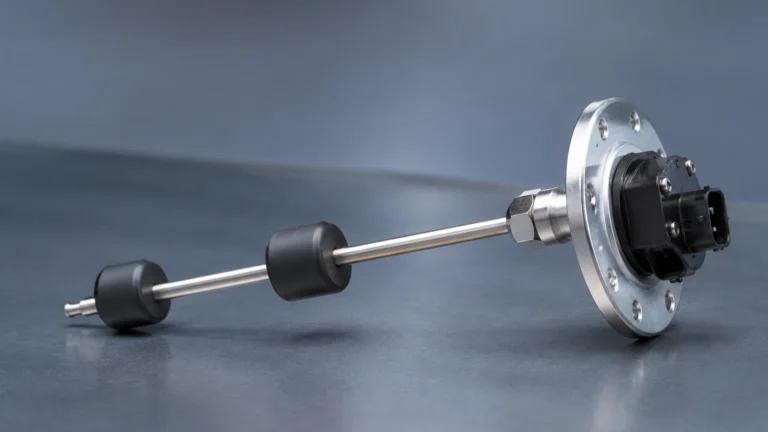
For high-pressure or high-temperature applications where visual confirmation is required alongside electronic signaling, magnetic level gauges use a float equipped with a permanent magnet. As the float rises and falls with the liquid level, it flips magnetic flaps on an external scale and can be paired with a reed switch or transmitter for remote control integration.
The Role of Controlel in Industrial Automation
Integrating these sensors into a control loop is what defines the "controlel" process. A standard level control loop consists of the sensor (the transmitter), a controller (such as a PLC or DCS), and a final control element (usually a pump or a valve).
1. Sensing: The Welk transmitter provides a 4-20mA, HART, or RS485 Modbus signal representing the current level.
2. Processing: The controller compares the measured level against a predefined setpoint. If the level is too high or too low, the controller calculates the necessary adjustment based on PID (Proportional-Integral-Derivative) logic.
3. Action: The controller sends a signal to a variable frequency drive (VFD) on a pump or an actuator on a valve to increase or decrease flow, thereby maintaining the desired level.
For more information on specific instrument models and their integration capabilities, engineers can visit the Main Page to review product options and application support.
Selection Criteria for Level Control Systems
Choosing the wrong technology for a specific medium can lead to signal loss, frequent maintenance, and system failure. The following table provides a general guide for selecting level measurement technologies based on common industrial variables.
| Application Criteria | Radar (80GHz) | Ultrasonic | Hydrostatic | Magnetic Gauge |
| :— | :— | :— | :— | :— |
| Medium State | Liquid / Solid | Liquid / Slurry | Liquid | Liquid |
| Max Range | Up to 120m (393 ft) | Up to 30m (98 ft) | Up to 200m (656 ft) | Up to 6m (20 ft) |
| Accuracy | ±1mm to ±2mm | ±0.25% to ±0.5% | ±0.1% to ±0.5% | ±5mm to ±10mm |
| Process Temp | -40°C to +250°C | -40°C to +80°C | -20°C to +80°C | Up to +450°C |
| Pressure | Vacuum to 4MPa | Atmospheric | Up to 10MPa | Up to 16MPa |
| Foam Resistance | Excellent | Poor | Excellent | Good |
| Cost | Higher | Moderate | Low to Moderate | Moderate |
Practical Installation Considerations
Proper installation is paramount to ensuring the accuracy of the control signal. Even the most advanced radar meter will fail if the signal path is obstructed.
Mounting Position and Obstructions
The sensor should be mounted away from the tank wall to avoid false reflections (echoes). For radar and ultrasonic sensors, the "beam angle" must be considered. Any internal structures, such as ladders, agitators, or heating coils, that fall within the beam angle will create interference. Modern Welk instruments often include "false echo suppression" software to ignore these static obstructions, but physical clearance remains the best practice.
Dead Zones (Blocking Distance)
Every top-down sensor has a minimum distance it cannot measure, known as the dead zone or blocking distance. For an ultrasonic sensor, this might be 0.25m to 0.5m (10 to 20 inches). If the liquid level enters this zone, the sensor will provide an erratic or "frozen" signal, which can cause the control system to overflow the tank.
Turbulence and Surface Conditions
In tanks with heavy agitation, the surface of the liquid may be turbulent. This can scatter the return signal of a radar or ultrasonic sensor. In such cases, installing a stilling well or a bypass pipe can provide a calm surface for measurement. Alternatively, hydrostatic transmitters are largely unaffected by surface turbulence.

Limitations and Risk Mitigation
While modern level measurement technology is highly advanced, there are inherent limitations that engineers must account for during the design phase of a level control project.
* Dielectric Constant (Dk): Radar measurement depends on the reflectivity of the medium, which is determined by its dielectric constant. Materials with a very low Dk (such as certain oils or liquefied gases) may require specialized high-sensitivity radar or guided wave radar.
* Build-up and Scaling: In chemical or wastewater applications, material can build up on the sensor face. While many Welk sensors feature self-cleaning designs or non-stick PTFE coatings, regular inspection schedules are necessary to prevent signal attenuation.
* Environmental Interference: Outdoor installations of ultrasonic sensors must be shielded from direct sunlight to prevent the integrated temperature sensor from giving false readings, which would incorrectly calculate the speed of sound.
Frequently Asked Questions (FAQ)
Q: How do I choose between 26GHz and 80GHz radar for my control system?
A: 80GHz radar is generally preferred for smaller tanks or vessels with internal obstructions because it has a much narrower beam angle. 26GHz radar is often more cost-effective for large-scale storage tanks where the environment is less cluttered.
Q: Can I use a hydrostatic transmitter in a pressurized tank?
A: A standard hydrostatic transmitter measures gauge pressure and assumes the tank is vented to the atmosphere. For pressurized tanks, you must use a differential pressure (DP) transmitter to subtract the headspace pressure from the total bottom pressure.
Q: What is the benefit of a 4-20mA HART signal in level control?
A: The 4-20mA signal provides the primary level measurement, while the HART (Highway Addressable Remote Transducer) protocol allows for digital communication. This enables remote calibration, diagnostics, and the transmission of secondary variables (like internal sensor temperature) over the same pair of wires.
Q: Is it necessary to have redundant level sensors?
A: In critical applications, such as high-level alarms for environmental protection or safety-instrumented systems (SIS), redundancy is highly recommended. Often, a continuous measurement (like radar) is paired with a point-level switch (like a tuning fork or float switch) to provide a secondary fail-safe.
Conclusion
Implementing a successful "controlel" strategy requires more than just purchasing a sensor; it requires a systematic approach to understanding the process environment and selecting the technology that offers the highest reliability. By considering factors such as media properties, tank geometry, and integration requirements, industrial operators can achieve precise level control that enhances both safety and productivity. For technical specifications and detailed engineering drawings of Welk level measurement solutions, please refer to the Main Page for comprehensive product documentation.