Polystyrene Dielectric Constant
Polystyrene Dielectric Constant
In the realm of industrial process automation, accurate level measurement of polymers is a fundamental requirement for inventory management and production efficiency. Polystyrene, one of the most widely used plastics globally, presents unique challenges to traditional measurement instrumentation. The primary factor influencing the performance of radar-based level sensors in these applications is the polystyrene dielectric constant.
Understanding how this physical property interacts with electromagnetic waves is essential for engineers and plant managers when selecting instrumentation. As a professional manufacturer, Welk provides high-precision instruments designed to overcome the hurdles associated with low-dielectric materials. This guide explores the technical nuances of polystyrene dielectric constant and provides a practical framework for selecting the most reliable level measurement solutions.
Measurement Principles and the Role of Dielectric Constant
To understand why the polystyrene dielectric constant is so critical, one must first examine the operating principles of radar level measurement. Radar sensors, whether non-contact or guided wave, utilize electromagnetic pulses or continuous waves to detect the surface of a material.
Reflection and Permittivity
The dielectric constant, also known as relative permittivity ($ε_r$), is a dimensionless measure of a material's ability to store electrical energy in an electric field. In the context of level measurement, it determines how much of the radar signal is reflected back to the sensor versus how much penetrates the material.
When a radar signal traveling through air ($ε_r ≈ 1$) hits the surface of a stored medium, a reflection occurs due to the change in dielectric properties. The strength of this reflection is governed by the reflection coefficient (Γ), which can be simplified as:
Γ = (√ε_r – 1) / (√ε_r + 1)
A material with a high dielectric constant, such as water (ε_r ≈ 80), produces a very strong reflection. Conversely, materials with a low dielectric constant, like polystyrene, reflect only a small fraction of the signal. If the reflection is too weak, the sensor may fail to distinguish the material surface from background noise or the bottom of the tank.
Propagation Speed
The dielectric constant also affects the speed at which electromagnetic waves travel through the medium. While this is more relevant for interface measurement (measuring the level of a liquid beneath another liquid), in solids like polystyrene pellets, it can influence how signals behave if the radar beam penetrates deep into the pile. For most level applications, the primary concern remains the signal amplitude at the surface interface.
Specific Values for Polystyrene Dielectric Constant
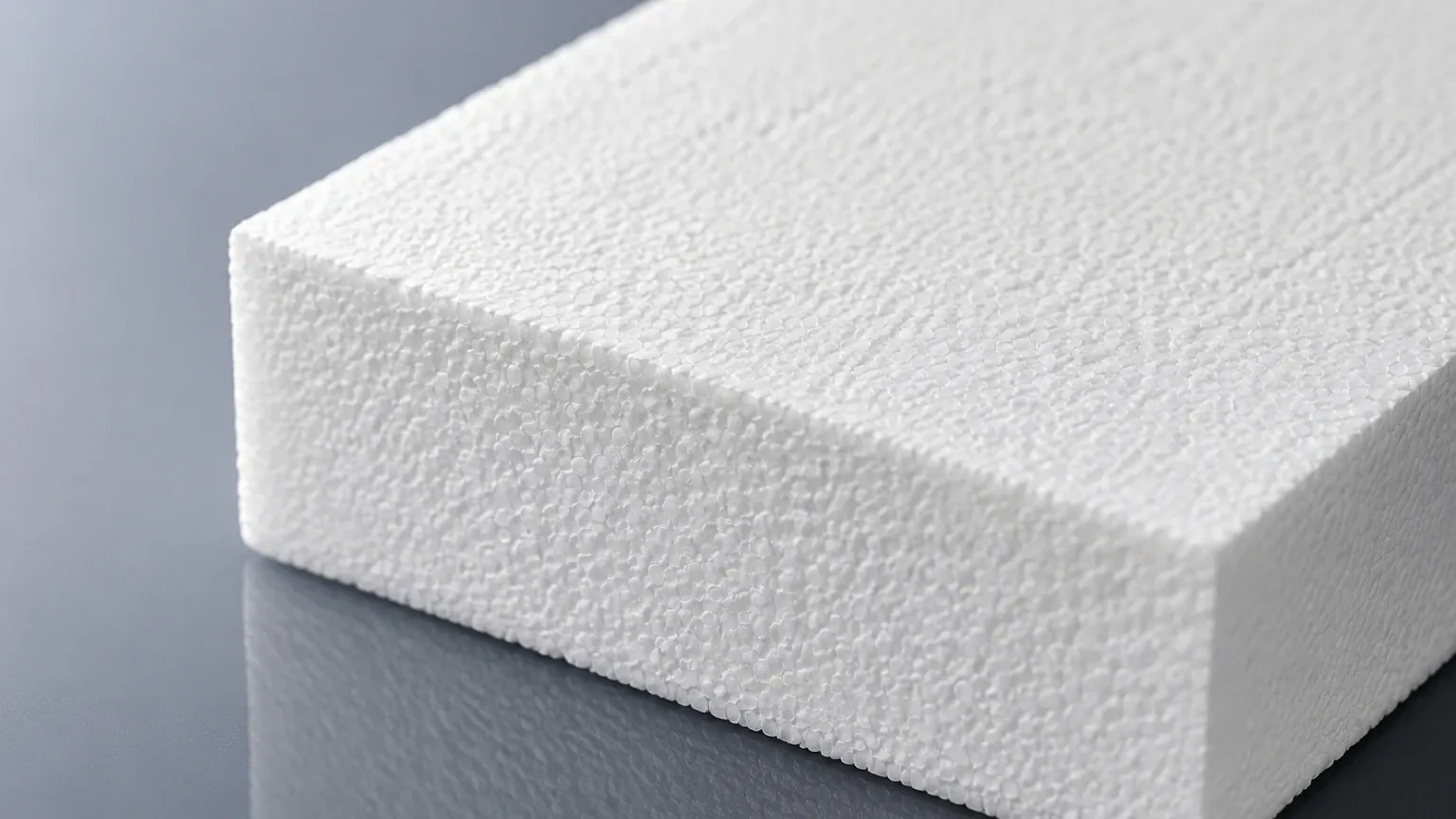
Polystyrene exists in various physical forms, from dense solid blocks to lightweight expanded foams and loose pellets. Each form has a different effective dielectric constant because the presence of air (which has a dielectric constant of 1.0) within the bulk material lowers the overall value.
| Form of Polystyrene | Typical Dielectric Constant (ε_r) | Reflectivity Level |
| :— | :— | :— |
| Solid Polystyrene | 2.4 – 2.7 | Moderate / Low |
| Polystyrene Pellets / Beads | 1.2 – 1.7 | Very Low |
| Expanded Polystyrene (EPS) | 1.02 – 1.1 | Extremely Low |
| Polystyrene Dust/Powder | 1.1 – 1.4 | Very Low |
Factors Influencing the Value
1. Bulk Density: For polystyrene pellets and beads, the ratio of solid material to air gaps (void fraction) significantly impacts the effective ε_r. More tightly packed pellets result in a slightly higher dielectric constant.
2. Moisture Content: Even trace amounts of surface moisture can drastically increase the dielectric constant, as water has a very high ε_r. However, in most polymer processing, the material is kept strictly dry.
3. Additives: The inclusion of carbon black, flame retardants, or pigments can alter the dielectric properties, though usually not enough to move polystyrene out of the "low dielectric" category.
Challenges in Measuring Polystyrene Levels
Because the polystyrene dielectric constant is frequently below 2.0, several technical challenges arise during instrument commissioning and operation.
Signal Attenuation and Sensitivity
In silos containing polystyrene pellets, the radar signal is largely absorbed or scattered rather than reflected. Standard 6GHz or 26GHz radar units may struggle to maintain a stable signal-to-noise ratio. This requires the use of high-sensitivity electronics and advanced signal processing algorithms that can track "faint" echoes.
The Angle of Repose
Polystyrene pellets are typically stored in large silos where they form a conical shape (the angle of repose). When a radar signal hits an inclined surface of a low-dielectric material, the small amount of reflected energy is often deflected away from the sensor's antenna. This "specular reflection" can lead to signal loss, especially in non-contact radar applications.
Dust and Build-up
Polystyrene processing often generates significant amounts of static dust. While the dust itself has a low dielectric constant and is largely transparent to radar, a thick coating of dust on the antenna can eventually attenuate the signal, particularly if moisture is present. For ultrasonic sensors, heavy dust can absorb the sound waves entirely, leading to measurement failure.
Recommended Level Measurement Technologies
Selecting the right technology depends on the specific form of polystyrene and the vessel geometry. For a comprehensive look at available hardware, you can Review product options and application support on our Main Page.
1. Guided Wave Radar (GWR)
Guided Wave Radar is often the preferred choice for low-dielectric solids like polystyrene pellets. By using a cable or rod probe to guide the electromagnetic pulse, the signal energy is concentrated around the probe rather than spreading out through the air. This significantly increases the signal strength returned from low ε_r materials.
* Advantages: Not affected by dust; provides a strong signal even with ε_r as low as 1.2.
* Considerations: The probe is subject to mechanical pull forces from the moving solid material. Heavy-duty 4mm or 6mm cables are usually required.
2. High-Frequency Non-Contact Radar (80GHz)
Modern 80GHz radar transmitters have revolutionized the measurement of low-dielectric solids. The higher frequency allows for a much narrower beam angle (as small as 3°), which concentrates the energy and increases the likelihood of receiving a reflection from an uneven surface.
* Advantages: No contact with the material; easy to install; high sensitivity for low polystyrene dielectric constant values.
* Considerations: Requires careful aiming (swivel flanges) to account for the angle of repose.
3. Ultrasonic Level Sensors
Ultrasonic sensors measure level by timing the reflection of sound waves. Unlike radar, sound reflection depends on the mechanical density of the material, not the dielectric constant.
* Advantages: Completely independent of dielectric properties.
* Limitations: Highly sensitive to dust and noise. In polystyrene silos, the high dust concentration and the sound-absorbing nature of the pellets often make ultrasonic technology unreliable for ranges over 5 meters (16.4 ft).
Selection Table for Polystyrene Applications
| Application Detail | Recommended Technology | Why? |
| :— | :— | :— |
| Small Buffer Hopper (Pellets) | 80GHz Non-contact Radar | Compact size, easy installation, high accuracy. |
| Large Storage Silo (Pellets) | Guided Wave Radar (GWR) | Overcomes signal scattering and low reflectivity. |
| EPS (Expanded Foam) Blocks | 80GHz Non-contact Radar | High sensitivity needed for extremely low ε_r. |
| Polystyrene Powder/Dust | Capacitance Switch | Reliable point-level detection for overfill prevention. |
| Liquid Polystyrene (Melt) | High-Temp GWR | Handles high process temperatures and low ε_r. |
Installation Considerations and Best Practices
To ensure the chosen instrument performs accurately despite the low polystyrene dielectric constant, follow these engineering guidelines:
Nozzle Placement and Height
For non-contact radar, the nozzle should be kept as short as possible to prevent internal reflections (ringing) that could mask the weak echo from the polystyrene. The sensor should be positioned at approximately 1/3 of the silo radius to get a representative average of the conical surface.
Avoiding Internal Obstructions
Low-dielectric signals are easily lost if the radar beam interacts with ladders, braces, or fill streams. Ensure a clear "line of sight" to the material. For GWR, the probe must be kept at a minimum distance of 300mm (11.8 in) from the silo wall and any metal obstructions to prevent signal interference.
Managing Pull Forces
When using Guided Wave Radar in tall silos, the downward friction of the polystyrene pellets on the cable can exert several tons of force. It is critical to verify the tensile strength of the cable and ensure the silo roof can support the load. Using a sliding attachment or a heavy-duty weight at the bottom can help, but the cable should never be anchored to the bottom of the silo in solids applications.
Limitations and Common Risks
While modern instrumentation is highly capable, there are inherent limitations when dealing with materials at the edge of the dielectric spectrum.
* The "Invisible" Surface: If the dielectric constant of expanded polystyrene (EPS) drops below 1.02, it becomes virtually transparent to most radar sensors. In such cases, mechanical systems like 3D solids scanners or laser-based sensors may be required.
* Static Discharge: Polystyrene is an excellent insulator. The movement of pellets can generate significant static electricity. All level instruments must be properly grounded, and in many cases, ATEX or IECEx certified explosion-proof models are mandatory due to the risk of dust explosions.
* Signal Loss at Bottom: As the silo empties, the radar signal may pass through the remaining thin layer of low-dielectric pellets and reflect off the metal floor instead. This can cause the sensor to report a "tank empty" status prematurely or show a jump in the level reading.
Frequently Asked Questions (FAQs)
Q: Can I use a standard 26GHz radar for polystyrene pellets?
A: It is possible if the pellets have a dielectric constant above 1.5 and the silo is relatively small. However, for reliability and to avoid signal loss during filling (when dust is high), an 80GHz radar or Guided Wave Radar is strongly recommended.
Q: Does the color of the polystyrene affect the measurement?
A: No. Radar and ultrasonic signals are not affected by the color of the material. Only the dielectric constant and surface texture matter.
Q: How do I measure the level of polystyrene foam (EPS)?
A: EPS has an extremely low dielectric constant (1.03-1.1). Non-contact radar with high-sensitivity settings is the best approach. If the foam is very light, ultrasonic sensors may work better, provided the environment is not too dusty.
Q: Is calibration required for the polystyrene dielectric constant?
A: For radar sensors, you typically do not need to input the exact dielectric constant for simple level measurement, but you must set the "sensitivity" or "threshold" to account for a low-reflectivity medium. For capacitance sensors, a full calibration with the material is required.
Conclusion
Successfully measuring the level of polystyrene requires a deep understanding of how the polystyrene dielectric constant influences signal behavior. While the low reflectivity of polymer pellets and foams presents a challenge, it is a challenge that can be met with the correct application of radar technology. By selecting high-sensitivity instruments and adhering to strict installation standards, process facilities can achieve the accuracy and reliability necessary for modern industrial operations.
For more technical specifications and to find the right sensor for your specific application, visit our Main Page and explore our range of industrial level measurement solutions.