Corriolis Meter
Corriolis Meter
In the landscape of industrial process control, the precise measurement of fluid movement is critical for maintaining product quality, ensuring safety, and optimizing operational efficiency. Among the various technologies available, the corriolis meter (commonly spelled Coriolis meter) stands out as one of the most accurate and versatile instruments. Unlike volumetric flow meters, which measure the space a fluid occupies, a corriolis meter measures the actual mass of the fluid passing through the system.
For engineers and project managers involved in liquid handling, chemical processing, and water treatment, understanding the mechanics and application of mass flow measurement is essential. While level measurement technologies—such as those provided by Main Page—focus on the volume or height of a medium within a vessel, the corriolis meter provides complementary data regarding the mass and density of the fluid entering or leaving that vessel. This article provides a technical overview of the measurement principles, selection criteria, and installation considerations for these instruments.
Fundamental Principles of Coriolis Mass Flow Measurement
The operation of a corriolis meter is based on the principles of classical mechanics, specifically the Coriolis effect. This effect describes the inertial force acting on an object that is in motion within a frame of reference that is rotating or oscillating.
The Coriolis Effect
In a typical instrument, the fluid flows through one or two vibrating tubes. These tubes are energized by an electromagnetic drive coil, causing them to oscillate at their natural resonant frequency. When a fluid (liquid or gas) flows through these vibrating tubes, it is forced to take on the vertical momentum of the vibrating tube.
As the fluid moves toward the point of maximum vibration (the center of the tube), it resists being pushed upward by the tube's motion, exerting a downward force. Conversely, as the fluid moves away from the center toward the outlet, it resists the slowing of its vertical motion, exerting an upward force. This results in a twisting or "phase shift" in the tube's oscillation.
Measuring Mass Flow and Density
The degree of this phase shift is directly proportional to the mass flow rate. Sensors (pick-off coils) located at the inlet and outlet sides of the tube detect the time difference in the vibration cycle. A higher mass flow results in a greater phase shift.
Simultaneously, the corriolis meter measures the density of the fluid. The resonant frequency at which the tube vibrates depends on the total mass of the tube and the fluid inside it. Since the volume of the tube is constant, a change in the fluid's density changes the total mass, which in turn alters the vibration frequency. By measuring this frequency, the meter can calculate the fluid's density in real-time. Most modern units also include an internal temperature sensor to compensate for thermal expansion of the tubes, providing a third variable: temperature.
Design Architectures: Bent Tube vs. Straight Tube
When selecting a corriolis meter, the geometry of the flow tube is a primary consideration. There are two main designs used in industrial applications: bent tube (often U-shaped) and straight tube.
Bent Tube Designs
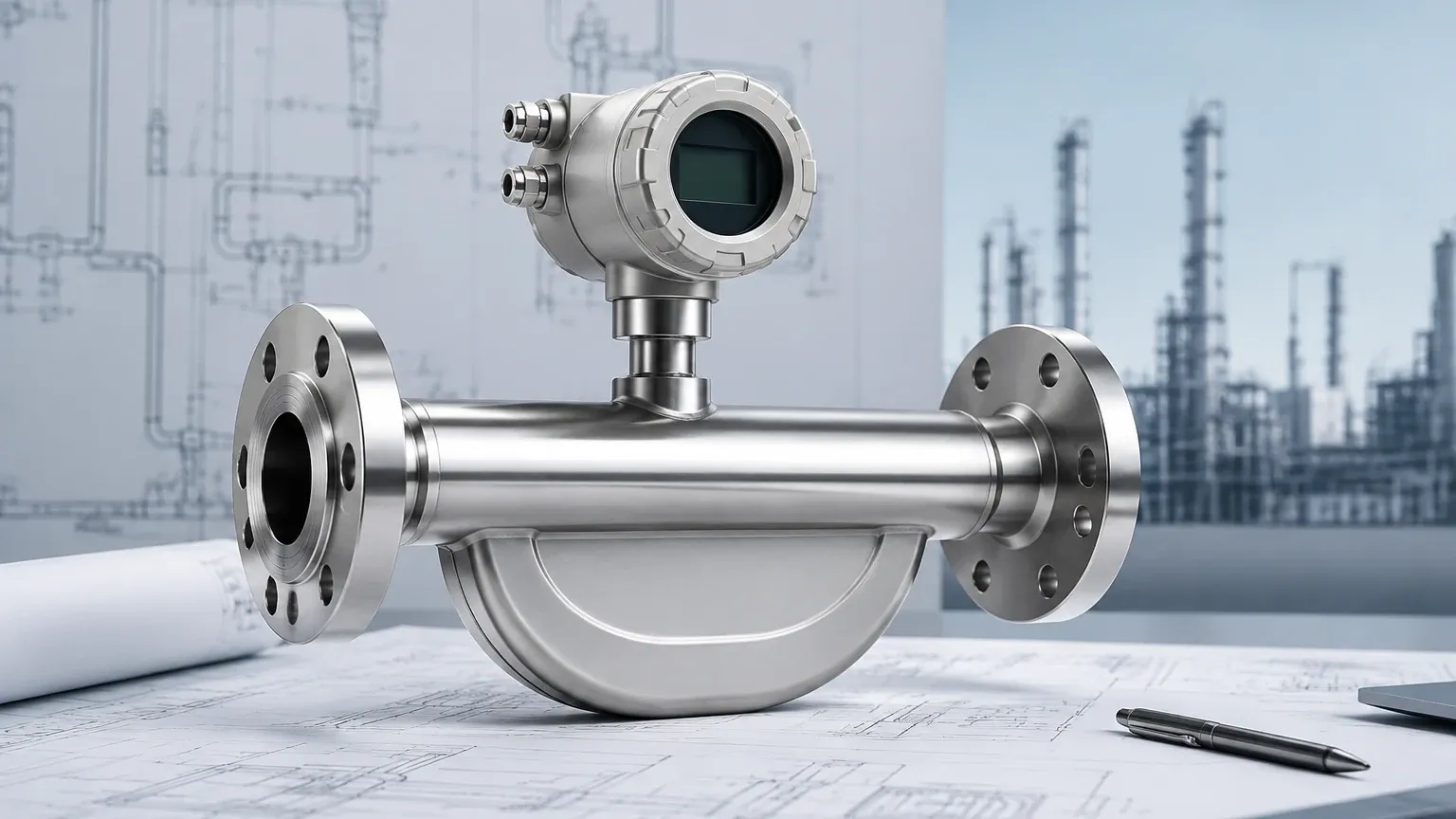
Bent tube meters are the most common and generally offer the highest sensitivity. Because the fluid must travel around a curve, the Coriolis forces are amplified, allowing for extremely high accuracy even at low flow rates. They are robust and can handle a wide range of temperatures and pressures.
* Pros: Highest accuracy (up to 0.05%), wide turndown ratio, excellent stability.
* Cons: Higher pressure drop, larger physical footprint, and more difficult to drain completely (not ideal for some hygienic applications).
Straight Tube Designs
Straight tube meters allow the fluid to pass through a linear path. These are often preferred in the food and beverage or pharmaceutical industries where "Clean-in-Place" (CIP) capabilities are required.
* Pros: Low pressure drop, easy to clean, compact installation, better handling of slurries or shear-sensitive fluids.
* Cons: Generally lower accuracy compared to bent tubes (typically 0.1% to 0.2%), more sensitive to external pipe vibrations, and limited temperature range due to the mechanical stress on the straight tubes.
Key Evaluation Criteria for Industrial Selection
Selecting the right corriolis meter requires a detailed analysis of the process conditions. Engineers should use the following table as a preliminary guide for evaluating different designs based on application needs.
| Feature | Bent Tube (U-Shape) | Straight Tube | Dual Tube Design |
| :— | :— | :— | :— |
| Typical Accuracy | 0.05% to 0.1% | 0.1% to 0.5% | 0.1% |
| Pressure Drop | Moderate to High | Low | Moderate |
| Self-Draining | Poor (requires vertical mount) | Excellent | Moderate |
| Vibration Resistance | High | Low to Moderate | Very High |
| Solids Handling | Limited (erosion risk) | Good | Moderate |
| Installation Space | Large | Compact | Moderate |
Material Compatibility
The wetted parts of the meter must be compatible with the process fluid. Standard meters are typically constructed from 316L stainless steel. However, for highly corrosive chemicals, materials such as Hastelloy C-22, Tantalum, or Titanium may be required. Ensuring material integrity is vital to prevent tube failure, which can lead to hazardous leaks.
Flow Range and Turndown
One of the greatest advantages of the corriolis meter is its turndown ratio (the ratio of maximum to minimum measurable flow). While many volumetric meters struggle at low flow rates, Coriolis technology maintains high accuracy across a broad range, often reaching 100:1 or better.
Installation Requirements and Best Practices
To achieve the specified accuracy, a corriolis meter must be installed according to strict engineering guidelines. Unlike ultrasonic or turbine meters, Coriolis meters do not require long straight runs of pipe upstream or downstream. However, they are sensitive to mechanical stress and vibration.
1. Support and Anchoring: The meter should be supported by the pipeline, and the pipeline itself must be rigidly anchored on both sides of the meter. This prevents external vibrations from interfering with the tube's natural resonance.
2. Orientation:
* Liquids: For liquid applications, the tubes should ideally point downward (in a U-shape) to ensure they remain full and to prevent gas bubbles from becoming trapped.
* Gases: For gas applications, the tubes should point upward to allow any condensed liquids to drain out.
* Slurries: Vertical installation with upward flow is often recommended to prevent solids from settling in the tubes.
3. Zero Calibration: After installation and under full-pipe, zero-flow conditions, a "zero trim" must be performed. This accounts for the specific mechanical stresses of the unique installation environment.
4. Avoid Cavitation: Ensure the downstream pressure is high enough to prevent the fluid from flashing or cavitating inside the meter, which will cause significant measurement errors.
Limitations and Operational Risks
While highly versatile, the corriolis meter is not a universal solution for every application. Understanding its limitations is key to avoiding project failures.
* Initial Cost: Coriolis meters are significantly more expensive than electromagnetic, vortex, or ultrasonic meters. The investment is usually justified only when high accuracy or mass/density data is required.
* Gas Entrainment: The presence of air bubbles in a liquid stream (two-phase flow) can dampen the tube vibration, leading to "stalling" of the electronics or significant inaccuracies. While modern "digital signal processing" (DSP) has improved performance in these conditions, high gas fractions remain a challenge.
* Size and Weight: For large pipe diameters (above 250mm or 10 inches), Coriolis meters become extremely heavy and bulky, often requiring specialized structural supports.
* Pressure Drop: The flow path restriction in bent-tube designs can cause a significant pressure drop, which may require larger pumps or affect process throughput.
Integrating Mass Flow with Level Measurement Systems
In many industrial setups, mass flow measurement and level measurement work in tandem to provide a complete picture of inventory and process stability. For example, in a storage tank containing a fluid with fluctuating density (such as a chemical mixture or a petroleum product), a hydrostatic level transmitter measures the pressure at the bottom of the tank.
To convert this pressure into an accurate level or volume reading, the exact density of the fluid must be known. By installing a corriolis meter on the tank's inlet line, the system receives real-time density data. This data can be fed into the control system to dynamically calibrate the level reading from the hydrostatic sensor. This synergy ensures that the inventory data remains accurate regardless of temperature changes or composition shifts. For comprehensive solutions in tank monitoring, users can Review product options and application support to find the right balance of flow and level instrumentation.
Frequently Asked Questions (FAQs)
Q: Does a corriolis meter require regular recalibration?
A: Because there are no moving parts in the fluid stream (no bearings or gears), Coriolis meters are extremely stable. Recalibration is typically only required if the tubes suffer from erosion, corrosion, or significant coating buildup. Many industries perform a "meter verification" check annually rather than a full wet calibration.
Q: Can a corriolis meter measure the flow of gases?
A: Yes, but with limitations. Because gases have much lower mass than liquids, the Coriolis forces generated are much weaker. This usually requires the gas to be at a relatively high pressure to increase its density, or the use of a meter specifically optimized for low-density gas flow.
Q: How does pipe vibration affect the meter?
A: High-frequency vibration near the resonant frequency of the meter's tubes can cause interference. This is why rigid mounting and the use of flexible connectors (in extreme cases) are important. Most modern meters use dual-tube designs that vibrate in opposition to cancel out external common-mode vibrations.
Q: What happens if the tubes become coated with residue?
A: Coating changes the mass of the tube, which will affect the density measurement. However, it usually has a much smaller effect on the mass flow measurement (the phase shift). If coating is expected, a straight-tube design is recommended for easier cleaning.
By carefully considering the fluid properties, installation environment, and the need for multivariable data, engineers can successfully implement a corriolis meter to achieve superior process control. Whether used for custody transfer, chemical dosing, or as a density reference for level systems, these instruments remain a cornerstone of modern industrial metrology.