Durchflussmessgerät
Durchflussmessgerät
In the landscape of industrial automation and process control, the measurement of fluid movement is as critical as the measurement of volume. A *durchflussmessgerät*, or flow meter, is an instrument used to measure the linear, non-linear, mass, or volumetric flow rate of a liquid or a gas. While level measurement focuses on the inventory within a vessel, flow measurement focuses on the rate of transfer. For many engineering applications, these two metrics are inextricably linked, particularly in open channel systems or tank discharge monitoring where level sensors are utilized to calculate flow velocity and volume.
Selecting the correct *durchflussmessgerät* requires a deep understanding of fluid dynamics, pipe geometry, and the physical properties of the media. As a professional manufacturer of industrial level measurement instruments, Welk provides the foundational technology—such as radar and ultrasonic sensors—that often serves as the core component in complex flow measurement systems.
Understanding the Principles of Flow Measurement
Before selecting a *durchflussmessgerät*, it is essential to understand the physical principles that govern different measurement technologies. Flow meters are generally categorized by the method they use to interact with the fluid.
Velocity-Based Measurement
Most modern electronic flow meters measure the velocity of the fluid moving through a known cross-sectional area. The volumetric flow rate ($Q$) is calculated using the formula $Q = A \times v$, where $A$ is the cross-sectional area of the pipe and $v$ is the average velocity of the fluid. Technologies such as ultrasonic, electromagnetic, and vortex meters fall into this category.
Differential Pressure (DP) Measurement
This classical method relies on Bernoulli’s principle. By placing a restriction in the pipe (like an orifice plate or Venturi tube), a pressure drop is created. The difference in pressure between the upstream and downstream sides of the restriction is proportional to the square of the flow rate. Hydrostatic pressure transmitters are frequently used in these setups to provide accurate DP readings.
Open Channel Flow (Level-to-Flow Conversion)
In environments like water treatment plants or irrigation channels, fluids do not flow in closed pipes. Instead, they move through flumes or over weirs. In these cases, a *durchflussmessgerät* is often a high-precision level sensor (radar or ultrasonic) mounted above the channel. By measuring the head (level) of the water and applying standardized mathematical formulas (such as the Manning equation or specific flume coefficients), the flow rate is determined with high accuracy.
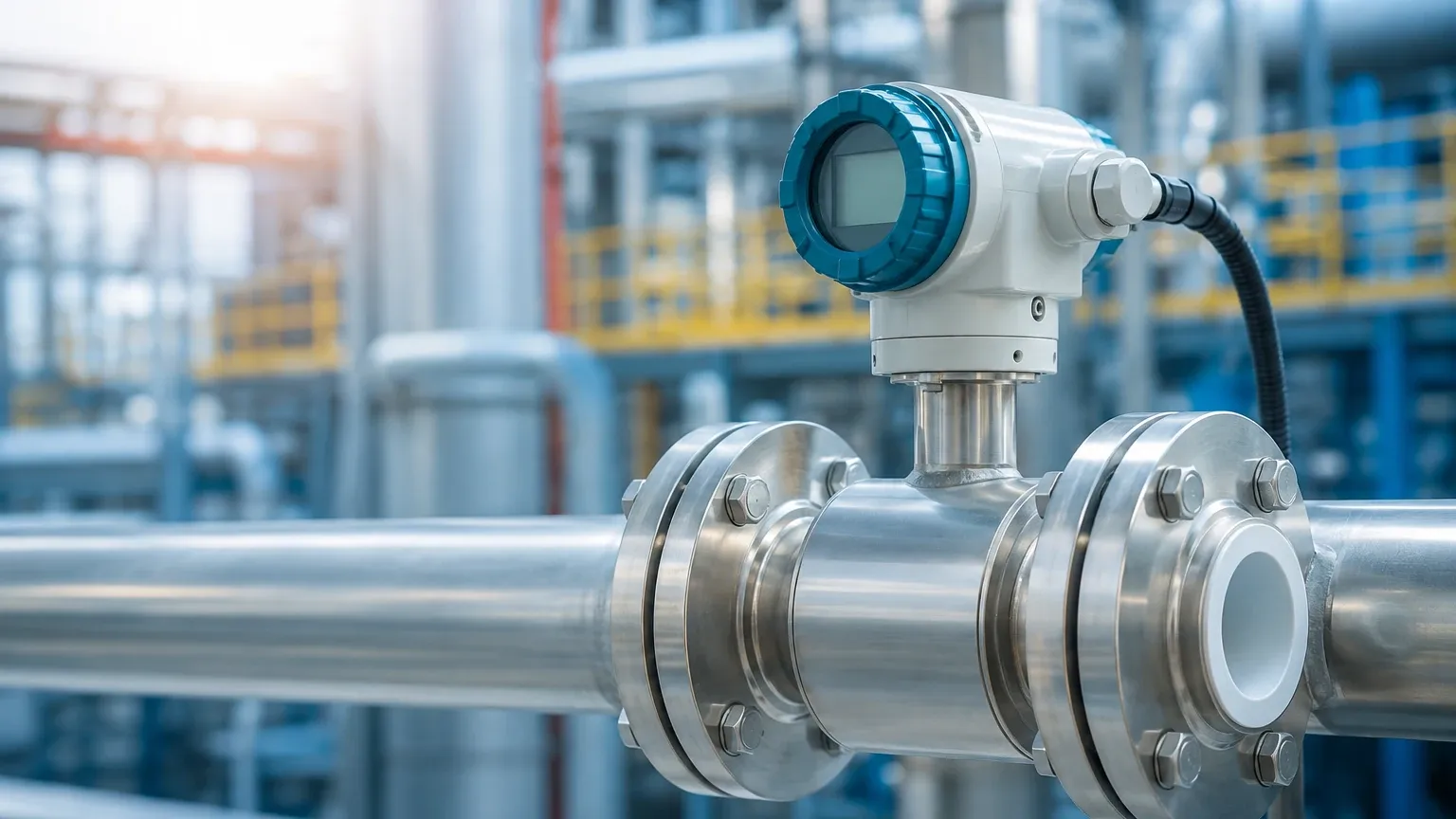
Electromagnetic Durchflussmessgerät: The Conductive Liquid Standard
Electromagnetic flow meters, often called "magmeters," operate based on Faraday’s Law of Electromagnetic Induction. This law states that a conductor moving through a magnetic field produces an electrical signal.
How it Works
In this application, the liquid itself acts as the conductor. The meter body contains electromagnetic coils that generate a magnetic field. As the conductive liquid flows through the field, it induces a voltage across electrodes located on the pipe walls. The magnitude of this voltage is directly proportional to the velocity of the liquid.
Advantages:
* No moving parts in the flow stream, resulting in zero pressure drop.
* Highly resistant to wear from abrasive slurries.
* Unaffected by changes in fluid density or viscosity.
Limitations:
* Requires a minimum fluid conductivity (typically >5 μS/cm).
* Cannot measure hydrocarbons (oils) or deionized water.
Ultrasonic Flow Measurement: Transit-Time and Doppler Methods
Ultrasonic technology is highly favored in modern industry because it allows for non-contact measurement. This is a field where Welk’s expertise in ultrasonic level sensors translates directly into high-performance flow solutions.
Transit-Time Method
This method uses two transducers that function as both transmitters and receivers. They are mounted on opposite sides of the pipe. One signal is sent upstream and the other downstream. The signal traveling with the flow moves faster than the signal traveling against it. The difference in time (the "transit time") is used to calculate the flow velocity. This is ideal for clean liquids like water, chemicals, and light oils.
Doppler Method
Doppler meters require particles or bubbles in the fluid to reflect the ultrasonic signal. As the fluid moves, the frequency of the reflected signal shifts (the Doppler effect). This shift is proportional to the flow rate. This method is preferred for wastewater, aerated liquids, and slurries where transit-time signals would be attenuated.
Open Channel Flow Measurement via Level Sensors
One of the most common industrial applications for a *durchflussmessgerät* in environmental engineering is open channel flow measurement. This application relies heavily on the precision of radar and ultrasonic level transmitters.
In a typical setup, a primary device (a weir or a flume) is installed in the flow stream. These devices have specific geometries that create a known relationship between the level of the liquid and the flow rate. A Welk radar level meter or ultrasonic sensor is installed at a specific distance upstream from the device.
Why Use Radar for Flow?
Radar level meters, operating at high frequencies (e.g., 26GHz or 80GHz), offer distinct advantages for flow measurement in harsh environments:
1. Vapor and Temperature Immunity: Unlike ultrasonic sensors, radar waves are not affected by air temperature fluctuations or heavy steam, which are common in industrial discharge.
2. Accuracy: Radar provides millimeter-level precision, which is vital when small changes in level represent large changes in flow volume.
3. Non-Contact: There is no risk of sensor fouling or corrosion from the measured media.
For more information on the specific sensors used in these applications, you can Review product options and application support.
Selection Criteria for Industrial Flow Meters
Choosing the right *durchflussmessgerät* involves evaluating the process conditions against the technical capabilities of the meter. The following table provides a general comparison of common technologies.
| Technology | Suitable Media | Accuracy (Typical) | Max Temperature | Pressure Drop |
| :— | :— | :— | :— | :— |
| Electromagnetic | Conductive Liquids | ±0.5% | Up to 180°C | None |
| Ultrasonic | Clean/Dirty Liquids | ±1.0% to 2.0% | Up to 200°C | None |
| Radar (Open Channel) | Any Liquid | ±2mm (Level) | Up to 250°C | N/A |
| Differential Pressure | Gas, Liquid, Steam | ±1.0% to 3.0% | Very High | Moderate to High |
| Vortex | Steam, Low-Visc Liq | ±1.0% | Up to 400°C | Low |
Key Considerations
1. Fluid Properties: Is the liquid corrosive? Does it contain solids? What is the conductivity?
2. Flow Range (Turndown Ratio): Ensure the meter can accurately measure both the minimum and maximum expected flow rates.
3. Pipe Size and Material: Some meters, like ultrasonic clamp-on types, are sensitive to pipe wall thickness and material (e.g., lined vs. unlined pipes).
Installation Guidelines and Best Practices
The performance of a *durchflussmessgerät* is often determined more by its installation than by its factory calibration. Engineering teams must adhere to strict installation protocols to ensure laminar flow at the point of measurement.
Straight Pipe Requirements
Most flow meters require a certain length of straight pipe both upstream and downstream of the sensor to eliminate turbulence caused by elbows, valves, or pumps. A common rule of thumb is "10D Upstream and 5D Downstream," where D is the pipe diameter. If a pipe has a 100 mm diameter, it requires 1000 mm of straight pipe before the meter and 500 mm after it.
Orientation and Filling
For liquid flow measurement, the pipe must always be completely full. If air pockets develop, the meter will provide erratic readings. In horizontal piping, electromagnetic and ultrasonic sensors should be installed at the 3 o'clock or 9 o'clock positions to avoid sediment at the bottom and air bubbles at the top.
Grounding
Electromagnetic flow meters are particularly sensitive to electrical noise. Proper grounding to the fluid and the earth is mandatory to prevent stray currents from interfering with the low-voltage signal generated by the flow.
Maintenance and Calibration Requirements
While modern solid-state instruments like those from Welk require minimal maintenance, a regular service schedule is necessary to maintain regulatory compliance and process efficiency.
* Zero-Point Calibration: Periodically checking the meter under "no-flow" conditions to ensure it reads zero. This is especially important for DP and electromagnetic meters.
* Sensor Cleaning: In applications involving wastewater or oil, sensors may experience buildup. Ultrasonic and radar sensors are less prone to this, but visual inspections are recommended.
* Verification: Many industrial sites use portable ultrasonic flow meters to verify the accuracy of installed inline meters without breaking the process line.
Frequently Asked Questions (FAQ)
Q: Can a level meter be used as a flow meter?
A: Yes, in open channel applications (like flumes or weirs) or when calculating the discharge rate of a tank with a known geometry, a level meter serves as the primary sensing element for flow calculation.
Q: What is the difference between mass flow and volumetric flow?
A: Volumetric flow measures the space the fluid occupies (m³/h), while mass flow measures the actual weight of the fluid (kg/h). Volumetric flow is sensitive to temperature and pressure changes, especially in gases.
Q: Why is my ultrasonic flow meter giving inconsistent readings?
A: This is often due to entrained air, excessive solids, or insufficient straight pipe runs causing turbulence. Ensure the pipe is full and the transducers are properly coupled to the pipe surface.
Q: Is radar better than ultrasonic for flow measurement?
A: Radar is generally superior in environments with high steam, dust, or varying air temperatures, as the radar signal is not dependent on the air medium for transmission.
For engineers and procurement professionals looking for reliable measurement solutions, understanding the synergy between level and flow is essential. For a comprehensive look at how Welk's technology integrates into these systems, visit the Main Page.