E&h Flow Meter
E&h Flow Meter
In the landscape of industrial process automation, the accurate measurement of fluid movement is as critical as the monitoring of storage volumes. While level measurement provides data on inventory and vessel status, flow measurement offers real-time insights into process dynamics, mass balance, and efficiency. Among the industry leaders, the E&H flow meter (Endress+Hauser) represents a benchmark for precision and reliability across diverse sectors, including water treatment, chemical processing, and oil and gas. For engineers and procurement specialists, understanding the underlying principles and selection criteria for these instruments is essential for optimizing plant performance.
This guide explores the technical foundations of flow measurement technologies, provides a framework for device selection, and examines how these systems integrate with broader instrumentation strategies, such as those found on the Main Page of industrial measurement providers.
Understanding Flow Measurement Principles
Before selecting an E&H flow meter, it is necessary to understand the physics governing different measurement technologies. No single technology is universal; each is suited to specific fluid properties and environmental conditions.
Electromagnetic Flow Meters (Magmeters)
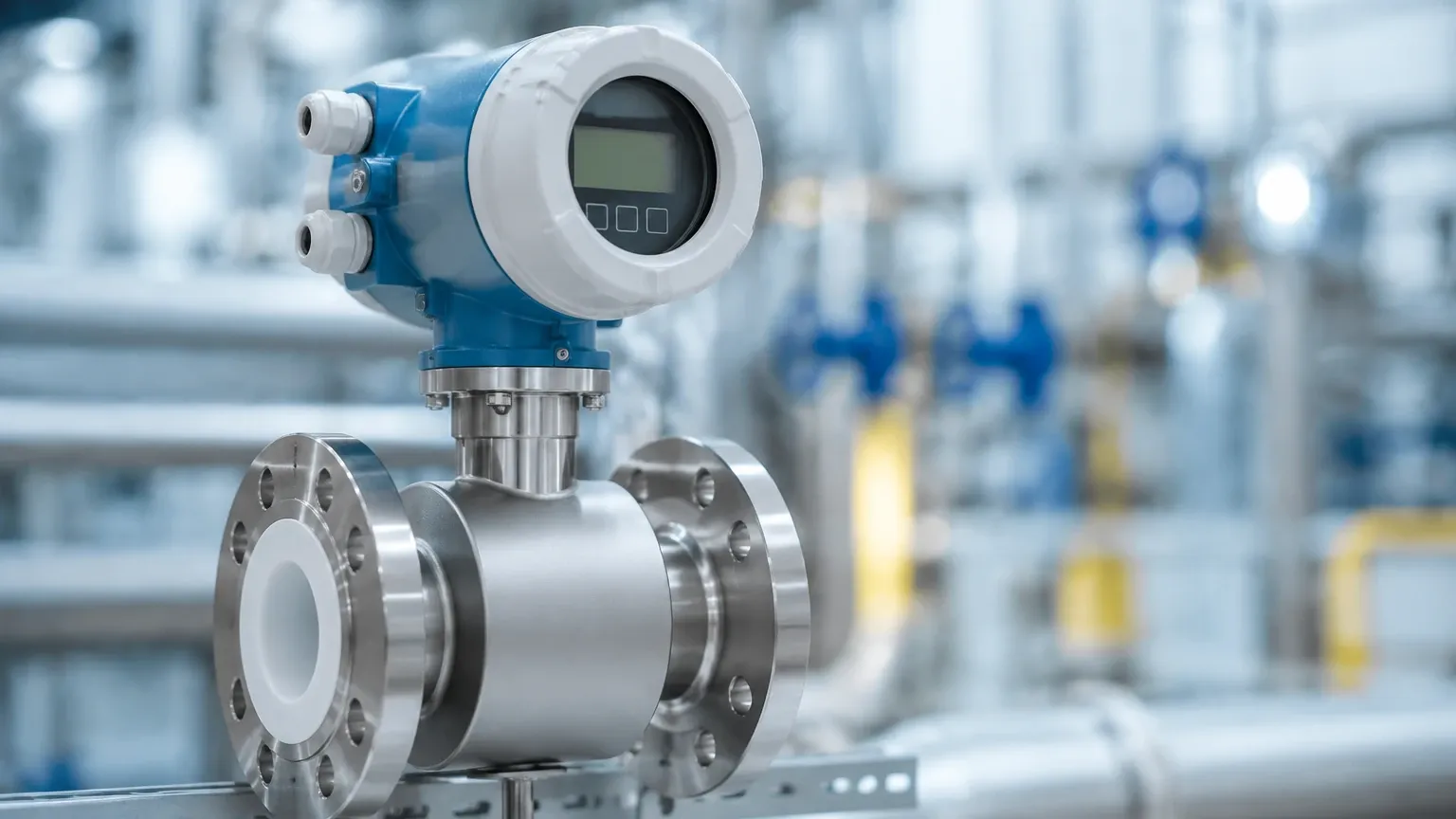
Electromagnetic meters operate on Faraday’s Law of Induction. When a conductive liquid flows through a magnetic field generated by the meter, it produces a voltage proportional to its velocity.
* Equation: $U_e = B \cdot L \cdot v$ (where $U_e$ is the induced voltage, $B$ is the magnetic field strength, $L$ is the distance between electrodes, and $v$ is the flow velocity).
* Best For: Conductive liquids (minimum conductivity typically > 5 μS/cm), such as water, wastewater, and acids.
* Advantages: No moving parts, zero pressure loss, and high accuracy (often ±0.2% of rate).
Coriolis Mass Flow Meters
Coriolis meters measure mass flow directly rather than volume. They utilize the Coriolis effect, where a vibrating tube experiences a phase shift as fluid passes through it. This shift is directly proportional to the mass flow rate.
* Best For: High-precision applications, custody transfer, and fluids with varying density or viscosity.
* Advantages: Measures mass, density, and temperature simultaneously. Extremely high accuracy (up to ±0.05%).
Ultrasonic Flow Meters
These instruments use sound waves to determine velocity. The most common type is the transit-time meter, which measures the difference in time it takes for an ultrasonic pulse to travel upstream versus downstream.
* Best For: Clean liquids (transit-time) or liquids with suspended solids/bubbles (Doppler).
* Advantages: Available as clamp-on versions, allowing for measurement without cutting into the pipe.
Vortex Flow Meters
Vortex meters work on the Karman Vortex Street principle. As fluid flows past a bluff body (a shedder bar), it creates alternating vortices. The frequency of these vortices is proportional to the flow velocity.
* Best For: Steam, gases, and low-viscosity liquids.
* Advantages: Robust construction, handles high temperatures and pressures well.
Technical Selection Criteria for Process Engineers
Selecting the correct E&H flow meter requires a detailed analysis of the process environment. Engineers must evaluate the following parameters to ensure long-term reliability:
1. Fluid Properties: Is the fluid conductive? What is the viscosity? Are there suspended solids? For example, a magnetic flow meter will fail if the fluid is non-conductive (like oil), whereas a Coriolis meter would excel.
2. Process Conditions: Maximum and minimum operating temperatures and pressures must be within the sensor's limits. Standard sensors often handle up to 200°C (392°F), but specialized versions are needed for cryogenic or high-heat applications.
3. Flow Range (Turndown Ratio): The ratio between the maximum and minimum measurable flow. A high turndown ratio (e.g., 100:1) is necessary for processes with high variability.
4. Accuracy and Repeatability: Critical for dosing or billing applications. While ±1% might suffice for general monitoring, custody transfer requires much tighter tolerances.
5. Installation Constraints: Consider the available straight pipe runs. Many technologies require 5 to 10 pipe diameters of straight run upstream to ensure a stable flow profile.
Selection Table: Technology Comparison
| Technology | Primary Fluid | Accuracy (Typical) | Conductivity Required? | Pressure Drop |
| :— | :— | :— | :— | :— |
| Electromagnetic | Conductive Liquids | ±0.2% to ±0.5% | Yes | Negligible |
| Coriolis | Liquids / Gases | ±0.05% to ±0.1% | No | Medium |
| Vortex | Steam / Gas / Liquid | ±0.75% to ±1.0% | No | Low to Medium |
| Ultrasonic | Clean Liquids | ±0.5% to ±2.0% | No | None (Clamp-on) |
| Thermal Mass | Gases | ±1.0% to ±5.0% | No | Low |
Installation and Commissioning Best Practices
Proper installation is the single most important factor in ensuring the accuracy of an E&H flow meter. Even the most expensive Coriolis or magnetic meter will provide erroneous data if installed incorrectly.
Piping and Orientation
* Straight Runs: To eliminate turbulence, follow the manufacturer's "Inlet/Outlet" requirements. Typically, this is 5xDN (nominal diameter) upstream and 2xDN downstream. If space is limited, flow conditioners may be required.
* Full Pipe Condition: For volumetric and mass meters, the pipe must be completely full. In horizontal lines, sensors should be installed in an upward-sloping section or at a low point to prevent air pockets.
* Vertical Installation: For liquids containing solids, vertical upward flow is preferred to ensure a uniform distribution and prevent sedimentation.
Grounding and Interference
Electromagnetic meters are sensitive to electrical noise. Proper grounding to the process liquid is mandatory. This is usually achieved via grounding rings or electrodes, especially in plastic or lined pipes. Additionally, avoid placing meters near high-power cables or large motors that generate significant electromagnetic interference (EMI).
Calibration and Verification
While E&H flow meters are factory-calibrated, in-situ verification is often required by regulatory bodies. Modern digital meters often include self-diagnostic tools (such as Heartbeat Technology) that allow for verification without interrupting the process.
Limitations and Common Application Risks
Despite their advanced technology, flow meters face several operational challenges:
* Cavitation and Flashing: If the pressure drops below the vapor pressure of the liquid, bubbles form (cavitation). This causes significant measurement errors and can physically erode the meter's internal components.
* Coating and Scaling: In chemical or wastewater applications, buildup on the electrodes or the inner wall of the pipe can insulate the sensor or change the effective diameter, leading to drift.
* Gas Entrainment: In liquid flow measurement, even a small percentage of entrained gas can cause a Coriolis meter to "stall" or significantly over-read in volumetric meters.
* Reynolds Number Sensitivity: Technologies like Vortex and Differential Pressure are dependent on the Reynolds number. If the flow becomes laminar (low velocity or high viscosity), these meters lose accuracy.
Integrating Flow and Level Measurement Systems
In a comprehensive industrial automation setup, flow and level measurement are often used in tandem. For instance, in a chemical blending tank, level sensors (such as radar or ultrasonic transmitters) monitor the total volume, while flow meters control the precise dosage of additives.
Companies like Welk specialize in providing the level measurement side of this equation, offering instruments that complement the data provided by an E&H flow meter. By cross-referencing flow rates against changes in level, operators can detect leaks, verify pump performance, and ensure mass balance across the plant. For those seeking to optimize their entire measurement loop, it is helpful to Review product options and application support to find the right combination of level and flow technologies.
Frequently Asked Questions (FAQs)
Q: Can a magnetic flow meter measure deionized water?
A: Generally, no. Deionized water has very low conductivity (often < 1 μS/cm), which is below the threshold required for most electromagnetic meters to function. An ultrasonic or Coriolis meter would be a better choice.
Q: What is the difference between mass flow and volumetric flow?
A: Volumetric flow measures the space the fluid occupies (e.g., m³/h). Mass flow measures the actual weight of the fluid (e.g., kg/h). Mass flow is more accurate for gases and liquids that change density with temperature or pressure.
Q: How often should an E&H flow meter be calibrated?
A: This depends on the criticality of the application and local regulations. For non-critical water monitoring, every 2-3 years may suffice. For custody transfer or high-value chemical dosing, annual or even semi-annual calibration is standard.
Q: Why is my vortex meter reading zero when there is flow?
A: This is often due to the flow rate being below the "cut-off" velocity. Vortex meters require a minimum Reynolds number to generate detectable vortices. If the flow is too slow, the shedder bar will not produce a signal.
Q: Can I install a flow meter immediately after a pump?
A: It is not recommended. Pumps create significant turbulence and pressure pulsations. Ideally, place the meter on the discharge side of the pump with at least 10-20 pipe diameters of straight pipe or a flow straightener in between.
By carefully considering the fluid dynamics, installation environment, and the specific strengths of each E&H flow meter technology, engineers can implement a robust measurement solution that enhances both safety and profitability.