Endress Hauser Flow Meter Promag 400
Endress Hauser Flow Meter Promag 400
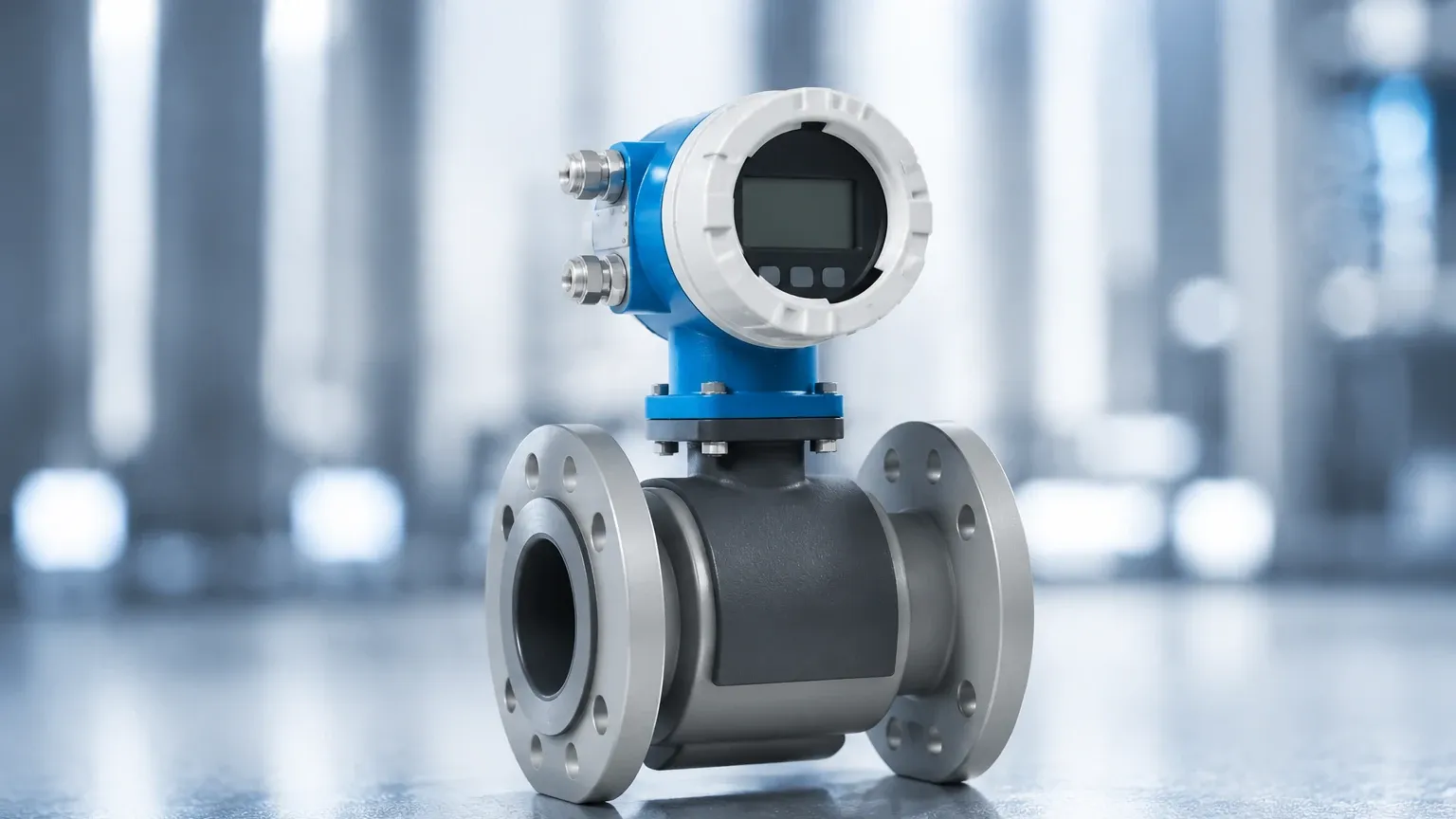
The Endress Hauser flow meter Promag 400 is a specialized electromagnetic flowmeter designed primarily for the water and wastewater industry. As a modular transmitter paired with various sensor types, it provides a robust solution for measuring the volume flow of conductive liquids. In industrial process control, accurate flow measurement is as critical as level monitoring; understanding how these instruments function and how to select the correct configuration is essential for operational efficiency and regulatory compliance.
Electromagnetic Measurement Principle
Before selecting or installing the Promag 400, it is necessary to understand the physical principle governing its operation. Electromagnetic flowmeters operate based on Faraday’s Law of Induction. This law states that a voltage is induced when a conductive fluid flows through a magnetic field.
In the Promag 400 system, the sensor generates a constant magnetic field by passing an alternating current through two field coils. As the liquid—which must have a minimum conductivity—flows through the pipe, it acts as a moving conductor. This movement induces a voltage that is picked up by two measuring electrodes located on opposite sides of the pipe. The induced voltage ($U$) is directly proportional to the flow velocity ($v$), the magnetic field strength ($B$), and the distance between the electrodes ($d$), which corresponds to the pipe diameter.
Mathematically, the relationship is expressed as:
U = B · v · d
Because the magnetic field and the pipe diameter are constant, the voltage is a direct representation of the flow velocity. The transmitter then converts this voltage into a standardized signal (such as 4-20 mA) or a digital communication protocol. This principle allows for a completely unobstructed flow path, meaning there are no moving parts and no pressure drop across the meter.
Sensor Variations and Selection Criteria
The Proline Promag 400 transmitter is typically paired with one of three primary sensors: the Promag W, Promag L, or Promag D. Each is engineered for specific mechanical and environmental conditions.
| Sensor Type | Connection Style | Primary Application | Key Advantage |
| :— | :— | :— | :— |
| Promag W | Flanged | Versatile water applications | "0 x DN" full-bore option available |
| Promag L | Flanged (Lap Joint) | Weight-sensitive installs | Reduced weight and flexible bolt holes |
| Promag D | Wafer (Between flanges) | Space-constrained areas | Compact design and low cost |
Promag W
The Promag W is the most common choice for water and wastewater treatment. It is available in large diameters, often up to DN 3000 (120 inches). One of its most significant technological advancements is the "0 x DN full bore" option, which allows the meter to be installed without the traditional requirement for straight inlet and outlet runs, making it ideal for tight pump skids.
Promag L
The Promag L is designed with lap-joint flanges. This makes it significantly lighter than the standard Promag W, which is a critical consideration for installations on plastic piping or in areas where structural support is limited. The rotating flanges also simplify bolt-hole alignment during installation.
Promag D
The Promag D is a wafer-style sensor. It is clamped between the process flanges using threaded rods. This design is highly compact and cost-effective for smaller line sizes, typically ranging from DN 25 to DN 100 (1 to 4 inches).
Transmitter Features: The Proline 400
The "400" designation refers to the transmitter, which handles the signal processing, user interface, and data communication. Key features include:
* Integrated Web Server: Users can connect to the device via a standard laptop and web browser without needing proprietary software. This allows for rapid configuration and troubleshooting.
* Heartbeat Technology: This is an integrated diagnostic and verification tool. It allows the instrument to perform self-checks to ensure it is still within factory calibration limits without interrupting the process.
* Data Storage (HistoROM): The device automatically backs up configuration data and event logs. If a transmitter needs to be replaced, the HistoROM module can be plugged into the new unit to restore all settings instantly.
Installation Considerations
To ensure the accuracy of an electromagnetic flow meter, several installation factors must be addressed. While some versions of the Promag 400 allow for zero straight runs, standard installations typically require specific pipe geometries to ensure a fully developed flow profile.
1. Inlet and Outlet Runs: Generally, a straight pipe length of 5 x DN (diameter nominal) is recommended upstream of the sensor, and 2 x DN is recommended downstream. This minimizes turbulence caused by elbows, valves, or pumps.
2. Full Pipe Requirement: The sensor must always be completely filled with liquid. For this reason, the meter should be installed in a rising pipe section or at a low point (a siphon). Avoid installing the meter at the highest point of a system or in a vertical down-pipe that discharges to the atmosphere, as air pockets will cause measurement errors.
3. Orientation: The electrodes should be positioned horizontally. If the electrodes are vertical, air bubbles at the top of the pipe or sediment at the bottom could interfere with the signal.
4. Grounding: Proper grounding is essential for electromagnetic meters. The fluid, the sensor, and the transmitter must be at the same electrical potential to prevent stray currents from interfering with the low-voltage measurement signal. In lined pipes (e.g., plastic or concrete), grounding rings or extra grounding electrodes are required.
Limitations and Risks
While the Endress Hauser flow meter Promag 400 is highly versatile, it is not suitable for every application. Engineers should be aware of the following limitations:
* Conductivity: The medium must have a minimum conductivity of 5 μS/cm (microsiemens per centimeter). It cannot measure demineralized water, oils, or hydrocarbons.
* Liner Vacuum Resistance: In applications where a vacuum might occur (e.g., rapid valve closure), the liner material must be chosen carefully. Hard rubber liners may collapse under vacuum, whereas PTFE liners with a supporting mesh are more resilient.
* Solids Content: While the Promag 400 can handle slurries, high concentrations of abrasive solids can wear down the liner or the electrodes over time. In such cases, specialized liner materials like polyurethane are recommended.
Integration with Level Measurement Systems
In many industrial environments, flow measurement is only one part of the process control loop. For instance, in wastewater lift stations or chemical dosing tanks, flow data from a Promag 400 is often used in conjunction with level measurement data to calculate mass balance or pump efficiency.
When managing complex fluid systems, engineers often require a suite of instruments. For those seeking comprehensive solutions, including radar or ultrasonic sensors to complement their flow data, it is advisable to Review product options and application support to ensure all measurement points are compatible and accurate. For example, a Welk ultrasonic level sensor can monitor the head level in an open channel, while a Promag 400 monitors the pressurized discharge line, providing a complete picture of the facility's water movement.
Frequently Asked Questions (FAQ)
Q: Can the Promag 400 measure flow in both directions?
A: Yes, electromagnetic flowmeters are inherently bi-directional. The Promag 400 can be configured to measure and totalize flow in both the forward and reverse directions, which is useful for applications like reservoir charging and discharging.
Q: How often does the Promag 400 need to be calibrated?
A: In many water applications, the device can remain stable for several years. However, regulatory requirements often dictate annual or biennial verification. Using Heartbeat Technology, users can perform a "verification" that produces a report for compliance without removing the meter from the pipe.
Q: What communication protocols are supported?
A: The Proline 400 transmitter supports a wide range of industrial protocols, including Modbus RS485, EtherNet/IP, and PROFINET. This allows for seamless integration into modern SCADA and PLC systems.
Q: What is the maximum temperature the sensor can handle?
A: The temperature limit depends on the liner material. For example, a hard rubber liner is typically limited to 80°C (176°F), while specialized liners can handle higher temperatures. Always check the specific sensor data sheet for the selected liner.
Conclusion
The Endress Hauser flow meter Promag 400 stands as a benchmark for reliability in the water industry. By leveraging the electromagnetic principle, it offers a maintenance-free, high-accuracy solution for conductive liquids. However, successful implementation requires careful attention to sensor selection, pipe geometry, and electrical grounding. When integrated with high-quality level measurement instruments, the Promag 400 enables precise control over the most demanding industrial fluid processes.