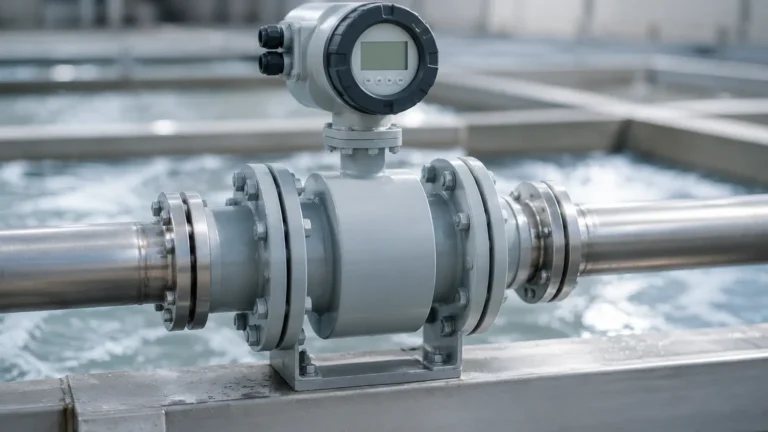
Endress Hauser Promag 400
Endress Hauser Promag 400
The Endress Hauser Promag 400 is a specialized electromagnetic flowmeter designed primarily for the water and wastewater industry. As a modular transmitter combined with various sensor options, it provides a comprehensive solution for measuring the volume flow of conductive liquids. In industrial process control, flow measurement is frequently paired with level instrumentation to provide a complete picture of mass balance and vessel inventory. While flowmeters like the Promag 400 track the movement of media through piping, level sensors—such as the radar and ultrasonic solutions found on the Main Page of industrial instrument providers—monitor the storage and surge capacities of the system.
This article examines the technical specifications, measurement principles, and installation requirements of the Promag 400 series, providing engineering teams with the data necessary for proper technology selection.
Understanding Electromagnetic Flow Measurement Principles
The Promag 400 operates on Faraday’s Law of Induction, a principle used to measure the flow of any liquid with a minimum electrical conductivity (typically > 5 μS/cm).
The Physical Principle
According to Faraday's Law, a voltage is induced when a conductive fluid moves through a magnetic field. This relationship is expressed by the formula:
E = B · v · d
* E: Induced voltage
* B: Magnetic field strength
* v: Flow velocity
* d: Inner diameter of the pipe (distance between electrodes)
In the Promag 400, two field coils located inside the sensor generate a constant magnetic field. As the liquid flows through the pipe, the ions in the fluid react to this field, creating a voltage that is picked up by two measuring electrodes. This voltage is directly proportional to the flow velocity. The transmitter then converts this signal into a standardized volume flow output (e.g., m³/h or gallons per minute).
Advantages of the Principle
Because the measurement is independent of pressure, density, temperature, and viscosity, electromagnetic flowmeters are highly versatile. Furthermore, because there are no moving parts in the flow profile, the sensor does not cause pressure drops or suffer from mechanical wear, making it ideal for fluids with suspended solids, such as raw sewage or sludge.
Key Features of the Promag 400 Series
The Promag 400 is not a single device but a system consisting of a transmitter (the 400) and a sensor (such as the Promag W, L, or D). The transmitter is optimized for the water industry, featuring digital capabilities that simplify commissioning and maintenance.
1. Integrated Web Server
The 400 transmitter includes an integrated web server. This allows maintenance personnel to access device data, configuration parameters, and diagnostic information using a standard laptop and a web browser. No specialized software or proprietary handheld terminals are required, which reduces the total cost of ownership (TCO).
2. Heartbeat Technology
This feature provides continuous self-diagnostics and verification. Heartbeat Technology allows for the verification of the instrument's health without interrupting the process. The system generates a report that complies with quality standards (such as ISO 9001), proving that the device is still within its original calibration specifications.
3. Flexible Integration
The device supports a wide range of industrial protocols, including:
* 4-20 mA HART
* Modbus RS485
* EtherNet/IP
* PROFINET
Practical Selection Table and Technical Specifications
Choosing the correct sensor to pair with the 400 transmitter depends on the application environment, pipe size, and installation constraints. The following table outlines the primary sensor variants used with the Promag 400.
| Feature | Promag W | Promag L | Promag D |
| :— | :— | :— | :— |
| Primary Application | All-round water/wastewater | Flexible flange concepts | Water applications in tight spaces |
| Design | Welded or Flanged | Flanged (Lap joint) | Wafer (Compact) |
| Nominal Diameter | DN 25 to 2400 (1" to 90") | DN 25 to 300 (1" to 12") | DN 25 to 100 (1" to 4") |
| Liner Materials | Hard rubber, Polyurethane, PTFE | Polyurethane, PTFE | Polyamide |
| Accuracy (Standard) | ±0.5% (o.r.) | ±0.5% (o.r.) | ±0.5% (o.r.) |
| Process Temp. | -20 to +90 °C (-4 to +194 °F) | -20 to +90 °C (-4 to +194 °F) | 0 to +60 °C (32 to 140 °F) |
*Note: (o.r.) stands for "of reading".*
Installation Guidelines for Optimal Performance
To ensure the accuracy of the Endress Hauser Promag 400, specific hydraulic conditions must be met. Electromagnetic flowmeters are sensitive to flow profiles; turbulence caused by elbows, valves, or pumps can lead to measurement errors.
Straight Pipe Runs
Traditionally, magmeters require a certain length of straight pipe upstream (inlet) and downstream (outlet) of the sensor.
* Standard Inlet: 5 x DN (5 times the nominal diameter).
* Standard Outlet: 2 x DN.
However, specific versions of the Promag W 400 feature a "Full Bore" design that allows for 0 x DN inlet runs. This is achieved through a specialized sensor geometry that compensates for turbulence, making it possible to install the meter directly after a pipe bend without significant loss of accuracy.
Pipe Orientation and Filling
The sensor must always be full of liquid. If the pipe is only partially filled, the meter will read incorrectly.
* Vertical Installation: Recommended with flow moving upward. This ensures the pipe remains full and prevents the accumulation of solids.
* Horizontal Installation: The electrodes should be on a horizontal plane (3 o'clock and 9 o'clock positions) to prevent interference from air bubbles at the top or sediment at the bottom.
Grounding
Since the measurement principle relies on low-voltage signals, proper grounding is critical. The fluid, the sensor, and the transmitter must be at the same electrical potential. In lined pipes or plastic piping systems, grounding rings are often necessary to establish an electrical connection with the medium.

Integrating Flow and Level Measurement in Process Automation
In modern industrial automation, flow and level measurements are rarely used in isolation. For example, in a wastewater lift station, ultrasonic or radar level meters (such as those offered by Welk) are used to trigger pumps based on the height of the effluent in the wet well. The Promag 400 then measures the volume of the fluid being discharged to the treatment plant.
This integrated approach allows for:
* Leak Detection: Comparing the change in level in a storage tank over time against the flow metered out of the tank.
* Pump Efficiency Monitoring: Correlating the power consumption of a pump with the flow rate and the head pressure (derived from level data).
* Inflow and Infiltration (I&I) Analysis: Identifying excess water entering the sewer system by monitoring flow peaks during rain events relative to baseline levels.
For engineers designing these systems, selecting a reliable level transmitter is as important as selecting the flowmeter. While the Promag 400 handles the pipe flow, hydrostatic or non-contact radar sensors are essential for monitoring the open basins and tanks that feed these pipes.
Limitations and Common Risks
While the Promag 400 is robust, it is not suitable for every application. Engineers should be aware of the following limitations:
1. Conductivity Threshold: It cannot measure hydrocarbons (oil, diesel) or demineralized water where the conductivity is below 5 μS/cm.
2. Vacuum Sensitivity: Certain liners, such as PTFE, can collapse or peel away from the sensor wall if the pipe is subjected to a vacuum. In such cases, a liner specifically designed for vacuum resistance (like PFA) or a mechanically anchored liner is required.
3. Electrode Coating: In applications involving heavy grease or scale-forming chemicals, the electrodes may become coated. While Heartbeat Technology can detect this, periodic cleaning or the use of "bullet-head" electrodes may be necessary.
4. Ambient Temperature: The transmitter electronics have a maximum ambient temperature limit (typically 60 °C / 140 °F). In hot climates, sunshades or remote-mounted transmitters are recommended.
Frequently Asked Questions (FAQs)
Can the Promag 400 measure bidirectional flow?
Yes, the Promag 400 is capable of measuring flow in both directions. The transmitter can be configured to show a positive flow in one direction and a negative flow in the other, or to provide a totalized value for both.
What is the difference between the Promag 400 and the Promag 10?
The Promag 10 is a basic, economical transmitter for simple applications. The Promag 400 is a more advanced, "industry-optimized" transmitter that includes the web server, expanded digital communication options, and Heartbeat Technology, making it better suited for complex water and wastewater networks.
How often does the Promag 400 need calibration?
In many water applications, the Promag 400 can operate for several years without recalibration because it has no moving parts. However, regulatory requirements often dictate a calibration check every 1 to 3 years. Heartbeat Technology allows for "verification" which can sometimes extend the intervals between full wet calibrations.
Is it possible to use the Promag 400 in hazardous areas?
Yes, the Promag 400 is available with various international approvals (ATEX, IECEx, CSA) for use in explosive atmospheres, which is common in certain industrial wastewater or chemical processing environments.
How does pipe vibration affect the measurement?
Electromagnetic flowmeters are generally resistant to vibration. However, extreme vibration can lead to mechanical fatigue of the housing or cable connections. If high vibration is expected, the remote version (where the transmitter is mounted away from the sensor) is the preferred configuration.