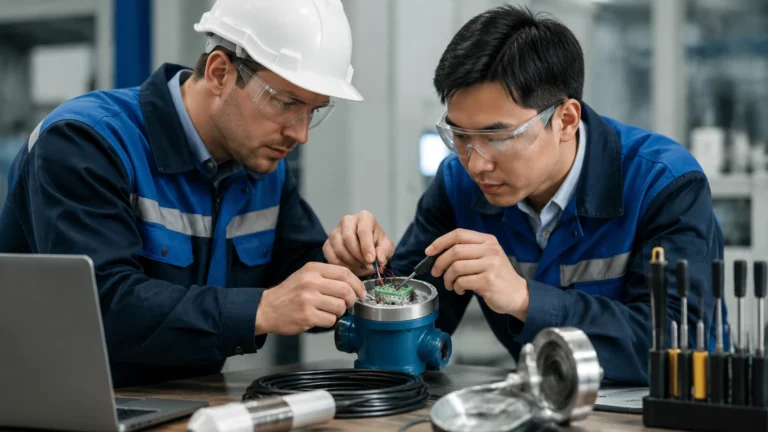
Endress Hauser Prowirl F200
Endress Hauser Prowirl F200
In the landscape of industrial process automation, the accurate measurement of fluids—whether liquids, gases, or steam—is fundamental to operational efficiency and safety. The Endress Hauser Prowirl F200 stands as a prominent solution in the category of vortex flowmeters. Designed to meet the rigorous demands of chemical, oil and gas, and power generation industries, this instrument provides multivariable measurement capabilities. While flow measurement focuses on the movement of media through pipes, it is often integrated into broader systems where level measurement is equally critical for inventory control and vessel safety. For comprehensive information on level-specific instrumentation, engineers frequently refer to the Main Page of specialized manufacturers to complement their flow data.
Measurement Principle: The Karman Vortex Street
To understand the efficacy of the Endress Hauser Prowirl F200, one must first grasp the physical principle upon which it operates: the Karman Vortex Street. This phenomenon occurs when a fluid (liquid or gas) flows past a non-streamlined object, known as a bluff body, placed in the flow stream.
As the fluid hits the bluff body, it cannot follow the contours of the object perfectly. This leads to the separation of the flow layers, creating alternating vortices (swirls) on downstream sides of the body. The frequency at which these vortices are shed is directly proportional to the velocity of the fluid within the pipe. By measuring this frequency using a specialized DSC (Differential Switched Capacitor) sensor, the Prowirl F200 calculates the flow rate.
The Strouhal Number
The relationship between vortex frequency ($f$), flow velocity ($v$), and the width of the bluff body ($d$) is defined by the Strouhal Number ($Sr$):
$$f = Sr \cdot (v / d)$$
Because the Strouhal Number remains constant over a wide range of Reynolds numbers, vortex flowmeters provide high linearity and a large turndown ratio, making them ideal for applications with fluctuating flow rates.
Technical Specifications and Features
The Prowirl F200 is engineered as a versatile, multivariable transmitter. Unlike basic vortex meters that only measure volume flow, the F200 series can incorporate temperature and pressure sensors to provide mass flow and energy flow readings, particularly for steam applications.
Key Technical Parameters
| Feature | Specification |
| :— | :— |
| Nominal Diameter | DN 15 to 300 (1/2" to 12") |
| Measuring Error | Volume flow (Liquid): ±0.75%; Steam/Gas: ±1.0% |
| Process Temperature | -200 to +400 °C (-328 to +752 °F) |
| Max. Pressure | Up to PN 100 / Class 600 |
| Communication | 4-20 mA HART, PROFIBUS PA, FOUNDATION Fieldbus |
| Protection Rating | IP66/67, Type 4X enclosure |
| Safety | SIL 2 / SIL 3 (according to IEC 61508) |
One of the standout features of this device is "Heartbeat Technology," which allows for continuous self-diagnostics and verification without interrupting the process. This is vital in high-availability environments where manual inspection is costly or hazardous.
Applications in Industrial Processes
The Endress Hauser Prowirl F200 is primarily utilized where durability and low maintenance are required. Since it has no moving parts, it is less susceptible to wear compared to turbine meters.
1. Steam Measurement: It is widely considered the standard for saturated and superheated steam. The F200 can detect "wet steam" conditions, which is crucial for preventing water hammer and ensuring the efficiency of heat exchangers.
2. Gas Measurement: Used for compressed air, nitrogen, and natural gas monitoring. Its ability to compensate for temperature and pressure ensures accurate billing and leak detection.
3. Liquid Measurement: Effective for low-viscosity liquids, including demineralized water and hydrocarbons. In many water treatment facilities, vortex meters monitor the main discharge lines while hydrostatic or ultrasonic sensors handle the level monitoring in storage tanks.
Comparison: Flow vs. Level Measurement
In practical engineering, flow and level measurement are two sides of the same coin. While the Prowirl F200 tells a technician how much fluid is moving through a pipe per hour, level measurement instruments—such as those found on the Main Page—indicate the total volume currently held in a vessel.
| Aspect | Vortex Flow Measurement (F200) | Level Measurement (Radar/Ultrasonic) |
| :— | :— | :— |
| Primary Goal | Rate of consumption or transfer | Inventory volume and overfill protection |
| Medium State | Dynamic (Moving) | Static or Dynamic (Stored) |
| Installation | Inline (In-pipe) | Top-mounted or Side-mounted on tanks |
| Maintenance | Low (No moving parts) | Low (Non-contact options available) |
For instance, in a chemical reactor, the Prowirl F200 might measure the inflow of reagents, while a radar level meter monitors the liquid level within the tank to prevent overflow. Both data points are integrated into a Distributed Control System (DCS) for holistic process management.

Practical Selection Table
When selecting a Prowirl F200, engineers must match the sensor size to the expected flow range, not necessarily the existing pipe size. Often, a reduced-bore version (Prowirl R) is used to maintain high fluid velocity for accurate measurement.
| Application Type | Recommended Bore Style | Key Consideration |
| :— | :— | :— |
| High-Velocity Steam | Standard (F) | Check for pressure drop constraints. |
| Low-Flow Gas Lines | Reduced Bore (R) | Increases velocity to meet minimum Reynolds number. |
| Cryogenic Liquids | Standard (F) | Ensure specialized low-temp gaskets are used. |
| Safety Instrumented Systems | Dualsens (S) | Provides redundant sensors for SIL 3 applications. |
Installation Considerations and Best Practices
Correct installation is paramount for the accuracy of any vortex meter. Because the measurement relies on a stable flow profile, the following guidelines should be strictly followed:
* Straight Pipe Runs: To ensure a fully developed flow profile, a minimum of 20xDN (nominal diameter) of straight pipe is typically required upstream of the meter, and 5xDN downstream. If there are multiple bends or valves upstream, these requirements may increase.
* Flow Direction: The meter must be installed according to the arrow on the sensor body indicating the direction of flow.
* Orientation: For liquid applications, the pipe must be completely full. In vertical pipes, flow should ideally be upward to prevent air pockets. For steam applications, the sensor should be mounted horizontally or at an angle to prevent condensate from pooling around the DSC sensor.
* Vibration: While the F200 is designed to be vibration-resistant, extreme mechanical vibration can introduce noise into the signal. Proper pipe support near the meter is recommended.
Limitations and Maintenance
Despite its versatility, the Endress Hauser Prowirl F200 has specific limitations:
* Minimum Reynolds Number: Below a certain flow velocity (typically a Reynolds number of 5,000 to 10,000), vortices are not shed consistently, leading to a "low-flow cut-off" where the meter reads zero.
* Viscosity: Highly viscous fluids dampen the formation of vortices. Vortex meters are generally not recommended for fluids with a viscosity greater than 30 centipoise (cP).
* Abrasive Media: While the bluff body is robust, highly abrasive slurries can wear down the leading edge of the body over time, changing the Strouhal number and affecting accuracy.
Maintenance is minimal. Periodic verification using Heartbeat Technology can extend calibration intervals, but physical inspection of the bluff body for buildup or erosion is recommended during major plant turnarounds.
Frequently Asked Questions (FAQs)
Q: Can the Prowirl F200 measure mass flow?
A: Yes, the multivariable version includes a built-in temperature sensor and can integrate an external pressure signal via HART to calculate the real-time mass flow of steam and gases.
Q: What happens if there is air in the liquid line?
A: Air bubbles can cause significant measurement errors and potentially damage the sensor due to cavitation effects. It is essential to ensure the pipe remains full and to use air eliminators if necessary.
Q: How does it compare to an orifice plate?
A: The Prowirl F200 offers a much wider turndown ratio (up to 30:1 or higher) compared to an orifice plate (typically 4:1). It also results in a lower permanent pressure loss, leading to energy savings over the life of the instrument.
Q: Is it suitable for hygienic applications in the food industry?
A: While the F200 is robust, it is generally intended for industrial processes. For high-purity hygienic applications, electromagnetic flowmeters or specialized hygienic vortex meters with specific surface finishes and certifications are usually preferred.
In conclusion, the Endress Hauser Prowirl F200 is a sophisticated tool for modern process control, offering reliability where mechanical meters fail. By understanding its measurement principles and installation requirements, engineers can ensure accurate data for their flow systems. For those looking to integrate these measurements with tank inventory data, exploring a range of level measurement solutions is the next logical step in optimizing plant performance.