What Is the Instrument Used to Measure Pressure
What Is the Instrument Used to Measure Pressure
In the realm of industrial process control and automation, pressure measurement is one of the most critical variables monitored alongside temperature, flow, and level. Understanding what is the instrument used to measure pressure requires an analysis of the physical principles of force and area, as well as the specific environmental conditions of the application. From simple mechanical gauges used for local monitoring to sophisticated electronic transmitters integrated into distributed control systems (DCS), the choice of instrument directly impacts safety, efficiency, and product quality.
For engineers and procurement professionals, identifying the correct tool involves distinguishing between gauge, absolute, and differential pressure. This guide explores the fundamental technologies behind these instruments, their practical applications in industrial level measurement, and the criteria for selecting the right solution for your facility.
Fundamental Principles of Pressure Measurement
Before selecting an instrument, it is essential to understand the physical principles that allow us to quantify pressure. Pressure ($P$) is defined as the force ($F$) exerted perpendicular to the surface of an object per unit area ($A$) over which that force is distributed ($P = F/A$). In industrial settings, this force is typically measured through one of the following mechanical or electronic principles.
Elastic Deformation
Most mechanical pressure instruments rely on the principle of elastic deformation. When a fluid exerts force on a metallic or ceramic element, the element deforms in a predictable way.
* Bourdon Tubes: A C-shaped, helical, or spiral tube that tends to straighten when pressurized. This movement is mechanically linked to a pointer on a dial.
* Diaphragms: A thin, flexible circular membrane. When pressure is applied to one side, the diaphragm deflects. This deflection can be measured mechanically or converted into an electrical signal.
* Bellows: A thin-walled metallic tube with deep convolutions. It expands or contracts axially in response to pressure changes, providing a larger displacement than a diaphragm.
Piezoresistive and Capacitive Sensing
Modern electronic transmitters often use solid-state sensors to provide higher accuracy and digital integration.
* Piezoresistive Sensors: These utilize the change in electrical resistance of a semiconductor (usually silicon) when subjected to mechanical strain. As pressure deforms the sensor, the resistance changes, which is then processed into a 4-20mA or digital signal.
* Capacitive Sensors: These measure the change in electrical capacitance between a sensing diaphragm and a fixed reference plate. As the diaphragm moves under pressure, the distance between the plates changes, altering the capacitance. This method is highly sensitive and stable over time.
Hydrostatic Principle
In the context of liquid storage, the hydrostatic principle is paramount. The pressure at the bottom of a liquid column is directly proportional to the height of the liquid and its density ($P = \rho gh$). This allows pressure instruments to function as highly accurate level measurement devices. Understanding this relationship is key to choosing the right Main Page for reviewing product options and application support regarding level and pressure instrumentation.
Types of Instruments Used to Measure Pressure
Depending on the required output and the environment, several distinct categories of instruments are utilized in B2B industrial applications.
1. Pressure Gauges
Pressure gauges are mechanical devices used for local, real-time visual monitoring. They do not require external power and are ubiquitous in pump stations, pipelines, and boilers.
* Standard Gauges: Used for air, water, or oil where no corrosive media are present.
* Chemical/Diaphragm Gauges: Feature a protective diaphragm to prevent the process media from entering the internal mechanism, ideal for viscous or corrosive fluids.
2. Pressure Transmitters and Transducers
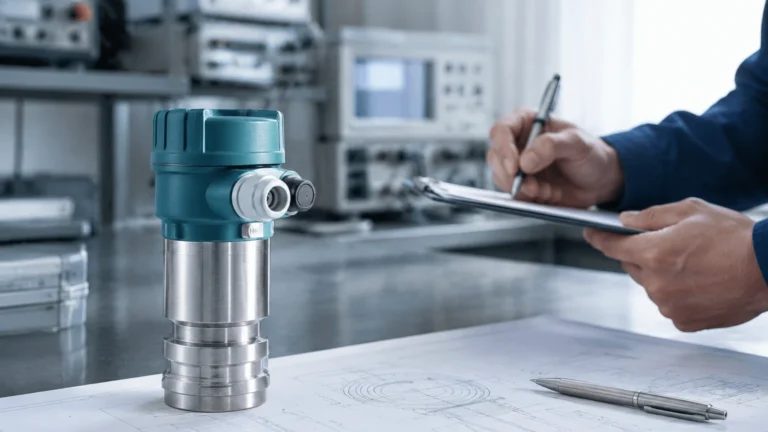
While "transducer" and "transmitter" are often used interchangeably, a transmitter typically converts the sensor's signal into a standardized industrial output, such as 4-20mA, HART, or Modbus. These are the workhorses of industrial automation, allowing for remote monitoring and control.
* Gauge Pressure Transmitters: Measure pressure relative to atmospheric pressure.
* Absolute Pressure Transmitters: Measure pressure relative to a perfect vacuum. These are essential in vacuum distillation and atmospheric research.
* Differential Pressure (DP) Transmitters: Measure the difference between two pressure points. These are widely used for flow measurement (across an orifice plate) and level measurement in pressurized tanks.
3. Hydrostatic Level Transmitters
These are specialized pressure instruments designed specifically for level detection. They can be submersible (dropped into a well or tank) or externally mounted via a flange at the bottom of a vessel. By measuring the head pressure of the liquid, they provide a continuous level reading that is unaffected by foam or surface turbulence.
Selection Criteria: Choosing the Right Instrument
Selecting the appropriate instrument requires a detailed understanding of the process parameters. Use the following table as a preliminary reference for comparing common technologies.
Pressure Instrument Selection Table
| Instrument Type | Measurement Principle | Typical Application | Accuracy (Full Scale) | Key Advantage |
| :— | :— | :— | :— | :— |
| Bourdon Gauge | Elastic Tube | Local pipe monitoring | ±1.0% to ±5.0% | No power required |
| Diaphragm Transmitter | Capacitive/Piezoresistive | Corrosive/Viscous media | ±0.1% to ±0.5% | High chemical resistance |
| Hydrostatic Level Sensor | Piezoresistive | Open tank level | ±0.25% | Simple installation |
| DP Transmitter | Differential Capacitance | Pressurized tank level | ±0.075% | Versatile for flow/level |
| Absolute Pressure Sensor | Sealed Vacuum Reference | Vacuum chambers | ±0.1% | Independent of weather |
Critical Evaluation Factors
1. Pressure Range: The operating pressure should ideally fall within 50-75% of the instrument's full-scale range to ensure longevity and accuracy.
2. Media Compatibility: Ensure that the wetted parts (the materials in contact with the fluid, such as 316L stainless steel, Hastelloy, or Tantalum) are resistant to corrosion.
3. Temperature Limits: High-temperature steam or cryogenic liquids require specialized cooling elements or siphons to protect the sensor electronics.
4. Environmental Rating: For outdoor or hazardous areas, instruments must have appropriate IP ratings (e.g., IP67/IP68) and explosion-proof (Ex d) or intrinsically safe (Ex i) certifications.
Installation and Maintenance Considerations
Even the most accurate instrument will provide faulty data if installed incorrectly. When determining what is the instrument used to measure pressure for a specific site, consider these logistical factors:
* Mounting Position: Pressure sensors are often calibrated in a specific orientation (usually vertical). Mounting them horizontally can introduce a zero-shift error due to the weight of the diaphragm or internal fill fluid.
* Impulse Piping: For remote transmitters, the piping (impulse lines) between the process and the sensor must be sloped to prevent gas pockets (in liquid lines) or liquid traps (in gas lines).
* Siphons and Seals: When measuring steam, a pigtail or U-type siphon must be used. The siphon traps condensed water, which acts as a thermal barrier to protect the gauge or transmitter from high temperatures.
* Calibration: Industrial instruments should be calibrated annually. In critical safety applications, such as those in the oil and gas or chemical sectors, more frequent verification against a deadweight tester or a high-precision digital pressure calibrator is recommended.

Limitations of Pressure Instrumentation
While highly reliable, pressure instruments have inherent limitations that engineers must account for:
* Density Sensitivity: Hydrostatic level instruments assume a constant liquid density. If the temperature of the liquid changes significantly, the density changes, which will lead to a level measurement error unless compensated for by a PLC or smart transmitter.
* Overpressure Events: Sudden pressure spikes (water hammer) can permanently deform diaphragms or Bourdon tubes. Selecting an instrument with a high overpressure rating or installing a pressure snubber can mitigate this risk.
* Mechanical Wear: Mechanical gauges have moving parts that can wear out over time, especially in high-vibration environments. In such cases, liquid-filled (glycerin or silicone) gauges are preferred to dampen vibration and lubricate the movement.
Frequently Asked Questions (FAQ)
Q: What is the difference between a pressure transducer and a pressure transmitter?
A: Generally, a transducer provides a raw voltage output (e.g., 0-100mV), while a transmitter includes signal conditioning electronics to provide a standardized current loop output (e.g., 4-20mA) capable of long-distance transmission without signal loss.
Q: Can I use a pressure gauge to measure the level of a tank?
A: Yes, provided the tank is vented to the atmosphere. A gauge installed at the bottom of the tank will measure the hydrostatic head. You can convert the pressure (bar or psi) to height (meters or feet) using the density of the liquid. For example, 0.1 bar of water pressure roughly equals 1 meter of water column (10.2 kPa ≈ 1.04 mH2O).
Q: Why is my pressure reading fluctuating?
A: Fluctuations are often caused by pump pulsations, turbulence, or rapid valve closures. Installing a snubber or using a transmitter with adjustable software damping can smooth the signal.
Q: What is a "smart" pressure transmitter?
A: A smart transmitter uses a microprocessor to perform onboard calculations, such as temperature compensation, self-diagnostics, and digital communication via protocols like HART, Foundation Fieldbus, or Profibus.
Conclusion
Identifying what is the instrument used to measure pressure is a foundational step in designing any industrial process. Whether the goal is to ensure the safety of a high-pressure steam line or to manage inventory through hydrostatic level measurement, the choice involves balancing accuracy, durability, and cost. By understanding the underlying measurement principles and the specific needs of the application, facility managers can implement solutions that provide reliable data for years of operation. For those seeking specific hardware configurations or customized OEM/ODM level and pressure solutions, visiting the Main Page provides access to a comprehensive range of industrial instrumentation tailored for water treatment, chemical processing, and automation.
Download What Is the Instrument Used to Measure Pressure as a PDF