Ethyl Acetate Dielectric Constant
Ethyl Acetate Dielectric Constant
In the field of industrial process control, the accurate measurement of liquid levels is fundamental to operational efficiency, safety, and inventory management. For chemical engineers and automation specialists working with volatile organic compounds (VOCs), understanding the electrical properties of the medium is as critical as knowing its density or viscosity. Among these properties, the ethyl acetate dielectric constant stands out as a primary variable that dictates the performance and selection of level measurement instrumentation.
Ethyl acetate ($CH_3COOC_2H_5$) is a widely used solvent in the pharmaceutical, coating, and printing industries. Its relatively low boiling point and high volatility necessitate precise monitoring within storage tanks and reactor vessels. However, because many modern level sensors—particularly radar and guided wave radar—rely on electromagnetic wave reflection, the dielectric constant ($ε_r$) of ethyl acetate determines how much signal returns to the sensor and, consequently, how reliable the measurement will be.
Understanding Dielectric Constant in Level Measurement
Before delving into the specific values for ethyl acetate, it is essential to understand the measurement principles involved. The dielectric constant, also known as relative permittivity, is a dimensionless measure of a substance's ability to store electrical energy in an electric field. In the context of level instrumentation, it identifies how "reflective" a liquid surface is to electromagnetic pulses.
The Physics of Reflection
When a radar signal (microwaves) travels through a gas or vacuum and hits a liquid surface, a portion of the energy is reflected back to the transmitter, while the rest penetrates the medium. The strength of this reflection is governed by the difference in dielectric constants between the upper medium (usually air or nitrogen, $ε_r ≈ 1$) and the liquid.
The reflection coefficient ($R$) can be simplified by the formula:
$$R = \frac{\sqrt{ε_r} – 1}{\sqrt{ε_r} + 1}$$
Liquids with high dielectric constants, such as water ($ε_r ≈ 80$), produce very strong reflections, making them easy to measure. Conversely, hydrocarbons and solvents with low dielectric constants, such as hexane ($ε_r ≈ 1.9$), reflect very little energy, requiring highly sensitive equipment. Ethyl acetate falls into the intermediate range, which presents specific engineering considerations for sensor configuration.
The Ethyl Acetate Dielectric Constant Value
The ethyl acetate dielectric constant is typically cited between 6.0 and 6.4 at 20°C (68°F). This value classifies it as a moderately polar solvent. While it is significantly more reflective than pure oils or alkanes, it is far less reflective than water or alcohols like ethanol ($ε_r ≈ 24$).
Factors Influencing the Dielectric Value
1. Temperature: The dielectric constant is temperature-dependent. As temperature increases, the molecular motion of ethyl acetate increases, making it harder for the molecules to align with an external electric field. Consequently, the dielectric constant decreases as the temperature rises. In high-temperature reactor applications, this reduction must be accounted for to ensure the radar signal remains detectable.
2. Purity: The presence of water (even in small percentages) will significantly increase the effective dielectric constant of the mixture, as water has a much higher $ε_r$. Conversely, mixing ethyl acetate with non-polar solvents will lower the value.
3. Frequency: For most industrial radar frequencies (6GHz to 80GHz), the dielectric constant of ethyl acetate remains relatively stable, though high-frequency sensors (80GHz) are generally preferred for lower dielectric liquids due to their better signal-to-noise ratios.
Selecting the Right Level Technology for Ethyl Acetate
Choosing a level meter for ethyl acetate requires balancing the dielectric properties with the physical characteristics of the tank environment. Below are the primary technologies used by Welk and other industrial manufacturers.
1. Non-Contact Radar Level Meters
Non-contact radar is often the preferred choice for ethyl acetate because it does not touch the medium, eliminating corrosion concerns and simplifying maintenance. With a dielectric constant of ~6.0, ethyl acetate provides a sufficient surface reflection for modern 26GHz and 80GHz radar transmitters.
* Advantages: No moving parts, unaffected by vacuum or pressure, and high accuracy (up to ±2mm).
* Considerations: In tanks with heavy agitation or foam, the signal may scatter. High-frequency 80GHz units are recommended because their narrow beam angle avoids internal tank obstructions and focuses more energy on the liquid surface.
2. Guided Wave Radar (GWR)
Guided wave radar uses a probe (cable or rod) to lead the microwave pulse directly to the liquid surface. This technology is exceptionally reliable for liquids with a dielectric constant in the range of ethyl acetate.
* Advantages: GWR is virtually unaffected by surface turbulence, foam, or tank geometry. It provides a much stronger signal return than non-contact radar because the energy is concentrated around the probe.
* Considerations: Since the probe is immersed in the liquid, material compatibility is vital. Ethyl acetate is compatible with 316L stainless steel and PTFE, which are standard materials for GWR probes.
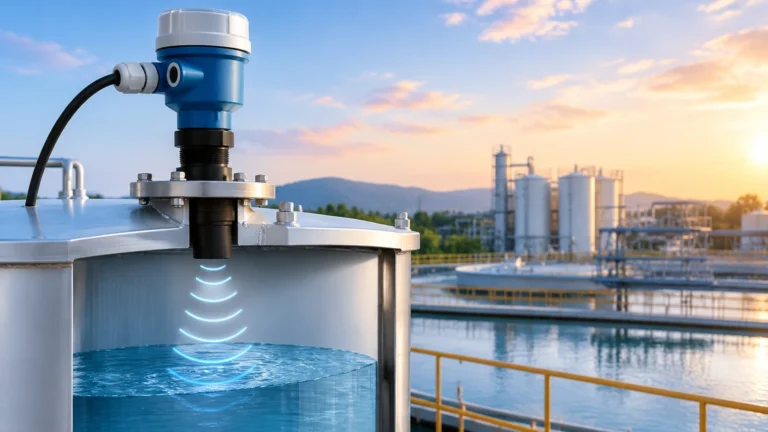
3. Ultrasonic Level Sensors
Ultrasonic sensors use sound waves rather than electromagnetic waves. Therefore, they are not affected by the ethyl acetate dielectric constant.
* Advantages: Cost-effective for simple atmospheric storage tanks.
* Limitations: Ethyl acetate is a volatile solvent. The vapor space in the tank can become saturated with ethyl acetate fumes, which changes the speed of sound in the tank. If the sensor is not calibrated for the specific vapor composition and temperature, significant measurement errors will occur. Furthermore, ultrasonic signals can be absorbed by heavy vapors.
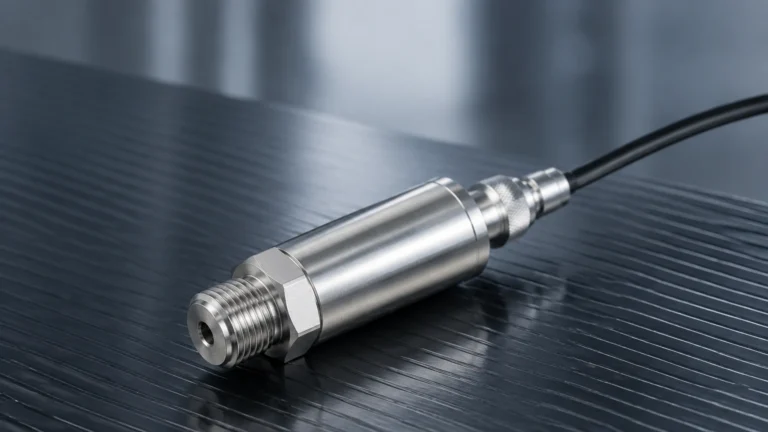
4. Hydrostatic Level Transmitters
These measure the pressure exerted by the liquid column. Like ultrasonic sensors, they are independent of the dielectric constant.
* Advantages: Simple and robust.
* Limitations: They require contact with the fluid and are density-dependent. If the temperature changes the density of the ethyl acetate, the level reading must be compensated.
Technical Comparison Table
| Technology | Suitability for Ethyl Acetate | Dependence on Dielectric Constant | Impact of Vapor/Foam |
| :— | :— | :— | :— |
| Non-Contact Radar (80GHz) | Excellent | High (Requires $ε_r > 1.4$) | Low impact from vapor; foam can attenuate signal |
| Guided Wave Radar | Excellent | High (Requires $ε_r > 1.2$) | Unaffected by vapor; handles foam well |
| Ultrasonic | Fair | None | High impact from solvent vapors |
| Hydrostatic | Good | None | Unaffected by vapor; requires density compensation |
| Magnetic Level Gauge | Good | None | Unaffected; requires float design for specific gravity |

Installation Considerations for Ethyl Acetate Applications
When installing level instruments in ethyl acetate service, engineers must look beyond the dielectric constant to ensure long-term reliability.
Vapor Space and Condensation
Ethyl acetate has a high vapor pressure. In outdoor storage tanks, temperature fluctuations can cause condensation on the sensor face or antenna. For non-contact radar, a PTFE drop antenna or a lens antenna is recommended to prevent droplets from clinging to the emitter, which could otherwise cause signal attenuation or a "false high" reading.
Tank Geometry and Obstructions
Because the dielectric constant of 6.0 is moderate, signal loss can occur if the radar beam hits internal structures like heating coils, ladders, or agitators. Utilizing a narrow-beam 80GHz radar or installing the sensor in a bypass chamber (stilling well) can mitigate these issues. A stilling well is particularly effective for ethyl acetate as it eliminates surface turbulence and increases the signal strength of the reflection.
Explosion Protection
Ethyl acetate is a flammable liquid with a flash point of approximately -4°C (25°F). All level measurement equipment must be certified for use in hazardous areas (Ex d or Ex ia). Both the transmitter and any associated cabling must meet local safety standards (such as ATEX, IECEx, or UL).
Limitations and Risks
While a dielectric constant of 6.0 is generally easy to measure, certain conditions can create challenges:
* Interface Measurement: If ethyl acetate is mixed with water, it will form a distinct layer (ethyl acetate is less dense and floats on water). Measuring the interface between the two requires Guided Wave Radar. However, because the dielectric constants are 6.0 and 80 respectively, the GWR must be configured to detect the second reflection from the water layer.
* Emulsions: If the two liquids are agitated into an emulsion, the dielectric gradient becomes blurred, making interface measurement difficult or impossible for radar-based systems.
* Low-Level Sensitivity: In tanks with conical bottoms, the radar signal may scatter when the level is very low. High-sensitivity electronics are required to track the signal down to the bottom of the vessel.
Frequently Asked Questions (FAQs)
Q: Can I use a standard radar sensor designed for water on an ethyl acetate tank?
A: Yes, most radar sensors designed for water will work, but you must ensure the sensitivity (gain) is adjusted. Since ethyl acetate reflects less energy than water, the sensor needs to be able to process a weaker return signal.
Q: How does temperature affect the measurement of ethyl acetate?
A: Temperature affects the dielectric constant slightly, but its primary impact is on vapor pressure and liquid density. If using radar, the dielectric change is usually negligible for the sensor. If using hydrostatic or ultrasonic, temperature compensation is mandatory.
Q: Is guided wave radar better than non-contact radar for ethyl acetate?
A: GWR is technically more robust for low-dielectric and turbulent applications. However, non-contact radar is often preferred to avoid cleaning the probe and to prevent potential leak paths at the process connection.
Q: What is the minimum dielectric constant a radar can measure?
A: Most modern high-performance radars can measure down to a dielectric constant of 1.4. With a value of 6.0, ethyl acetate provides a very comfortable margin for these sensors.
Conclusion
Successful level measurement of ethyl acetate hinges on understanding that its dielectric constant of ~6.0 provides a reliable but moderate reflection for electromagnetic sensors. While it is not as challenging as measuring liquid hydrogen or pure hydrocarbons, it requires a thoughtful approach to sensor selection—prioritizing high-frequency non-contact radar or guided wave radar to ensure accuracy amidst volatility and potential turbulence.
For engineers seeking to optimize their chemical storage or processing lines, selecting the correct instrumentation involves evaluating the full process environment, from the chemical properties to the physical tank constraints. You can review product options and application support on our Main Page to find the specific configuration that matches your ethyl acetate application requirements. By adhering to established engineering principles and accounting for the unique behavior of the ethyl acetate dielectric constant, plants can achieve the precision required for modern industrial automation.