Express 1 Atmospheric Pressure in Cgs System
Express 1 Atmospheric Pressure in Cgs System
In the fields of industrial automation and process control, pressure measurement is a fundamental parameter that dictates the selection and calibration of level measurement instruments. While the International System of Units (SI) is the modern standard, many engineering legacy systems and specific scientific applications still utilize the CGS (Centimetre-Gram-Second) system. Understanding how to express 1 atmospheric pressure in cgs system is not merely a theoretical exercise; it is a practical necessity for engineers calibrating hydrostatic level transmitters, designing vacuum systems, or managing high-precision chemical processes.
Atmospheric pressure represents the force per unit area exerted by the weight of the atmosphere above a specific point. At sea level, this is defined as "standard atmosphere" (atm). To accurately translate this value into the CGS system, one must understand the relationship between mass, gravity, and fluid density. This guide provides a detailed derivation, practical comparisons, and engineering insights into how these units impact industrial level measurement technologies.
The Physics of Pressure and the CGS System
Pressure is defined as the force applied perpendicular to the surface of an object per unit area. The mathematical expression is $P = F/A$. In the CGS system, the unit of force is the dyne, and the unit of area is the square centimeter (cm²). Therefore, the unit of pressure in the CGS system is dynes/cm², also known as the Barye (Ba).
To express 1 atmospheric pressure in cgs system, we typically reference the height of a mercury column that the atmosphere can support. Under standard conditions (0°C at sea level), the atmosphere supports a column of mercury (Hg) exactly 76 cm (760 mm) high.
The Hydrostatic Formula
The pressure exerted by a column of fluid is calculated using the formula:
$$P = \rho gh$$
Where:
* $\rho$ (Rho): The density of the fluid (for mercury, this is approximately 13.6 g/cm³ in CGS).
* $g$: The acceleration due to gravity (approximately 980.665 cm/s² in CGS).
* $h$: The height of the fluid column (76 cm for 1 atm).
Step-by-Step Calculation: 1 Atmospheric Pressure in CGS
To find the exact value, we substitute the standard physical constants into the hydrostatic equation using CGS units.
1. Density of Mercury ($\rho$): 13.595 g/cm³ (at 0°C).
2. Acceleration due to Gravity ($g$): 980.665 cm/s².
3. Height of Column ($h$): 76 cm.
Calculation:
$$P = 13.595 \, \text{g/cm}^3 \times 980.665 \, \text{cm/s}^2 \times 76 \, \text{cm}$$
$$P = 1,013,250.144 \, \text{dynes/cm}^2$$
In scientific notation, this is approximately $1.01325 \times 10^6$ dynes/cm². This value is the foundation for defining the "bar," where 1 bar is exactly $10^6$ dynes/cm². Consequently, 1 standard atmosphere is slightly more than 1 bar (1.01325 bar).
Relevance to Industrial Level Measurement
For engineers visiting our Main Page, understanding these pressure conversions is vital for selecting the right level measurement technology. Hydrostatic level transmitters, for instance, operate by measuring the pressure exerted by a liquid column. If a sensor is calibrated in a specific unit system, the engineer must be able to convert between atmospheric references and gauge pressure accurately.
Hydrostatic Level Measurement Principle
Hydrostatic level sensors measure the pressure at the bottom of a tank. Since the pressure is directly proportional to the height of the liquid ($P = \rho gh$), the sensor can calculate the level if the density of the liquid is known. If the tank is open to the atmosphere, the sensor must account for the 1.013 million dynes/cm² of atmospheric pressure pressing down on the liquid surface. This is usually handled by using a "vented" gauge pressure sensor that naturally offsets the atmospheric component.
Comparison Table: Pressure Units in Industrial Contexts
When selecting instrumentation, you may encounter various units. The following table provides conversion factors from 1 standard atmosphere (atm) to other common industrial units.
| Unit System | Unit Name | Value for 1 atm |
| :— | :— | :— |
| CGS | Dynes/cm² (Barye) | 1,013,250 |
| SI (Metric) | Pascal (N/m²) | 101,325 |
| Metric (Industrial) | Bar | 1.01325 |
| Imperial | PSI (lbs/in²) | 14.696 |
| Manometric | mm of Mercury (mmHg) | 760 |
| Manometric | Meters of Water (mH₂O) | 10.33 |
Technology Selection Based on Pressure Requirements
Different level measurement technologies handle atmospheric and process pressure differently. Selecting the wrong instrument for a pressurized environment can lead to significant measurement errors or equipment failure.
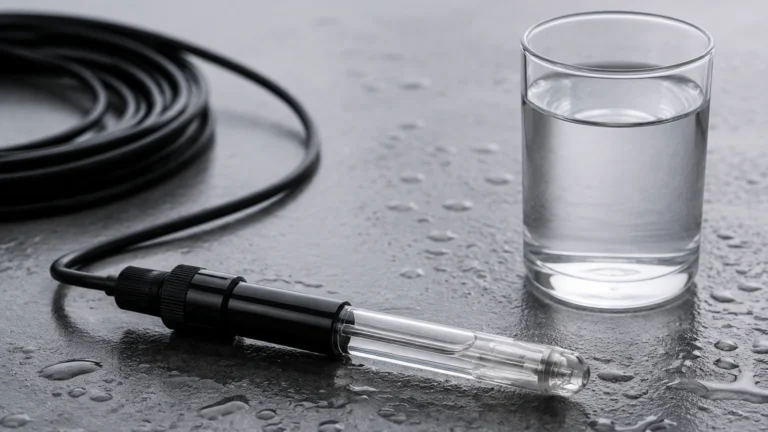
1. Hydrostatic Level Transmitters
* Best For: Vented tanks, deep wells, and water treatment.
* Pressure Consideration: Requires a vent tube in the cable to compensate for atmospheric pressure changes. In pressurized tanks, a differential pressure (DP) transmitter is required to subtract the headspace pressure from the total bottom pressure.
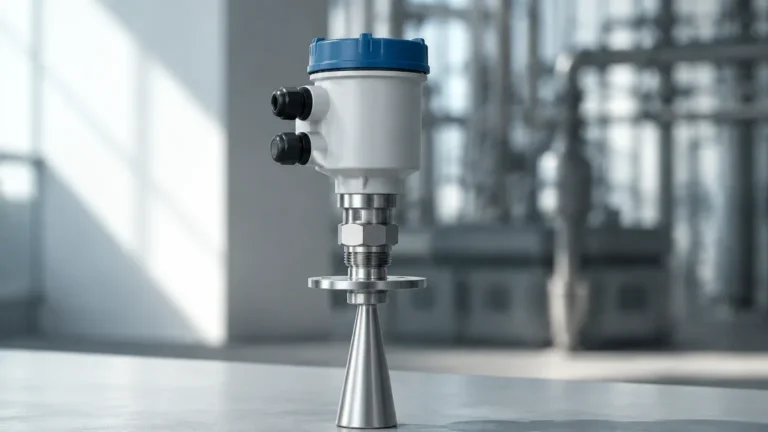
2. Radar Level Meters (Non-Contact)
* Best For: Corrosive chemicals, high temperatures, and pressurized vessels.
* Pressure Consideration: Radar signals are largely unaffected by the density of the vapor space or changes in atmospheric pressure. They are ideal when the internal tank pressure deviates significantly from $1.013 \times 10^6$ dynes/cm².
3. Ultrasonic Level Sensors
* Best For: Simple liquid level monitoring in open channels or atmospheric tanks.
* Pressure Consideration: Ultrasonic waves are affected by the density of the air. Significant deviations from standard atmospheric pressure can change the speed of sound, leading to inaccuracies unless compensated.

Installation Considerations for Pressure-Sensitive Applications
When installing level meters where atmospheric pressure or vacuum conditions are present, follow these engineering guidelines:
* Venting Requirements: For hydrostatic sensors in atmospheric tanks, ensure the breather tube is clear and protected by a moisture filter. If the vent is blocked, the sensor will not correctly reference the $1.013 \times 10^6$ dynes/cm² baseline, causing drift.
* Density Compensation: Since hydrostatic pressure depends on density ($\rho$), ensure that your calculations account for temperature-induced density changes. A liquid that is less dense than standard water will exert less pressure per centimeter of height.
* Mounting Position: Avoid areas of high turbulence or near agitators, as dynamic pressure (kinetic energy of the fluid) can interfere with the static pressure measurement required for level calculation.
* Vacuum Hazards: Standard hydrostatic sensors may be damaged by vacuum conditions if the diaphragm is not designed for negative pressure. Always check the absolute pressure rating of the instrument.
Limitations of Pressure-Based Measurement
While expressing 1 atmospheric pressure in cgs system is precise, real-world application has limitations:
1. Altitude Variations: Atmospheric pressure decreases with altitude. An instrument calibrated at sea level ($1.013 \times 10^6$ dynes/cm²) will show an offset if moved to a high-altitude facility without recalibration.
2. Vapor Pressure: In closed tanks, the liquid's own vapor pressure adds to the headspace pressure, which can confuse simple hydrostatic sensors.
3. Mechanical Stress: High-pressure applications can cause diaphragm fatigue in contact-type sensors, necessitating the use of non-contact methods like radar.
Frequently Asked Questions (FAQ)
Q: Why use CGS units instead of SI units in modern engineering?
A: While SI (Pascals) is standard, CGS units like dynes/cm² are still frequently used in fluid mechanics and physics research because they scale conveniently for small-scale laboratory experiments. Many legacy calibration benches also still feature CGS-based gauges.
Q: How does 1 atm in CGS relate to the "bar" unit?
A: 1 bar is defined as exactly $10^6$ dynes/cm². Since 1 atm is $1.01325 \times 10^6$ dynes/cm², the two units are very close, but 1 atm is approximately 1.3% higher than 1 bar.
Q: Can I use a hydrostatic level sensor in a vacuum tank?
A: Only if it is a differential pressure sensor or an absolute pressure sensor. A standard vented gauge sensor will provide incorrect readings in a vacuum because its reference point (the atmosphere) is higher than the process pressure.
Q: Does temperature affect the CGS value of atmospheric pressure?
A: The *definition* of 1 standard atmosphere is fixed. However, the *actual* atmospheric pressure at a location changes with weather and temperature. Furthermore, the density of mercury used in the calculation changes with temperature, which is why the standard is specifically defined at 0°C.
Conclusion
Accurately being able to express 1 atmospheric pressure in cgs system is a cornerstone of fluid statics. For the industrial professional, this value—$1,013,250$ dynes/cm²—serves as the benchmark for calibrating sensors and understanding the forces at play within a process vessel. Whether you are implementing hydrostatic transmitters or non-contact radar systems, recognizing the impact of atmospheric pressure ensures higher accuracy, improved safety, and better process efficiency. For detailed product specifications and selection support, engineers should evaluate their specific pressure and media requirements against the technical capabilities of modern level instrumentation.
Download Express 1 Atmospheric Pressure in Cgs System as a PDF