Flanged Thermowells
Flanged Thermowells
In the landscape of industrial process control, the protection of sensitive instrumentation is as critical as the measurement itself. Flanged thermowells serve as the primary mechanical barrier between a temperature sensor—such as a Resistance Temperature Detector (RTD) or thermocouple—and the process media. By isolating the sensor from high pressures, corrosive chemicals, and high-velocity flows, these components ensure long-term reliability and facilitate maintenance without necessitating a system shutdown.
For engineers and procurement specialists at firms like Welk, understanding the nuances of flanged thermowells is essential for maintaining the integrity of complex systems, including those involving advanced level measurement where temperature compensation is vital. This guide provides a technical deep dive into the principles, selection criteria, and installation practices for flanged thermowells in B2B industrial environments.
Measurement Principles and Thermal Dynamics
A thermowell is essentially a pressure-tight receptacle designed to accept a temperature-sensing element. While the thermowell itself does not measure temperature, its design directly influences the accuracy and speed of the measurement. The process follows three primary stages of heat transfer:
1. Convection: Heat is transferred from the process fluid (liquid or gas) to the outer surface of the thermowell.
2. Conduction: Heat moves through the wall of the thermowell to the internal cavity.
3. Convection/Radiation: Heat is transferred from the internal wall of the thermowell to the sensor itself.
The use of a flanged thermowell introduces a "thermal lag" or response time delay. Because the sensor is not in direct contact with the media, it must wait for the thermowell material to reach thermal equilibrium with the process. Engineers must balance the thickness of the thermowell wall—required for pressure resistance—with the need for a fast response time. Thinner walls or tapered designs are often used to improve sensitivity, provided they meet the structural requirements of the application.
Design and Geometry Variations
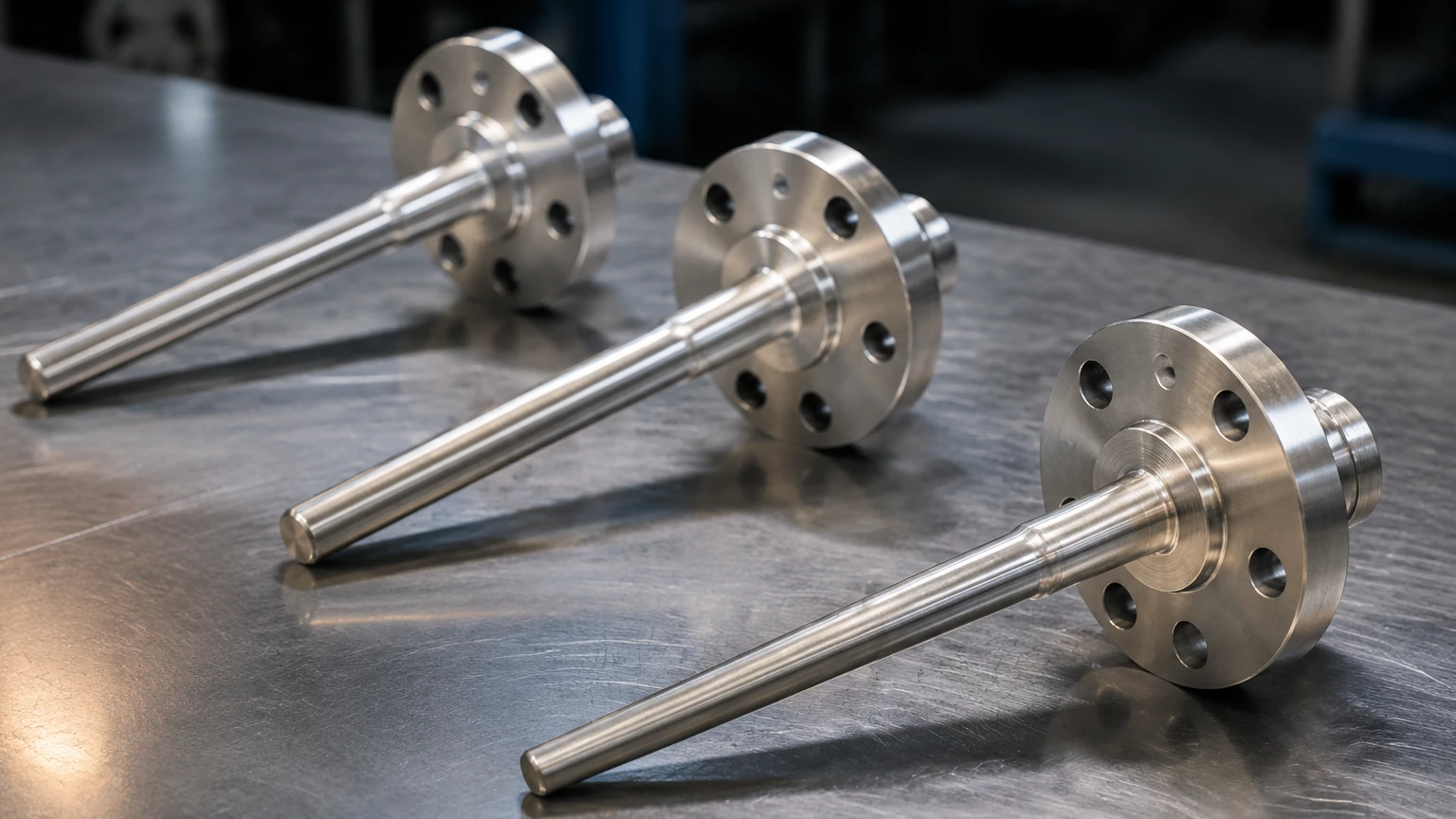
Flanged thermowells are categorized by their shank construction, which determines how they interact with the fluid flow. The choice of shank style affects the wake frequency and the mechanical strength of the assembly.
Straight Shank
This design maintains a consistent diameter along the entire insertion length (U-length). It is the simplest to manufacture and provides robust protection, but it has a higher mass, leading to a slower response time and higher drag in high-velocity flows.
Stepped Shank
A stepped thermowell has a larger diameter at the base (near the flange) and a reduced diameter at the tip (near the sensor). This reduction in mass at the tip significantly improves the response time while maintaining structural rigidity at the point of highest stress.
Tapered Shank
Tapered designs offer a compromise between straight and stepped shanks. The diameter gradually decreases from the flange to the tip. This geometry provides a high strength-to-weight ratio and is particularly effective at shedding vortices, making it the preferred choice for high-velocity applications where wake frequency vibration is a concern.
Material Selection and Chemical Compatibility
In B2B industrial applications, the material of the thermowell must be compatible with the process media to prevent premature failure due to corrosion or erosion. Common materials include:
* Stainless Steel 316/316L: The industry standard for general-purpose applications, offering good corrosion resistance and high-temperature stability.
* Hastelloy C-276: Used in highly aggressive chemical environments, such as those involving wet chlorine gas or ferric chlorides.
* Monel 400: Ideal for applications involving sea water or hydrofluoric acid.
* Inconel 600: Specifically designed for high-temperature service where oxidation resistance is paramount.
When selecting a material, it is also vital to match the flange material to the thermowell stem. Dissimilar metals can lead to galvanic corrosion or mechanical failure at the weld point under thermal cycling.
Selection Table: Comparing Connection Types
Choosing between flanged, threaded, and welded thermowells depends on the pressure rating, maintenance requirements, and industry standards. The following table summarizes the key differences:
| Feature | Flanged Thermowell | Threaded Thermowell | Socket Weld Thermowell |
| :— | :— | :— | :— |
| Pressure Rating | High (Class 150 to 2500) | Low to Medium | Very High |
| Ease of Maintenance | Excellent (Bolt-on) | Good | Poor (Requires cutting) |
| Leak Resistance | High (Dependent on Gasket) | Moderate (NPT risks) | Highest (Permanent) |
| Typical Pipe Size | 1.5" (40mm) and larger | 0.5" to 1" (15-25mm) | 0.75" to 1.5" (20-40mm) |
| Common Industry | Oil & Gas, Chemical | HVAC, Water Treatment | Power Generation, Steam |
Wake Frequency and Structural Integrity
One of the most critical aspects of flanged thermowell engineering is the Wake Frequency Calculation (WFC). When a fluid flows past a thermowell, it creates a wake—a series of vortices known as the Von Karman vortex street. If the frequency of these vortices matches the natural frequency of the thermowell, resonance occurs. This can lead to catastrophic fatigue failure in a matter of hours.
Standard ASME PTC 19.3 TW provides the mathematical framework for evaluating thermowell suitability. It considers:
* Static Stress: The pressure of the process fluid.
* Dynamic Stress: The vibration caused by fluid flow.
* Resonance: Ensuring the wake frequency does not exceed 80% of the thermowell's natural frequency.
For high-velocity steam or oil pipelines, a tapered flanged thermowell with a shorter insertion length is often required to pass PTC 19.3 TW requirements.
Installation Guidelines for Industrial Applications
Proper installation is as important as proper design. A poorly installed flanged thermowell can result in inaccurate readings or mechanical failure.
1. Insertion Length (U-Length): For liquids, the thermowell should extend at least 5 to 8 times its diameter into the process. For gases, 10 to 15 times the diameter is recommended to overcome stem conduction error (where heat travels up the thermowell wall to the ambient air).
2. Orientation: In piping, thermowells are ideally installed in an elbow, pointing upstream. If installed in a straight run, they should be perpendicular to the flow. In large tanks, they should be positioned away from agitators or fill streams to avoid mechanical impact.
3. Gasket Selection: The gasket used between the process flange and the thermowell flange must be compatible with the process temperature and pressure. Spiral-wound gaskets are common in high-pressure steam, while PTFE gaskets are used in chemical processing.
4. Insulation: The external portion of the flange and the connection head should be insulated to prevent heat loss, which can cause the sensor to read lower than the actual process temperature.
Relationship with Level Measurement Systems
While thermowells are temperature-focused, they play a supporting role in precision level measurement. In many industrial tanks, the density of the liquid changes significantly with temperature. For hydrostatic level transmitters, which calculate level based on pressure (P = ρgh), an accurate temperature reading is required to compensate for changes in density (ρ).
Furthermore, in radar or ultrasonic level applications, temperature gradients in the vapor space can affect the speed of the signal. By using flanged thermowells to house accurate temperature sensors at multiple points in a vessel, operators can ensure that their level measurement data is corrected for environmental variables. Professionals looking to integrate these technologies can Review product options and application support on the Welk Main Page to find compatible instrumentation suites.
Maintenance and Troubleshooting
Flanged thermowells are generally low-maintenance, but they should be inspected during scheduled plant turnarounds. Key areas of focus include:
* Erosion and Pitting: Check the leading edge of the thermowell for signs of material loss, especially in abrasive slurries.
* Corrosion: Look for discoloration or "necking" near the flange weld, which may indicate stress corrosion cracking.
* Scale Buildup: In water treatment or lime applications, calcium deposits can insulate the thermowell, leading to extremely slow response times. These must be mechanically or chemically removed.
* Sensor Fit: Ensure the temperature sensor is bottomed out in the thermowell. If there is an air gap at the tip, the reading will be inaccurate. Using thermal transfer paste can help, though it is not always recommended for high-temperature applications.
Frequently Asked Questions
Q: Can I use a flanged thermowell in a pipe smaller than 3 inches?
A: Yes, but it often requires a "pipe tee" expansion or an elbow installation. If a flanged thermowell is placed in a small pipe, it may restrict flow (causing a pressure drop) or be subject to excessive fluid velocity.
Q: What is the difference between a "Van Stone" thermowell and a standard flanged thermowell?
A: A standard flanged thermowell has the flange welded to the stem. A Van Stone thermowell features a shank that passes through a lap-joint flange. This allows the flange to rotate for easier bolt-hole alignment and is often used in high-pressure applications where a full-penetration weld might be a point of weakness.
Q: How do I determine the correct flange rating?
A: The flange rating (e.g., Class 150, 300, 600) must match or exceed the pressure rating of the process piping and the vessel. This is governed by ASME B16.5 standards. Always consult the piping specification for the specific project.
Q: Why use a flanged connection instead of a threaded one?
A: Flanged connections are preferred in high-pressure, high-temperature, and hazardous chemical applications. They provide a more reliable seal, are easier to remove for inspection, and do not suffer from the "galling" or cross-threading issues common with large NPT connections.
Conclusion
Flanged thermowells are indispensable components for industrial process safety and accuracy. By providing a rugged interface for temperature sensors, they allow for continuous monitoring in the harshest environments. Whether you are managing a chemical reactor, a steam boiler, or a large-scale storage tank, selecting the right thermowell geometry and material is vital for operational success. For more information on how temperature integration improves the accuracy of level measurement systems, visit the Main Page for technical specifications and engineering support.