Fluid Level Switch
Fluid Level Switch
In the landscape of industrial process control, the fluid level switch serves as a fundamental component for safety, automation, and inventory management. Unlike continuous level transmitters that provide a constant stream of data regarding the exact volume or height of a liquid, a fluid level switch is a point-level detection device. Its primary function is to trigger a discrete output—typically an electrical signal—when a liquid reaches a specific threshold within a tank, vessel, or pipe. This signal is then used to actuate pumps, open or close valves, or trigger alarms to prevent overfill or dry-run conditions.
Selecting the appropriate fluid level switch requires an engineering-led approach that considers the physical properties of the media, the environmental conditions of the process, and the specific mechanical constraints of the installation site. As a professional manufacturer, Welk provides a range of measurement technologies designed to meet these diverse industrial needs, from water treatment to high-pressure chemical processing.
Understanding Fluid Level Switch Measurement Principles
Before selecting a device, it is essential to understand the underlying physics that govern different switching technologies. Each principle offers distinct advantages and faces specific limitations based on the fluid's characteristics.
1. Buoyancy-Based Float Switches
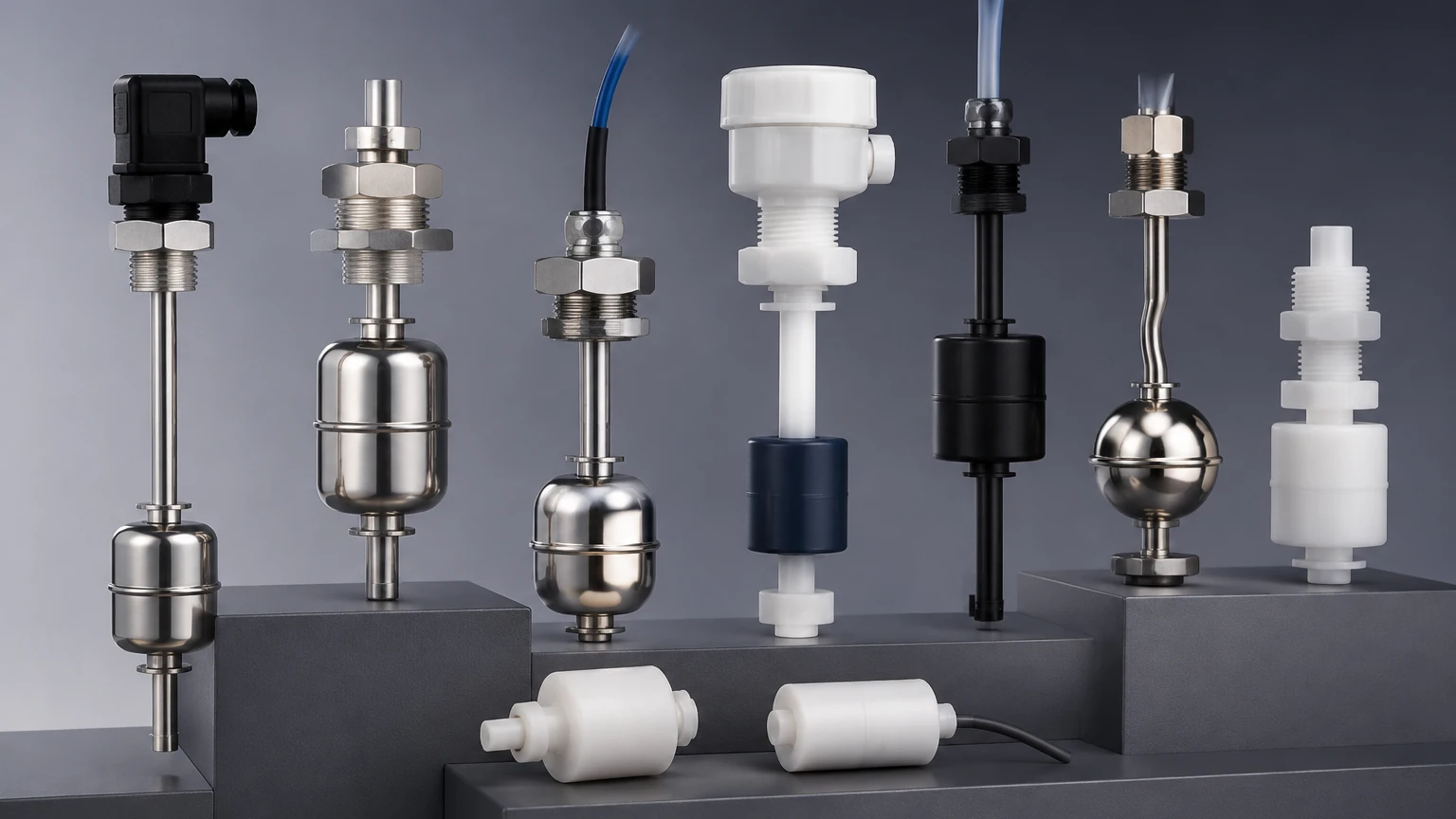
The float switch is perhaps the most traditional form of fluid level detection. It operates on the principle of buoyancy, where a float—constructed from a material less dense than the liquid—moves vertically along a stem or pivots on a hinge as the liquid level changes. Inside the float or the stem is a permanent magnet. When the float reaches a predetermined point, the magnetic field actuates a hermetically sealed reed switch.
* Advantages: Simple, low cost, and requires no external power for the sensing element itself.
* Limitations: Susceptible to mechanical wear and fouling. It is generally not recommended for high-viscosity liquids or fluids containing debris that could jam the moving parts.
2. Vibrating Tuning Fork Switches
Vibrating level switches utilize a tuning fork-shaped sensing element that is piezoelectrically energized to vibrate at its natural resonant frequency in the air. When the fork is submerged in a liquid, the frequency of vibration shifts due to the increased density of the surrounding medium. An internal electronic circuit detects this frequency change and converts it into a switching signal.
* Advantages: Highly reliable, unaffected by bubbles, foam, or vibration in the tank. It is suitable for a wide range of liquids and slurries.
* Limitations: While robust, heavy coating or build-up between the tines of the fork can lead to false readings if the material is not self-cleaning.
3. Capacitive Level Switches
Capacitance switches operate based on the electrical property of capacitance. The sensor probe and the tank wall (or a second reference probe) act as the two plates of a capacitor. The liquid acts as the dielectric material. As the fluid level rises and covers the probe, the dielectric constant changes, causing a measurable shift in capacitance. This change is processed to trigger the switch.
* Advantages: No moving parts, suitable for high temperatures and pressures, and can be used with both conductive and non-conductive liquids.
* Limitations: Accuracy depends on the dielectric constant remaining relatively stable. Significant build-up on the probe can interfere with the measurement.
4. Conductive Level Switches
Conductive switches are designed specifically for conductive liquids like water, acids, and alkalis. The system uses a low-voltage, low-current circuit between two or more electrodes. When the conductive liquid touches the electrodes, it completes the circuit, triggering the switch.
* Advantages: Extremely simple and cost-effective for basic water-based applications.
* Limitations: Cannot be used with non-conductive fluids like oils or hydrocarbons. Electrodes may suffer from corrosion or scaling over time.
5. Optical Level Switches
Optical switches utilize an infrared LED and a phototransistor. The sensor head is typically a conical prism. In air, the infrared light is reflected within the prism back to the receiver. When the prism is immersed in liquid, the light is refracted into the fluid, causing the receiver to detect a loss of signal, which triggers the switch.
* Advantages: Extremely compact, no moving parts, and very fast response times.
* Limitations: Not suitable for liquids that leave a thick coating on the prism or for fluids with high turbidity that might scatter the light prematurely.
6. Ultrasonic Level Switches
Ultrasonic point level switches use a pair of crystals (transmitter and receiver) separated by a small gap. The transmitter sends an ultrasonic signal across the gap. If the gap is filled with air, the signal is too weak to reach the receiver. When liquid fills the gap, the signal is transmitted efficiently, triggering the switch.
* Advantages: Non-contact options available; highly effective for clean liquids.
* Limitations: Can be affected by heavy foam or high-density vapors in the gap.
Technical Selection Criteria
Choosing the right fluid level switch involves matching the technology to the application's specific parameters. The following table provides a general guideline for technology selection based on common industrial variables.
| Technology | Media Type | Viscosity Limit | Max Temp (Typical) | Pressure Resistance | Maintenance Level |
| :— | :— | :— | :— | :— | :— |
| Float | Clean Liquids | Low | 120°C (248°F) | Medium | Moderate |
| Tuning Fork | Liquids/Slurries | Medium-High | 150°C (302°F) | High | Low |
| Capacitive | Most Liquids | Medium | 200°C+ (392°F+) | Very High | Moderate |
| Conductive | Conductive Only | Low | 100°C (212°F) | Low-Medium | Moderate |
| Optical | Clean Liquids | Low | 85°C (185°F) | Medium | Low |
| Ultrasonic | Clean/Aerated | Low | 100°C (212°F) | Medium | Low |
Media Considerations
The chemical compatibility of the wetted parts is paramount. For corrosive fluids, stainless steel (316L), PTFE, or PP (Polypropylene) housings are often required. Furthermore, the density of the fluid must be checked against the float's buoyancy or the tuning fork's sensitivity settings. For example, a float designed for water (density 1.0 g/cm³) may not function in light hydrocarbons (density 0.6–0.7 g/cm³).
Process Conditions
Process temperature and pressure are critical boundaries. High-pressure vessels often require magnetic level gauges or heavy-duty capacitive switches. Temperature extremes can affect the electronics of the switch, necessitating remote-mounted electronics or specialized cooling fins for the sensor head.
Installation Considerations and Best Practices
Proper installation is as important as technology selection. Even the most advanced fluid level switch will fail if positioned incorrectly within the process vessel.
1. Avoid the Fill Stream: Never install a level switch directly beneath a liquid inlet. The turbulence and force of the incoming fluid can cause false triggers or mechanical damage to the sensor.
2. Orientation: Most tuning fork and capacitive switches can be mounted horizontally (side-mount) or vertically (top-mount). However, for horizontal mounting, the tines of a tuning fork should be oriented vertically so that liquid can easily drain off them, preventing "bridging" or false detection.
3. Dead Zones and Nozzles: Ensure the sensing element extends far enough into the tank to clear any mounting nozzles. If a sensor is recessed within a narrow nozzle, liquid may become trapped due to surface tension, leading to a "stuck" high-level alarm.
4. Turbulence and Agitation: In tanks with agitators, use stilling wells for float switches to prevent the float from bouncing. For non-mechanical switches, ensure the sensor is mounted away from the vortex created by the agitator.
5. Wiring and Protection: Use appropriate cable glands to maintain the IP (Ingress Protection) rating of the housing. In hazardous environments, ensure the switch is certified (e.g., ATEX or IECEx) and installed with the correct intrinsic safety barriers.
For a comprehensive overview of available hardware and technical specifications, engineers should Review product options and application support on our Main Page.
Common Risks and Limitations
While fluid level switches are highly reliable, certain environmental factors can introduce risks to the measurement accuracy:
* Build-up and Coating: In applications involving wastewater or chemical resins, material can accumulate on the sensor. Tuning forks and capacitive probes are sensitive to this. Selecting a switch with a "coating rejection" feature or a self-cleaning design is vital in these scenarios.
* Foam and Bubbles: Foam can be interpreted as liquid by some technologies (like ultrasonic or optical) while being ignored by others (like buoyancy-based floats). If the goal is to detect the liquid surface *under* the foam, a float or a tuning fork with adjusted sensitivity is often preferred.
* Electromagnetic Interference (EMI): Electronic switches, particularly capacitive and ultrasonic types, can be affected by nearby heavy machinery or variable frequency drives (VFDs). Shielded cabling and proper grounding are essential mitigation strategies.
Frequently Asked Questions (FAQs)
Q: Can a fluid level switch be used for continuous measurement?
A: No. A level switch only provides a point-level signal (e.g., tank is 90% full). For continuous data (e.g., tank is 42.5% full), you must use a level transmitter, such as a radar or hydrostatic pressure sensor.
Q: What is the difference between a NORMALLY OPEN (NO) and NORMALLY CLOSED (NC) switch?
A: A Normally Open switch remains open (no current flow) until the liquid reaches it. A Normally Closed switch remains closed (current flows) until the liquid reaches it. Many industrial switches allow the user to select the output logic during installation to ensure fail-safe operation.
Q: How do I handle liquids with varying densities?
A: If the density varies significantly, avoid buoyancy-based switches. Tuning fork or capacitive switches are generally more forgiving of density changes, provided the dielectric constant or viscosity remains within the sensor's operating range.
Q: Are there switches suitable for hygienic food and beverage applications?
A: Yes. Hygienic fluid level switches feature polished stainless steel surfaces, Tri-clamp connections, and materials that comply with FDA or 3-A standards to ensure they can be cleaned-in-place (CIP).
Conclusion
The selection of a fluid level switch is a critical decision that impacts the safety and efficiency of industrial operations. By understanding the physical principles of buoyancy, vibration, capacitance, and conductivity, engineers can specify the right tool for the job. Whether managing a simple water storage tank or a complex chemical reactor, the right switch ensures that processes remain within their intended boundaries. For detailed technical guidance and to explore the full range of industrial level measurement instruments, visit our Main Page to find the solution that fits your specific application requirements.