Food Manufacturing Efficiency
Food Manufacturing Efficiency
In the modern industrial landscape, food manufacturing efficiency is no longer just a metric of production speed; it is a comprehensive measure of resource optimization, waste reduction, and consistent product quality. For process engineers and plant managers, achieving high efficiency requires precise control over every stage of the production cycle. Central to this control is the accurate measurement of raw materials, intermediate batches, and finished liquid products.
Level measurement instruments play a critical role in automating these processes. By providing real-time data on tank levels, these sensors prevent costly overflows, eliminate dry-run damage to pumps, and ensure that inventory management is based on factual data rather than estimates. As a professional manufacturer, Welk provides a range of industrial level measurement instruments designed to meet the rigorous demands of food-grade environments, helping facilities reach their peak operational potential.
Understanding Measurement Principles for Food-Grade Applications
Before selecting a sensor to improve food manufacturing efficiency, it is essential to understand the physical principles governing different measurement technologies. Each method has distinct advantages depending on the physical properties of the food or beverage being processed.
Radar Level Measurement (Non-Contact)
Radar level meters operate on the Time-of-Flight (ToF) principle. The sensor emits high-frequency microwave pulses (typically in the 26GHz or 80GHz range) that travel at the speed of light. When these pulses hit the surface of the medium, they are reflected back to the antenna. The instrument calculates the distance based on the time interval between transmission and reception.
In food processing, radar is highly valued because it is non-contact. This means the sensor does not touch the product, reducing the risk of contamination. Furthermore, radar is largely unaffected by changes in temperature, pressure, or the presence of vapors and dust, which are common in cooking or mixing vessels.
Ultrasonic Level Measurement
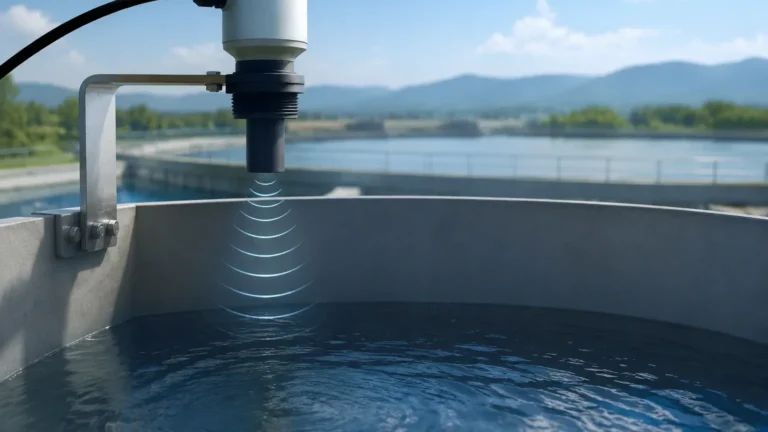
Ultrasonic sensors also use the ToF principle but utilize sound waves instead of microwaves. The sensor emits an ultrasonic pulse that reflects off the liquid surface. The time taken for the echo to return is proportional to the distance.
While cost-effective, ultrasonic measurement is sensitive to air temperature and turbulence. In food manufacturing, these are best suited for water treatment processes or storage of stable liquids at ambient temperatures where high-precision radar might be over-engineered.
Hydrostatic Level Measurement
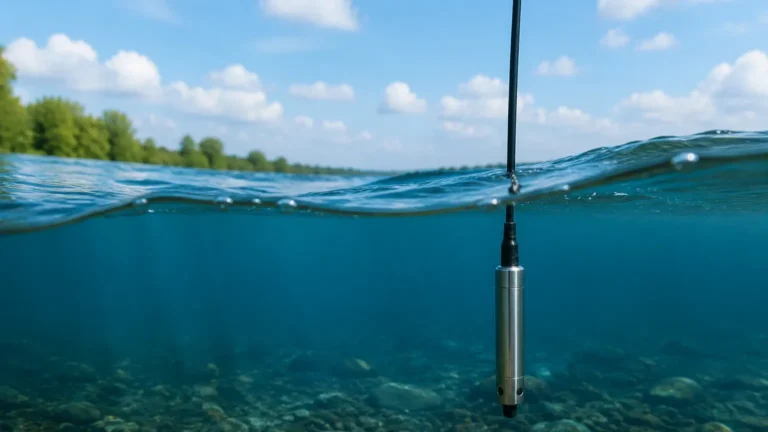
Hydrostatic transmitters measure the pressure exerted by a liquid column at the bottom of a tank. Since pressure is directly proportional to the height of the liquid and its density ($P = \rho \cdot g \cdot h$), the level can be accurately calculated. For food applications, these sensors must feature flush diaphragms to prevent food particles from clogging the sensing element, ensuring they remain CIP (Clean-in-Place) compatible.
Magnetic Level Gauges
Magnetic gauges utilize a float containing a permanent magnet that moves with the liquid level inside a bypass chamber. Outside the chamber, magnetic flaps or a tracker move in response to the float. This provides a clear, highly visible local indication without requiring a power source, making it an excellent secondary safety system for large storage silos.
Technology Selection for Food Manufacturing Efficiency
Choosing the right technology is the first step toward optimizing a production line. The following table provides a comparison of common technologies used to enhance food manufacturing efficiency through better level control.
| Technology | Typical Accuracy | Operating Range | Key Advantage in Food Processing |
| :— | :— | :— | :— |
| 80GHz Radar | ±1 mm to ±2 mm | Up to 30m (98ft) | Unaffected by steam, foam, or agitators; high precision. |
| Ultrasonic | ±0.25% of range | 0.3m – 15m (1ft – 49ft) | Cost-effective for non-volatile liquids like water. |
| Hydrostatic | ±0.1% to ±0.5% | 1m – 200m (3ft – 656ft) | Excellent for deep tanks and pressurized vessels. |
| Magnetic Gauge | ±5 mm to ±10 mm | 0.3m – 6m (1ft – 20ft) | Visual fail-safe; no power required for local reading. |
| Level Switches | N/A (Point level) | Fixed point | Prevents overfill and pump cavitation. |
When evaluating these options, engineers should consult the Main Page of specialized manufacturers to review specific model specifications and chemical compatibility charts.
Practical Selection Criteria for Food Environments
To maximize food manufacturing efficiency, the selection of level instruments must go beyond basic measurement. The following criteria are vital for the food and beverage industry:
1. Hygienic Design: Sensors must be constructed from food-grade materials, typically 316L stainless steel. They must feature smooth surfaces (Ra < 0.8 μm) to prevent bacterial growth.
2. CIP/SIP Compatibility: Instruments must withstand Clean-in-Place (CIP) and Steam-in-Place (SIP) cycles. This involves exposure to caustic cleaning agents and temperatures often exceeding 120°C (248°F).
3. Process Connections: Standard threaded connections are often avoided in favor of Tri-clamp, Varivent, or hygienic flange connections to ensure there are no "dead spaces" where product can stagnate.
4. Media Characteristics: Does the liquid foam? Is it highly viscous like honey, or does it contain solids like fruit pulp? Radar is generally superior for foaming liquids, while hydrostatic sensors are excellent for consistent, high-viscosity fluids.
Installation and Engineering Considerations
Even the most advanced sensor will fail to deliver food manufacturing efficiency if installed incorrectly. Proper engineering at the installation phase prevents signal interference and maintenance headaches.
Avoiding Obstructions
For radar and ultrasonic sensors, the "beam angle" is a critical factor. The sensor should be mounted away from the tank wall and clear of internal obstructions such as agitator blades, heating coils, or ladders. If an agitator is present, radar units with advanced "false echo suppression" software should be used to filter out the signal from the moving blades.
Nozzle Geometry
The mounting nozzle should be kept as short as possible. Long, narrow nozzles can create "ringing" or internal reflections that interfere with the sensor’s ability to detect the true liquid level, especially when the tank is nearly full.
Environmental Protection
In wash-down environments, sensors should have a minimum ingress protection rating of IP67, though IP69K is preferred. This ensures that high-pressure, high-temperature cleaning sprays do not penetrate the electronics housing.

Limitations and Process Challenges
While modern instrumentation is highly capable, certain physical limitations must be acknowledged to maintain food manufacturing efficiency.
* Heavy Foam: Thick, dense foam can absorb ultrasonic signals and some radar frequencies. In these cases, high-frequency 80GHz radar or guided wave radar (GWR) is often necessary to penetrate the foam and reach the liquid surface.
* Rapid Temperature Changes: Sudden shifts in temperature (e.g., during a CIP cycle) can cause condensation on sensor faces. Welk radar sensors often utilize PTFE or PEEK covers that are naturally hydrophobic to shed droplets and maintain signal integrity.
* Vacuum Conditions: In vacuum-sealed processing, the boiling point of liquids changes, and vapor density can shift. Radar is the preferred technology here as it does not rely on air density for signal transmission.
Impact on Operational ROI
Investing in high-quality level measurement directly influences the bottom line. By optimizing food manufacturing efficiency, plants can see immediate returns in several areas:
* Reduced Product Loss: Accurate level monitoring ensures that tanks are filled to their maximum safe capacity without overflowing, and emptied completely to reduce residual waste.
* Energy Savings: Automation of heating and cooling cycles based on precise volume data reduces the energy required to maintain product temperature.
* Labor Efficiency: Automating level checks removes the need for manual "dipping" or visual inspections, allowing personnel to focus on higher-value tasks.
* Compliance and Safety: Automated overfill protection is a critical safety layer that prevents environmental incidents and ensures compliance with strict food safety regulations.
Frequently Asked Questions (FAQ)
Q: Can radar level meters measure dry ingredients like flour or sugar?
A: Yes. High-frequency radar is excellent for solids and powders. It can handle the dust generated during filling and accurately track the uneven surface (angle of repose) of dry bulk materials.
Q: How often do food-grade level sensors need calibration?
A: This depends on the technology and the criticality of the process. While radar and ultrasonic sensors are generally low-maintenance, hydrostatic sensors may require annual calibration to account for diaphragm wear or drift.
Q: What is the benefit of 80GHz radar over 26GHz radar in food plants?
A: 80GHz radar has a much narrower beam angle. This makes it easier to install in small tanks or tanks with internal obstructions like agitators, as the beam is less likely to hit the tank walls or internal components.
Q: Are these sensors compatible with existing PLC systems?
A: Most industrial level sensors from Welk provide standard outputs such as 4-20mA (with HART), RS485 Modbus, or Profibus, ensuring seamless integration into existing automation frameworks to drive food manufacturing efficiency.
By integrating these advanced measurement technologies, food and beverage producers can ensure their operations are as precise, safe, and efficient as possible. For detailed technical support and to explore the full range of available instrumentation, engineers are encouraged to review product options and application support on the manufacturer's official site.