High Accuracy Sanitary Flow Meter
High Accuracy Sanitary Flow Meter
In the modern landscape of industrial processing, particularly within the food, beverage, pharmaceutical, and biotechnology sectors, the precision of fluid measurement is a fundamental requirement for both quality control and regulatory compliance. A high accuracy sanitary flow meter is a specialized instrument engineered to provide precise measurement of liquid media while adhering to stringent hygienic design standards. These instruments ensure that products remain uncontaminated, batch consistency is maintained, and waste is minimized through rigorous monitoring of flow rates.
For engineers and plant managers, selecting the correct flow measurement technology involves understanding the underlying physics of the meter, the chemical properties of the fluid, and the specific sanitary requirements of the application. This guide examines the primary technologies used for high-accuracy sanitary flow measurement, their selection criteria, and practical installation considerations.
Measurement Principles of Sanitary Flow Meters
High-accuracy measurement in sanitary environments is typically dominated by two technologies: Electromagnetic (Magmeter) and Coriolis Mass Flow. Each operates on distinct physical principles that dictate their suitability for specific fluids.
Electromagnetic Flow Meters (Magmeters)
Electromagnetic flow meters operate based on Faraday’s Law of Electromagnetic Induction. This law states that a conductor moving through a magnetic field produces an electrical signal proportional to the velocity of the conductor. In this application, the conductive liquid acts as the conductor.
* The Principle: The meter consists of a non-magnetic tube lined with an insulating material. Two magnetic coils generate a magnetic field perpendicular to the flow. As the liquid flows through the tube, it generates a voltage. This voltage is picked up by two electrodes mounted in the tube wall and is directly proportional to the flow velocity.
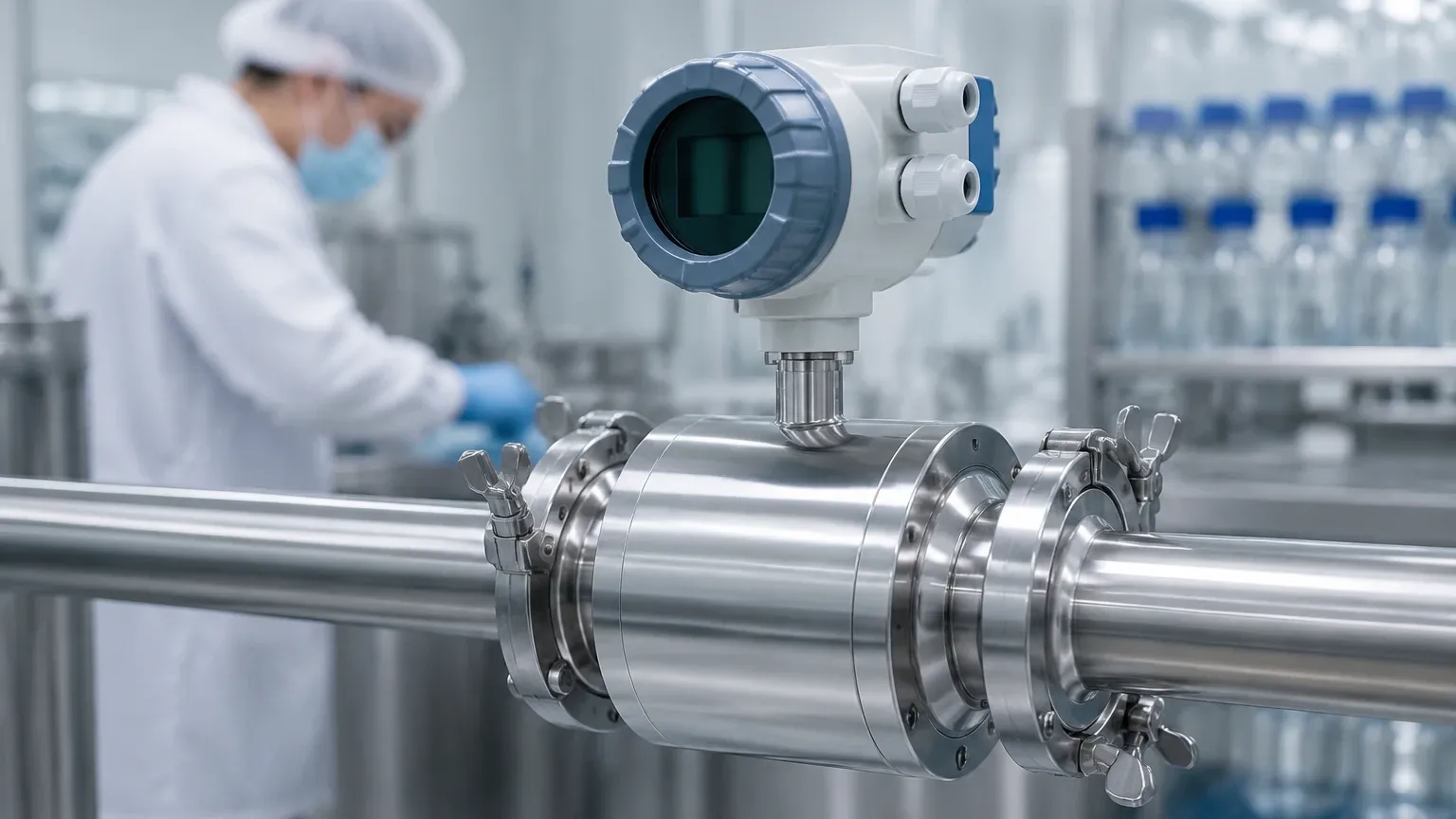
* Sanitary Advantage: Magmeters have no moving parts and no obstructions in the flow path. This "full-bore" design ensures there are no areas where bacteria can grow or where solids can become trapped, making them ideal for Clean-in-Place (CIP) and Sterilize-in-Place (SIP) processes.
Coriolis Mass Flow Meters
Coriolis meters are often considered the gold standard for accuracy because they measure mass flow directly rather than volume. This is critical in applications where the density of the fluid changes due to temperature or pressure fluctuations.
* The Principle: The meter contains one or more vibrating tubes. When a fluid flows through these vibrating tubes, it induces a Coriolis force, causing the tubes to twist. The amount of twist is directly proportional to the mass flow rate. Sensors at the inlet and outlet of the tubes measure the phase shift (time delay) between the vibrations, which the electronics convert into a mass flow reading.
* Sanitary Advantage: Like magmeters, modern sanitary Coriolis meters are designed with smooth internal surfaces and are capable of measuring not only mass flow but also density and temperature simultaneously. This multi-variable capability is highly valued in dairy and pharmaceutical blending.
Key Evaluation Criteria for Sanitary Applications
When evaluating a high accuracy sanitary flow meter, technical specifications must go beyond simple flow ranges. The following factors are critical for maintaining process integrity.
1. Material and Surface Finish
Sanitary instruments must be constructed from non-reactive, non-corrosive materials. The industry standard is Stainless Steel 316L (1.4404/1.4435). However, the internal surface finish is equally important. To prevent microbial attachment, the wetted surfaces must be polished to a specific roughness average (Ra). For most sanitary applications, an Ra ≤ 0.8 μm is required, often achieved through mechanical polishing or electropolishing.
2. Certifications and Compliance
In B2B industrial procurement, compliance is non-negotiable. Essential certifications include:
* 3-A Sanitary Standards: A US-based standard focused on the design and fabrication of equipment for the dairy and food industries.
* EHEDG (European Hygienic Engineering & Design Group): Provides guidelines for hygienic design to prevent contamination.
* FDA Compliance: Ensures that all wetted parts (liners, gaskets, electrodes) are made from materials recognized as safe for food and drug contact.
3. Accuracy and Repeatability
Accuracy is typically expressed as a percentage of the measured value (e.g., ±0.5% of rate). Repeatability, the ability of the meter to provide the same result under identical conditions, is often more critical for batch consistency. For a high accuracy sanitary flow meter, expect accuracy levels of ±0.2% to ±0.5% for electromagnetic models and as high as ±0.1% for Coriolis models.
Technology Selection Table
The following table provides a comparison of the two leading high-accuracy technologies used in sanitary environments.
| Feature | Electromagnetic (Magmeter) | Coriolis Mass Flow Meter |
| :— | :— | :— |
| Primary Measurement | Volumetric Flow | Mass Flow |
| Typical Accuracy | ±0.2% to ±0.5% of rate | ±0.1% to ±0.2% of rate |
| Fluid Requirements | Must be conductive (>5 μS/cm) | Any liquid or gas |
| Moving Parts | None | None (vibrating tubes) |
| Pressure Drop | Negligible (Full bore) | Low to Moderate (Tube geometry) |
| Viscosity Impact | Minimal | Minimal |
| Common Applications | Water, milk, juice, beer | Oils, syrups, chemicals, dosing |
| Relative Cost | Moderate | High |
Installation Considerations
Even the most advanced high accuracy sanitary flow meter will underperform if installed incorrectly. Engineering teams must adhere to the following guidelines to ensure specified accuracy.
Piping and Orientation
* Straight Pipe Runs: Electromagnetic meters generally require a straight run of pipe before (upstream) and after (downstream) the meter to ensure a stable flow profile. A common rule is 5D (five times the pipe diameter) upstream and 2D downstream. Coriolis meters are generally less sensitive to flow profiles but should still be installed according to manufacturer specifications to avoid turbulence.
* Orientation: To ensure the meter remains full of liquid (a requirement for accuracy), vertical installation with upward flow is often preferred. If installed horizontally, the meter should be placed at a low point in the piping, and for magmeters, the electrodes should be in a horizontal plane to prevent interference from air bubbles or sediment.
Grounding and Interference
For electromagnetic meters, proper grounding is essential. Because the meter measures micro-volt signals, any stray electrical noise in the piping can lead to significant measurement errors. Grounding rings or specific grounding electrodes are used to ensure the fluid and the meter are at the same electrical potential.
Cleaning and Maintenance
In sanitary environments, the meter must withstand CIP (Clean-in-Place) and SIP (Sterilize-in-Place) cycles. These processes involve high temperatures (up to 140°C/284°F) and aggressive chemical cleaning agents (caustics and acids). The meter’s liner (for magmeters) and seals must be rated for these conditions. Regular calibration is also necessary to maintain high accuracy over the instrument's lifecycle.
Limitations and Common Risks
While high-accuracy meters are robust, they are not universal solutions. Understanding their limitations prevents costly procurement errors.
1. Conductivity (Magmeters): Electromagnetic meters cannot measure non-conductive fluids like hydrocarbons, distilled water, or alcohols. If the fluid conductivity drops below the threshold (typically 5 to 20 μS/cm), the meter will fail to provide a reading.
2. Entrained Air: Air bubbles or gas pockets in the liquid can cause significant errors in both magmeters and Coriolis meters. In Coriolis meters, "two-phase flow" can dampen the tube vibration, leading to measurement instability.
3. Vibration (Coriolis): Because Coriolis meters rely on precise tube vibrations, high levels of external plant vibration (e.g., from nearby pumps or heavy machinery) can interfere with the sensor signal if the meter is not properly decoupled or mounted.
4. Cost vs. Benefit: While Coriolis meters offer the highest accuracy, their capital cost is significantly higher than magmeters. For applications where volumetric measurement is sufficient and the liquid is conductive, a magmeter often provides the best return on investment.
Industrial Context: Level and Flow Integration
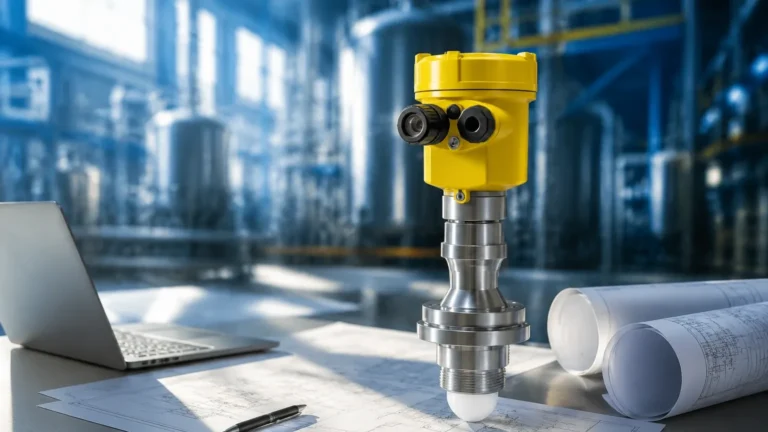
In many industrial automation setups, flow measurement is used in conjunction with level measurement to provide a complete picture of process efficiency. While flow meters track the movement of product through pipes, level sensors—such as those manufactured by Welk—monitor the inventory within tanks and vessels. Welk provides a range of industrial level measurement instruments, including radar level meters and ultrasonic sensors, which are often used alongside flow meters in water treatment and chemical processing. For more information on integrated measurement solutions, you can visit the Main Page.
Frequently Asked Questions (FAQ)
Q: Can a sanitary flow meter be used for steam measurement?
A: Standard electromagnetic and Coriolis sanitary flow meters are designed for liquids. For steam measurement, vortex flow meters or specialized differential pressure meters are typically used, though these often have different sanitary ratings.
Q: How often should a high accuracy sanitary flow meter be calibrated?
A: Calibration frequency depends on the criticality of the process and regulatory requirements (such as FDA or ISO standards). Most facilities perform an annual wet calibration or an on-site verification using a master meter.
Q: What is the difference between a "sanitary" meter and a "standard" industrial meter?
A: The primary differences are the materials of construction (316L SS), the internal surface finish (Ra < 0.8 μm), the absence of crevices where bacteria can grow, and the use of hygienic process connections like Tri-clamps instead of standard flanges.
Q: Do Coriolis meters require straight pipe runs?
A: Generally, Coriolis meters are immune to flow profile distortions and do not require the long straight runs necessitated by magmeters or turbine meters. However, they should be installed in a way that prevents air entrapment and mechanical stress on the sensor tubes.
Conclusion
Selecting a high accuracy sanitary flow meter requires a balance between technical performance and hygienic safety. Electromagnetic meters offer a cost-effective, obstruction-free solution for conductive liquids, while Coriolis meters provide unmatched mass-flow precision for a wider variety of fluids. By adhering to proper installation practices and ensuring compliance with standards like 3-A and EHEDG, industrial operators can ensure long-term reliability and product quality. For engineers looking to complement their flow systems with professional level measurement technology, reviewing the options available on the Main Page of specialized manufacturers like Welk is a recommended next step in system design.