High Pressure Coriolis Flow Meter
High Pressure Coriolis Flow Meter
In the landscape of industrial process control, the requirement for precise mass flow measurement under extreme conditions is a recurring challenge. A high pressure coriolis flow meter represents one of the most sophisticated solutions for these environments, providing direct mass flow, density, and temperature readings without the need for additional compensation. As industries such as oil and gas, chemical processing, and hydrogen refueling move toward higher operating pressures to increase efficiency and storage capacity, understanding the technical nuances of these instruments becomes critical for engineering teams.
Understanding the Coriolis Measurement Principle
Before evaluating specific high-pressure models, it is essential to understand the fundamental physics that allow a Coriolis meter to function. Unlike volumetric flow meters (such as turbine or ultrasonic meters), which measure the space fluid occupies, a Coriolis meter measures the actual mass of the fluid moving through the system.
The Coriolis Effect
The measurement is based on the Coriolis effect, an inertial force described by Gustave-Gaspard Coriolis in the 19th century. In a typical meter, the fluid passes through one or two vibrating tubes. These tubes are driven to oscillate at their resonant frequency by an electromagnetic drive coil.
When there is no flow, the tubes vibrate in a uniform, symmetrical manner. However, when fluid begins to flow, the mass of the fluid moving through the vibrating tubes generates a Coriolis force. This force acts in opposite directions on the inlet and outlet sides of the tube, causing a slight "twist" or phase shift in the vibration cycle.
Phase Shift and Mass Flow
Sensors (pick-off coils) located at the inlet and outlet of the tubes detect this phase shift. The time delay between the two signals is directly proportional to the mass flow rate. Because mass is an intrinsic property that does not change with pressure or temperature, the Coriolis meter provides an exceptionally stable and accurate measurement, even when the fluid's physical properties are fluctuating.
Density and Temperature Integration
In addition to mass flow, the resonant frequency of the tube vibration changes depending on the density of the fluid. A denser fluid increases the mass of the vibrating system, lowering the frequency. By measuring this frequency, the meter can calculate real-time density. Integrated RTD (Resistance Temperature Detector) sensors monitor the tube temperature to compensate for changes in material elasticity and provide a third process variable.
Engineering Challenges in High-Pressure Applications
Designing a high pressure coriolis flow meter involves a complex balance between structural integrity and measurement sensitivity. Standard Coriolis meters often operate at pressures up to 40 bar (580 psi) or 100 bar (1,450 psi). However, specialized high-pressure applications—such as chemical injection in subsea oil wells or high-pressure gas storage—require ratings exceeding 345 bar (5,000 psi), 700 bar (10,150 psi), or even 1,000 bar (14,500 psi).
Material Selection and Wall Thickness
To withstand high internal pressures, the flow tubes must be constructed with thicker walls. However, increasing the wall thickness makes the tubes more rigid, which reduces the magnitude of the phase shift generated by the Coriolis force. To maintain accuracy, engineers must use high-strength materials such as 316L Stainless Steel, Hastelloy C22, or Titanium. These materials offer the necessary tensile strength while maintaining enough flexibility to allow for detectable vibration.
Secondary Containment
Safety is paramount in high-pressure systems. Most high-pressure Coriolis meters include a secondary containment vessel—a rugged outer housing designed to contain the process fluid in the event of a primary tube failure. This housing is often pressure-rated and may include a burst disc or a vent to safely manage a leak.
Sensor Geometry
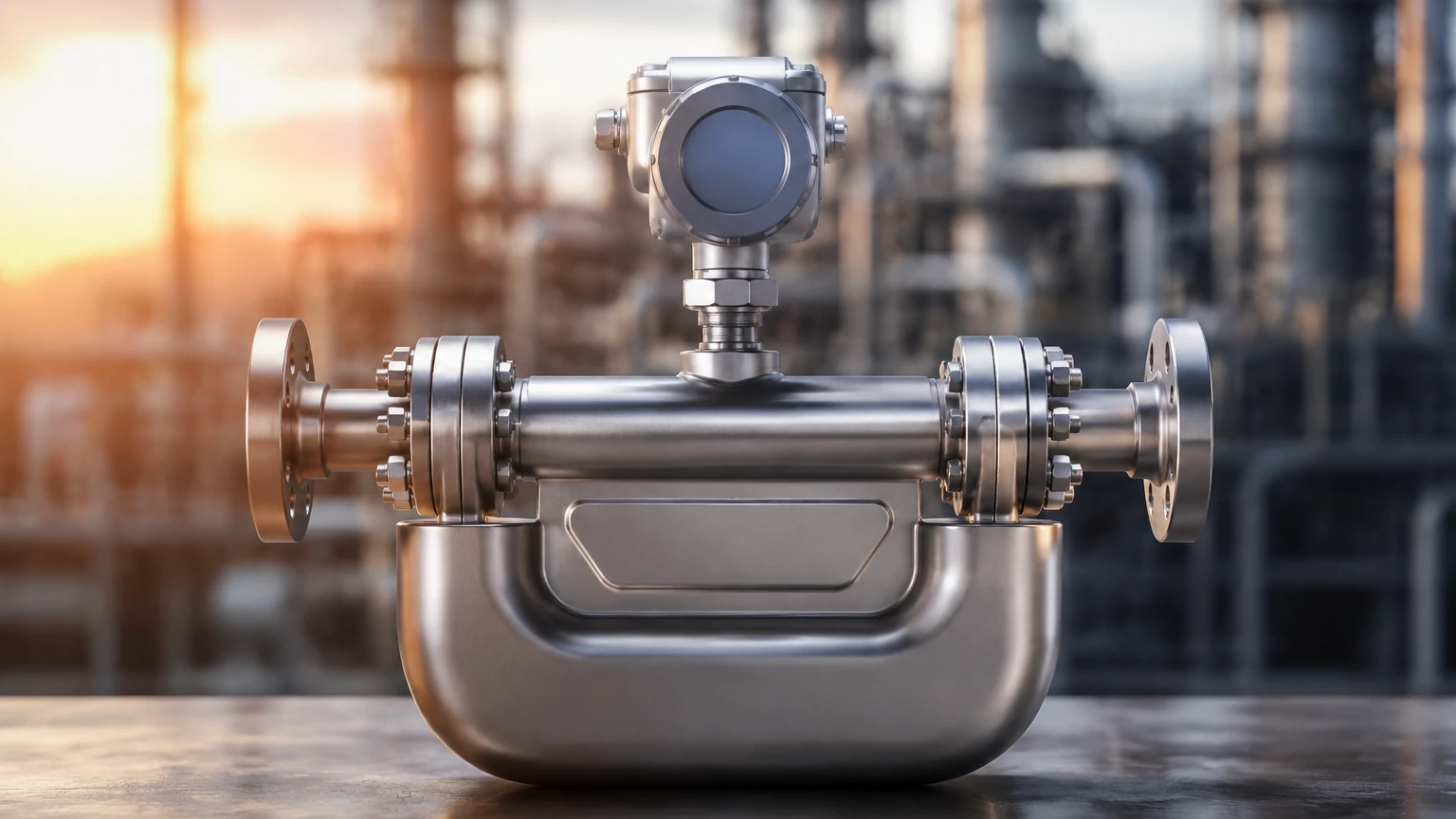
High-pressure meters often utilize a U-shaped or curved tube design. Curved tubes are generally more sensitive to the Coriolis force than straight tubes, allowing for better measurement resolution even when the tube walls are thick. However, straight-tube designs are sometimes preferred for high-pressure applications involving slurry or fluids that require easy cleaning (CIP), though they are more susceptible to thermal expansion stresses.
Key Selection Criteria for High Pressure Coriolis Flow Meters
When selecting an instrument for a high-pressure application, engineers must look beyond the basic pressure rating. The following table provides a framework for evaluating different performance tiers typically found in the industry.
| Feature | Standard Industrial | High Pressure Tier 1 | Ultra-High Pressure |
| :— | :— | :— | :— |
| Pressure Range | Up to 100 bar (1,450 psi) | 100 to 414 bar (6,000 psi) | 414 to 1,035+ bar (15,000+ psi) |
| Typical Accuracy | 0.1% to 0.2% | 0.1% to 0.5% | 0.5% to 1.0% |
| Common Materials | 316L Stainless Steel | 316L, Hastelloy C22 | XM-19 (Nitronic 50), Titanium |
| Applications | Water, General Chemicals | Chemical Injection, Gas Lift | Hydrogen Refueling, Subsea |
| Flow Range | Broad (up to 500 t/h) | Medium (up to 50 t/h) | Low (up to 5 t/h) |
Process Fluid State
It is vital to confirm whether the fluid is a liquid, a gas, or a supercritical fluid. At high pressures, many gases reach a supercritical state where they exhibit properties of both liquids and gases. Coriolis meters are particularly well-suited for supercritical CO2 or hydrogen because they measure mass directly, bypassing the complexities of gas compressibility factors. For more information on selecting the right instrumentation for complex process conditions, engineers can review product options and application support on the Main Page.
Accuracy vs. Pressure Drop
As tube walls thicken to accommodate pressure, the internal diameter may decrease for a given flange size. This can lead to a higher pressure drop across the meter. Engineers must calculate the allowable pressure drop at maximum flow rates to ensure the meter does not cause cavitation in liquids or excessive velocity in gases.
Installation Considerations and Best Practices
The performance of a high pressure coriolis flow meter is heavily dependent on the quality of its installation. High-pressure piping systems often introduce significant mechanical stress and vibration that can interfere with the meter’s sensitive measurements.
1. Rigid Mounting: The meter should be supported by the adjacent piping, and that piping must be securely anchored to a rigid structure. This prevents external vibrations from being interpreted as a Coriolis force by the pick-off sensors.
2. Zeroing Under Pressure: Zero-point calibration is the most critical step during commissioning. For high-pressure applications, the zeroing process must be performed while the meter is filled with the process fluid at the actual operating pressure and temperature, but with zero flow. This accounts for the "pressure effect"—the slight stiffening of the tubes caused by internal pressure.
3. Orientation:
* Liquids: The meter should ideally be installed in a vertical line with flow moving upward to ensure the tubes remain full and to allow air bubbles to escape.
* Gases: The meter should be installed in a position that allows any condensed liquids to drain out of the tubes, typically with the tubes pointing upward (in a "U" configuration) or in a vertical line with downward flow.
4. Stress Isolation: Use flexible connectors or expansion loops if the piping is subject to significant thermal expansion. However, ensure these do not introduce unstable vibrations. High-pressure fittings (such as Autoclave or NPT) must be tightened to specific torque values to prevent leaks without distorting the meter body.
Limitations and Operational Boundaries
While Coriolis technology is highly versatile, it is not without limitations, especially in high-pressure contexts.
* Cost: Due to the specialized materials and thick-walled construction required for safety, high-pressure models are significantly more expensive than standard electromagnetic or vortex meters.
* Weight: High-pressure meters are heavy. A meter rated for 700 bar may weigh three to five times more than a standard meter of the same line size, requiring specialized lifting equipment and robust structural supports.
* Zero Stability: In very low flow applications at high pressure, the signal-to-noise ratio can become an issue. The "zero stability" value provided by the manufacturer defines the smallest flow rate the meter can reliably distinguish from zero. At high pressures, this value may be slightly higher due to the increased stiffness of the tubes.
* Entrained Gas: While Coriolis meters handle homogeneous fluids perfectly, the presence of entrained gas in a high-pressure liquid (or liquid droplets in a high-pressure gas) can cause "slug flow." This disrupts the vibration of the tubes and can lead to significant measurement errors or a complete loss of signal (stalling).
Frequently Asked Questions (FAQ)
Q: Does high pressure affect the calibration of a Coriolis meter?
A: Yes. Internal pressure causes a slight stiffening of the flow tubes, which can lead to a small but predictable measurement offset (the "pressure effect"). Most modern transmitters allow for a pressure compensation factor to be entered, or they can take a live feed from a pressure transmitter to automatically correct the mass flow reading.
Q: Can a high pressure coriolis flow meter measure hydrogen gas?
A: Yes, they are a preferred technology for hydrogen refueling stations. Because hydrogen is stored at extremely high pressures (350 to 700 bar) and has a very low density, Coriolis meters provide the necessary accuracy for custody transfer by measuring the mass directly.
Q: How often should the meter be recalibrated?
A: In stable applications, Coriolis meters have no moving parts and rarely drift. However, in high-pressure or corrosive environments, annual verification is recommended. Many advanced meters now offer "Smart Meter Verification" (SMV), which checks the structural integrity of the tubes and the health of the electronics without removing the meter from the process line.
Q: What is the maximum temperature for these meters?
A: Most high-pressure Coriolis meters can handle process temperatures from -200°C (-328°F) for cryogenic applications up to +200°C (392°F). Specialized models are available for even higher temperatures, though pressure ratings may be de-rated as temperature increases according to ASME or EN standards.
Conclusion
The implementation of a high pressure coriolis flow meter is a strategic decision for any facility requiring high-precision mass flow data in demanding environments. By understanding the relationship between tube mechanics and the Coriolis principle, engineers can better navigate the trade-offs between pressure resistance, material selection, and measurement accuracy. Proper installation, particularly regarding zeroing under process pressure and rigid mounting, remains the most effective way to ensure long-term reliability. For those seeking to integrate these instruments into broader industrial automation systems, consulting a professional manufacturer like Welk ensures that the selected equipment meets both the technical requirements and the safety standards of the specific application.