High Pressure Sensors
High Pressure Sensors
In the landscape of industrial automation and process control, high pressure sensors serve as critical components for ensuring safety, efficiency, and precision. Whether monitoring hydraulic systems, chemical reactors, or deep-well level applications, these instruments must withstand extreme mechanical stress while providing repeatable data. For engineering professionals, selecting the correct sensor involves a deep understanding of measurement physics, material science, and the specific demands of the operating environment.
As a professional manufacturer, Welk specializes in providing robust level and pressure measurement solutions. Understanding the nuances of high pressure sensors is essential for optimizing system performance and preventing catastrophic failures in high-stakes industrial applications.
Understanding High Pressure Sensor Measurement Principles
Before selecting a device, it is vital to understand how different technologies convert physical force into an electrical signal. High pressure sensors generally rely on the deformation of a diaphragm, but the method of detecting that deformation varies.
Piezoresistive Sensors
These sensors utilize the piezoresistive effect of semiconductors (usually silicon). When pressure is applied to the diaphragm, the electrical resistance of the integrated resistors changes.
- Mechanism: A Wheatstone bridge circuit detects these small resistance changes.
- Advantages: High sensitivity and excellent stability at low to medium-high pressures.
- Limitations: Sensitive to temperature fluctuations, requiring sophisticated compensation circuitry.
Thin-Film Strain Gauge Sensors
For extremely high pressures, thin-film technology is often preferred. In this process, the strain gauge material is sputtered directly onto a stainless steel or ceramic diaphragm at the molecular level.
- Mechanism: The molecular bond ensures that the strain gauge and the diaphragm expand and contract as a single unit.
- Advantages: Exceptional long-term stability, high resistance to vibration, and the ability to handle pressures exceeding 1,000 bar (14,500 psi).
- Limitations: Lower sensitivity compared to piezoresistive types, often requiring higher amplification.
Capacitive Sensors
Capacitive high pressure sensors measure the change in electrical capacitance between a flexible diaphragm and a fixed backplate.
- Mechanism: As the diaphragm moves under pressure, the distance between the plates changes, altering the capacitance.
- Advantages: High overpressure resistance and good accuracy in harsh chemical environments.
- Limitations: Can be sensitive to electromagnetic interference (EMI).
The Role of High Pressure Sensors in Industrial Level Measurement
While pressure sensors are often associated with pipe flow, they are fundamental to hydrostatic level measurement. In high-pressure environments, such as pressurized chemical tanks or boiler systems, the sensor must distinguish between the head pressure of the liquid and the static pressure of the gas blanket.
In deep-well applications, the hydrostatic pressure at the bottom of a 400-meter (1,312 ft) column of water reaches approximately 40 bar (580 psi). High pressure sensors used in these submersed conditions must be hermetically sealed and designed to handle the continuous mechanical load without drift. Welk’s range of hydrostatic transmitters is designed specifically to balance these requirements, ensuring accurate level readings even at great depths.
For a comprehensive overview of our full range of industrial instrumentation, including radar and ultrasonic options, you may visit the Main Page.
Critical Selection Criteria for Engineering Professionals
When evaluating high pressure sensors, engineers must look beyond the basic pressure range. The following criteria are essential for long-term reliability:
1. Pressure Range and Overpressure Rating: The sensor should have a nominal range that covers the maximum expected operating pressure. However, the "proof pressure" (the maximum pressure the sensor can withstand without permanent damage) and "burst pressure" (the pressure at which the sensor housing fails) are equally critical safety metrics.
2. Media Compatibility: The wetted parts must be compatible with the process fluid. While 316L stainless steel is standard, aggressive chemicals may require Hastelloy C-276, Monel, or Tantalum coatings.
3. Temperature Range and Compensation: High-pressure processes often involve high temperatures. Sensors must include active temperature compensation to prevent thermal drift from skewing the data.
4. Output Signals: Standard industrial outputs include 4-20 mA (current loop), 0-10 VDC, or digital protocols like HART, Modbus RS485, and CANopen for integration into PLC and SCADA systems.
5. Accuracy and Linearity: This includes the combined effects of non-linearity, hysteresis, and repeatability. For most industrial B2B applications, an accuracy of 0.25% to 0.5% Full Scale (FS) is standard, though high-precision labs may require 0.1% FS.
Practical Selection Table for Pressure Instruments
The following table provides a general guideline for selecting sensor types based on common industrial scenarios.
| Application | Typical Pressure Range | Recommended Sensor Tech | Preferred Material |
| :— | :— | :— | :— |
| Hydraulic Power Units | 0–600 bar (8,700 psi) | Thin-film Strain Gauge | 17-4 PH Stainless Steel |
| Chemical Reactors | 0–160 bar (2,320 psi) | Piezoresistive (Isolated) | Hastelloy C-276 |
| Oil & Gas Pipelines | 0–400 bar (5,800 psi) | Thin-film / Capacitive | 316L or Duplex Steel |
| Deep Well Level | 0–40 bar (580 psi) | Piezoresistive Hydrostatic | 316L SS / Titanium |
| Steam Boilers | 0–100 bar (1,450 psi) | Capacitive / Piezoresistive | 316L with Siphon |
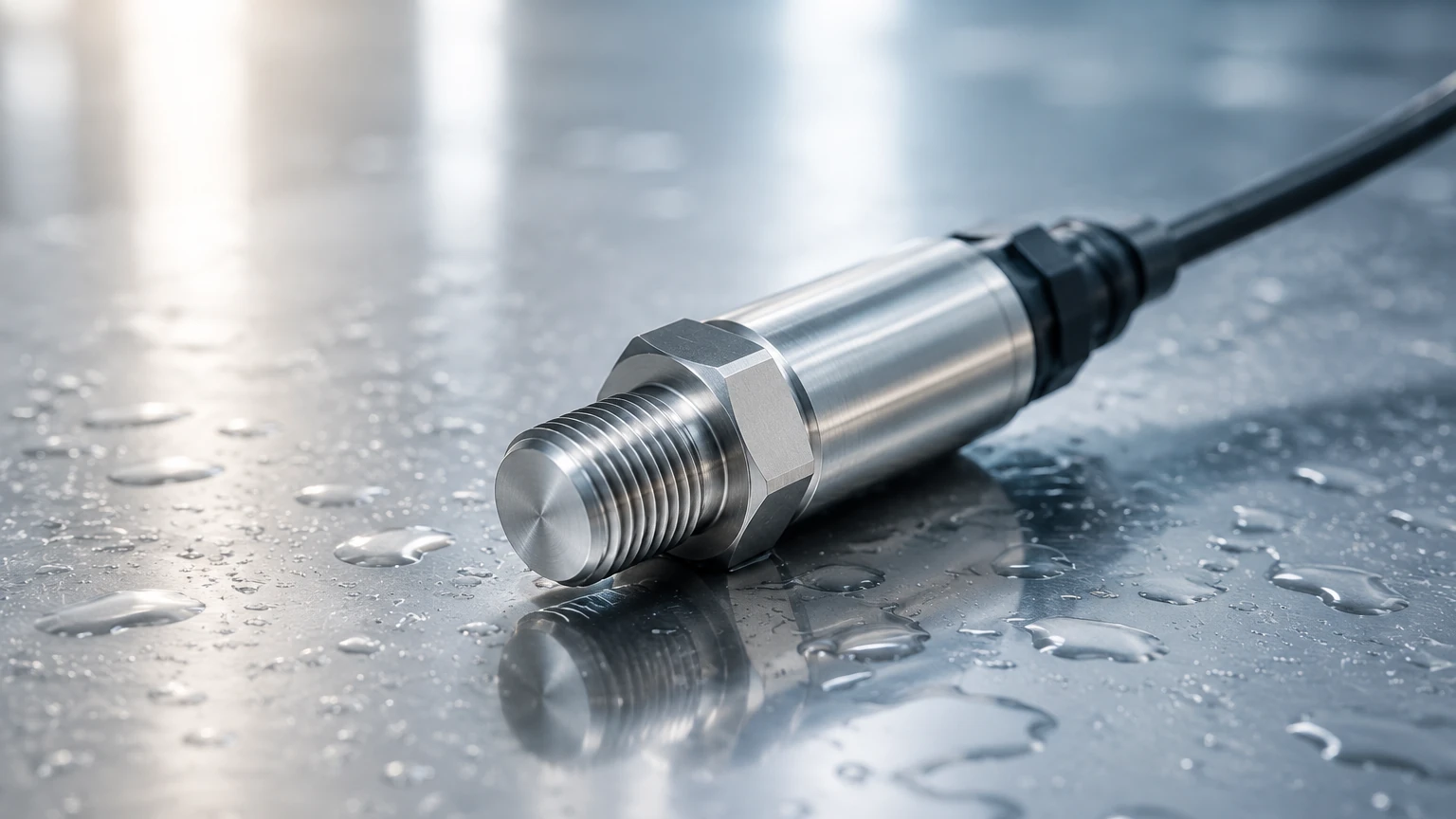
Installation and Maintenance Best Practices
Proper installation is as important as the sensor selection itself. Even the highest quality high pressure sensors will fail or provide inaccurate data if installed incorrectly.
Mounting Considerations
- Orientation: While many sensors are position-insensitive, high-accuracy sensors may show a slight zero-shift if mounted horizontally versus vertically. Always zero the sensor after installation in its final orientation.
- Pressure Snubbers: In systems prone to pressure spikes or "water hammer" (such as hydraulic lines), a pressure snubber should be installed to dampen the shock before it reaches the sensor diaphragm.
- Impulse Lines: For high-temperature gases or steam, use impulse piping or siphons to create a liquid seal, protecting the sensor from direct thermal contact.
Sealing and Threading
High-pressure applications require robust mechanical connections. Common threads include NPT (National Pipe Thread) for tapered seals or BSPP (British Standard Pipe Parallel) with an O-ring or bonded washer. Ensure that the thread sealant or O-ring material is compatible with the process temperature and chemical composition.
Electrical Protection
High pressure sensors are often located in electrically noisy environments. Use shielded cabling and ensure the sensor housing is properly grounded to prevent EMI from affecting the signal. In hazardous areas, ensure the sensor carries the appropriate ATEX or IECEx certifications for intrinsic safety (Ex i) or flameproof (Ex d) protection.
Identifying Risks and Navigating Limitations
Despite their robust design, high pressure sensors face several operational risks:
- Fatigue Failure: Continuous pressure cycling can lead to metal fatigue in the diaphragm. In high-cycle applications, selecting a sensor with a higher overpressure rating can extend its service life.
- Hydrogen Embrittlement: In high-pressure hydrogen applications, standard stainless steels can become brittle and crack. Specialized gold-plated diaphragms or specific alloys are required for these environments.
- Clogging: In viscous or slurry-filled media, the pressure port can become blocked. Flush-mount diaphragms are the preferred solution here, as they eliminate the cavity where material could collect.
- Long-term Drift: All sensors drift over time. A regular calibration schedule (typically annually) is necessary to maintain system accuracy.
Frequently Asked Questions (FAQ)
Q: What is the difference between Gauge, Absolute, and Sealed Gauge pressure?
A: Gauge pressure is referenced to the current atmospheric pressure. Absolute pressure is referenced to a perfect vacuum. Sealed Gauge pressure is referenced to a fixed pressure (usually 1 bar) sealed within the sensor, which is common for high-pressure sensors to prevent atmospheric moisture from entering the internal electronics.
Q: Can a high pressure sensor be used for vacuum measurement?
A: Some sensors are designed as "compound" sensors, capable of measuring both vacuum and positive pressure. However, a sensor specifically ranged for 400 bar will not have the resolution required to measure vacuum levels accurately.
Q: How do I protect the sensor from corrosive chemicals?
A: The most effective method is using a diaphragm seal (also known as a chemical seal). This uses a flexible membrane and a fill fluid (like silicone oil) to transmit the pressure to the sensor while keeping the corrosive media away from the sensitive instrument components.
Q: What is the typical lifespan of a high pressure sensor?
A: In a well-designed system operating within specified limits, a sensor can last 5 to 10 years. However, factors like extreme pressure spikes, excessive vibration, or corrosive environments can significantly shorten this lifespan.
Conclusion
Selecting and implementing high pressure sensors requires a balance of technical knowledge and practical experience. By understanding the underlying measurement principles and adhering to strict installation guidelines, engineering teams can ensure the safety and longevity of their industrial processes. Welk continues to support global industries with high-performance level and pressure measurement tools tailored to the most demanding conditions. For detailed product specifications and application engineering support, please refer to the technical resources available on our Main Page.