5000 Electromagnetic Flow Meter
5000 Electromagnetic Flow Meter
In the landscape of industrial process control, the 5000 electromagnetic flow meter represents a standard for high-precision measurement of conductive liquids. These instruments are fundamental in sectors ranging from municipal water treatment to complex chemical processing. Unlike mechanical flow meters that rely on moving parts, electromagnetic meters—often referred to as magmeters—utilize electromagnetic fields to determine the velocity of a fluid, offering a non-invasive solution that minimizes pressure drop and maintenance requirements.
Selecting the correct flow measurement technology requires a deep understanding of the fluid characteristics and the environmental conditions of the installation site. For engineers and procurement specialists, the 5000 series is frequently specified due to its balance of accuracy, durability, and versatility across various pipe diameters and lining materials.
Measurement Principle: Faraday’s Law of Induction
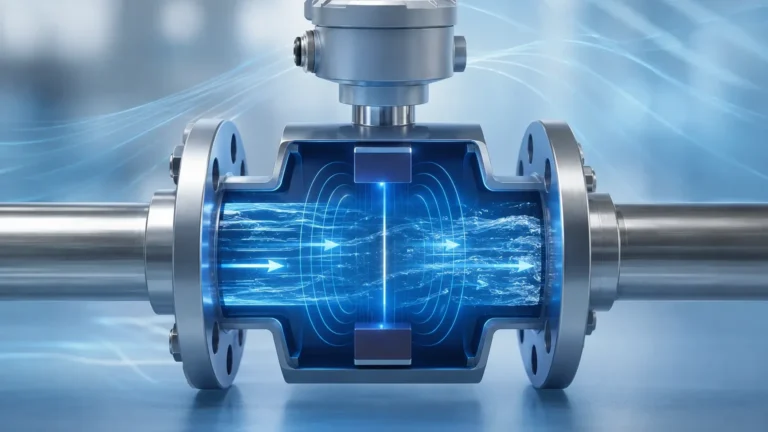
The operation of a 5000 electromagnetic flow meter is based on Faraday's Law of Electromagnetic Induction. This principle states that a conductor moving through a magnetic field produces an electrical signal within the conductor, which is directly proportional to the velocity of the movement.
In the context of a flow meter:
1. The Magnetic Field: The meter’s transmitter energizes coils located inside the meter body, creating a stable magnetic field across the cross-section of the pipe.
2. The Conductor: The conductive liquid flowing through the pipe acts as the moving conductor.
3. Voltage Generation: As the liquid moves through the magnetic field, a voltage is induced. This voltage is picked up by two electrodes mounted on opposite sides of the pipe wall.
4. Calculation: The induced voltage ($E$) is calculated using the formula $E = B \cdot v \cdot D$, where $B$ is the magnetic field strength, $v$ is the average fluid velocity, and $D$ is the distance between the electrodes (the pipe diameter). Since $B$ and $D$ are constant, the voltage is directly proportional to the fluid velocity.
Because the meter measures the volume flow at the actual operating temperature and pressure, it is highly reliable for liquids with varying densities, provided the minimum conductivity threshold (typically 5 μS/cm) is met.
Key Features of the 5000 Series
The "5000" designation often refers to a class of high-performance industrial meters designed for longevity in harsh environments. These units typically feature sophisticated signal processing to filter out process noise and provide stable readings even in turbulent conditions.
Lining and Electrode Materials
To handle corrosive or abrasive fluids, the interior of the 5000 electromagnetic flow meter is lined with specialized materials. Common options include:
* PTFE (Teflon): Excellent for high temperatures and aggressive chemicals.
* PFA: Similar to PTFE but with better mechanical resistance at high temperatures, often used in food and pharma.
* Hard Rubber/Neoprene: Preferred for water treatment and mildly abrasive slurries.
* Ceramic: Used for extremely abrasive or high-pressure chemical applications.
Electrodes are typically constructed from 316L Stainless Steel, Hastelloy C, Titanium, or Tantalum to ensure chemical compatibility with the process media.
Technical Selection Criteria
When specifying a 5000 electromagnetic flow meter, engineers must evaluate several parameters to ensure the device performs within its calibrated accuracy range (typically ±0.5% of rate). The following table provides a general guideline for selecting meter sizes based on flow rates for standard industrial applications.
Selection Table: Flow Range vs. Pipe Diameter (DN)
| Nominal Diameter (DN) | Flow Range (m³/h) at 0.5 m/s | Flow Range (m³/h) at 10 m/s | Common Applications |
| :— | :— | :— | :— |
| DN25 (1") | 0.88 | 17.67 | Chemical dosing, small pilot plants |
| DN50 (2") | 3.53 | 70.69 | Water distribution, cooling loops |
| DN100 (4") | 14.14 | 282.74 | Wastewater discharge, pulp & paper |
| DN200 (8") | 56.55 | 1,130.97 | Municipal water mains, mining slurries |
| DN400 (16") | 226.19 | 4,523.89 | Large scale irrigation, intake water |
| DN600 (24") | 508.94 | 10,178.76 | Industrial effluent, raw water transport |
*Note: For optimal accuracy, it is recommended to size the meter so that the normal flow velocity falls between 2 m/s and 6 m/s.*
Installation Considerations
The accuracy of an electromagnetic flow meter is highly dependent on the flow profile. Turbulence caused by valves, pumps, or elbows can lead to measurement errors. To mitigate this, specific "straight run" requirements must be followed.
1. Straight Pipe Requirements: Generally, a minimum of 5D (five times the pipe diameter) of straight pipe is required upstream of the meter, and 2D is required downstream. If a pump or a modulating valve is located immediately upstream, this requirement may increase to 10D or more.
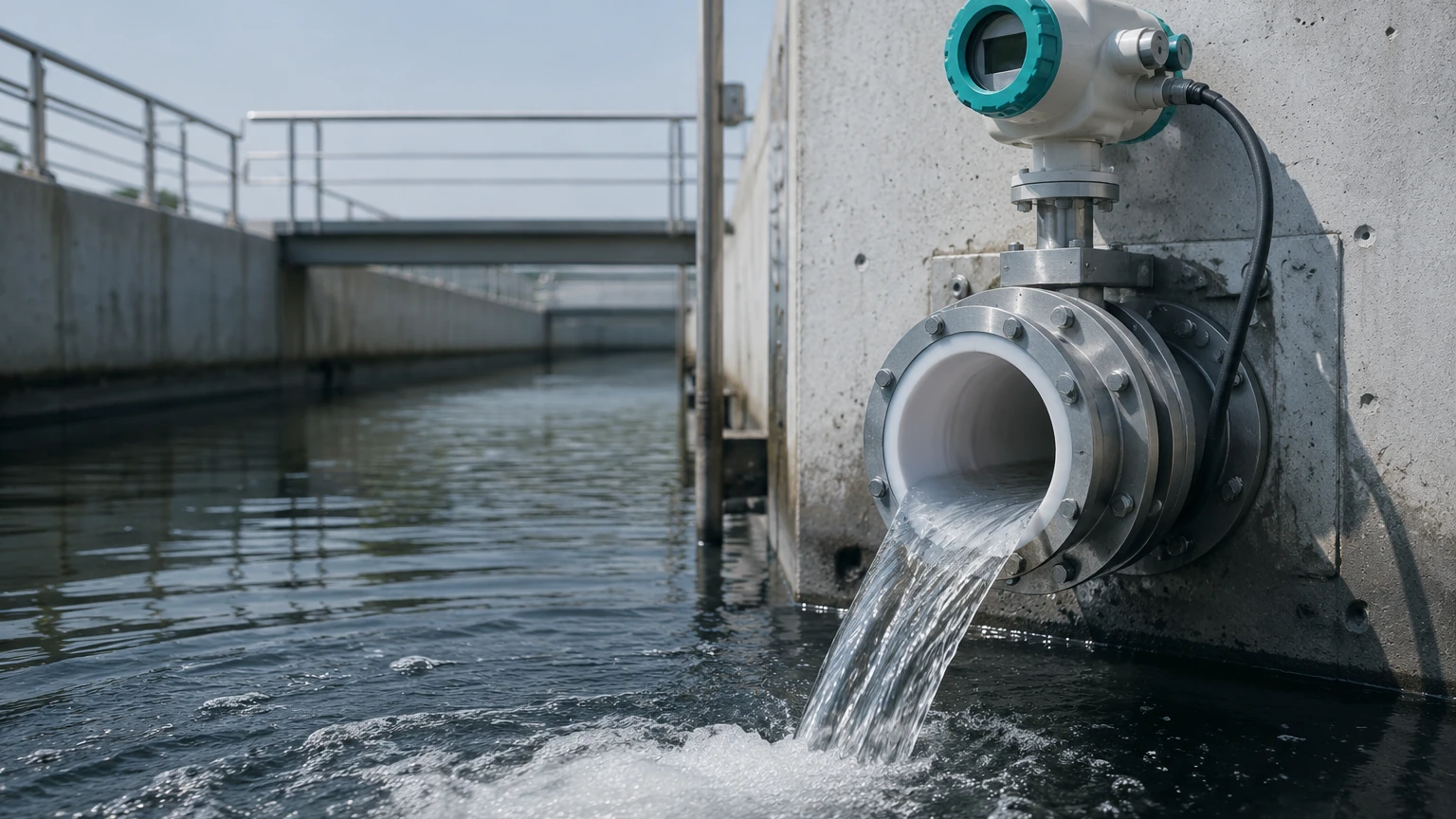
2. Full Pipe Condition: The meter must always be full of liquid. If the pipe is partially empty, the meter will over-read or fail to provide a stable output. Therefore, installing the meter in a vertical line with upward flow is the preferred orientation.
3. Grounding: Since the meter measures very small millivolt signals, electrical noise can interfere with the reading. Proper grounding of the fluid to the meter body is essential. In lined pipes or plastic piping systems, grounding rings are often necessary to establish an electrical connection with the fluid.
4. Avoid Vacuum: Certain liners, particularly PTFE, can collapse or peel away from the pipe wall if the system is subjected to a vacuum. If vacuum conditions are possible, PFA liners with stainless steel mesh reinforcement should be specified.
Limitations and Practical Constraints
While the 5000 electromagnetic flow meter is highly versatile, it is not a universal solution for all fluids. Understanding its limitations is critical for project success.
* Conductivity: The fluid must be electrically conductive. This excludes most oils, distilled water, and pure hydrocarbons. If the fluid is non-conductive, alternative technologies like ultrasonic or Coriolis meters must be considered.
* Gas Content: Large bubbles or entrained air can disrupt the magnetic field and cause significant measurement errors. If gas is present, air eliminators should be installed upstream.
* Solid Deposits: In applications involving heavy slurries or liquids that tend to coat surfaces, non-conductive deposits on the electrodes can insulate them from the fluid, leading to signal loss. Many 5000 series meters include electrode cleaning circuits or removable electrodes to address this.
Integration with Level Measurement Systems
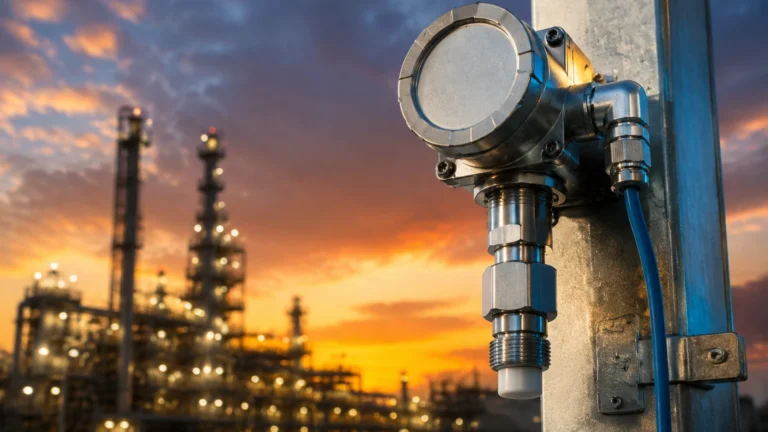
In many industrial B2B applications, flow measurement is only one part of the mass balance equation. For comprehensive process monitoring, flow data is often paired with level data. For instance, in a chemical storage tank, a 5000 electromagnetic flow meter monitors the outflow while a radar or ultrasonic level transmitter monitors the inventory.
Professional manufacturers like Welk provide a broad range of instruments to complete these control loops. Engineers looking for integrated solutions often Review product options and application support to ensure that both flow and level instruments are compatible in terms of communication protocols (such as HART, Modbus, or Profibus) and environmental ratings.
Frequently Asked Questions (FAQ)
Q: Can a 5000 electromagnetic flow meter measure the flow of steam or gas?
No. Electromagnetic flow meters require a conductive liquid to function. For steam or gas, vortex or differential pressure meters are typically used.
Q: How often does the meter need to be calibrated?
In stable applications with clean liquids, a 5000 series meter can maintain accuracy for several years. However, in regulated industries like food or pharmaceutical, annual or biennial wet-calibration or electronic verification is standard.
Q: What happens if the flow direction changes?
Most modern electromagnetic flow meters are bi-directional. They can be configured to measure flow in both directions and provide separate totals for forward and reverse flow, which is particularly useful in water distribution networks.
Q: Is it possible to install the meter in a horizontal pipe?
Yes, horizontal installation is common. However, the electrodes should be positioned horizontally (at the 3 o'clock and 9 o'clock positions) to prevent air bubbles at the top of the pipe or sediment at the bottom from interfering with the signal.
Conclusion
The 5000 electromagnetic flow meter is a cornerstone of modern industrial fluid management. By offering high accuracy without the maintenance burden of mechanical parts, it provides a reliable data stream for process optimization. When selecting a unit, prioritizing the correct liner material and adhering to strict installation guidelines regarding straight pipe runs and grounding will ensure the longevity and performance of the instrument. For complex projects requiring both flow and level measurement, consulting comprehensive technical resources at the Main Page can assist in selecting the most effective combination of sensors for specific industrial challenges.