High Temperature Flow Sensor
High Temperature Flow Sensor
In industrial process control, measuring the flow of liquids, gases, and steam at elevated temperatures presents a unique set of engineering challenges. A high temperature flow sensor must not only maintain accuracy under extreme thermal stress but also ensure long-term structural integrity and safety. These instruments are critical components in power generation, chemical processing, oil and gas refining, and heavy manufacturing, where process temperatures often exceed 250°C (482°F) and can reach as high as 500°C (932°F) or more.
Selecting the appropriate high temperature flow sensor requires a deep understanding of the underlying measurement principles, material science, and the specific dynamics of the fluid being measured. This guide examines the primary technologies used in high-temperature environments, provides selection criteria, and outlines best practices for installation and maintenance.
Understanding the Principles of High-Temperature Measurement
Before selecting a sensor, it is vital to understand how different technologies interact with heat. High temperatures affect fluid density, viscosity, and the physical dimensions of the sensor itself. The most reliable technologies for these applications typically minimize moving parts and utilize heat-resistant materials or remote electronics.
Vortex Shedding Principle
Vortex flow meters operate on the Karman Vortex Street principle. When a fluid flows past a non-streamlined object (a bluff body) placed in the flow stream, it creates alternating vortices. The frequency of these vortices is directly proportional to the velocity of the fluid.
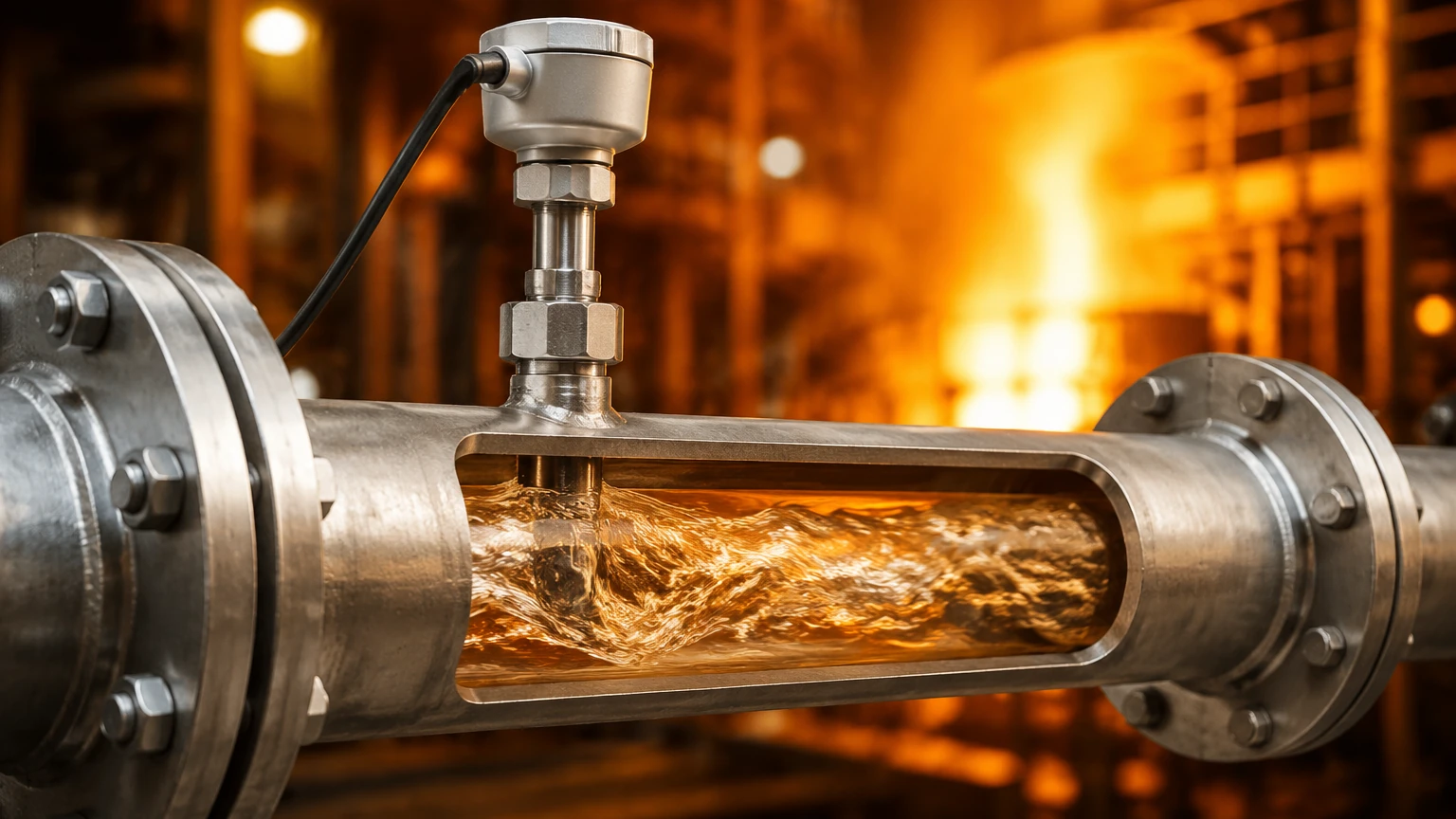
In high-temperature applications, vortex meters are highly valued because they have no moving parts that could seize or wear out due to thermal expansion. The sensors used to detect the vortices—often piezoelectric crystals—are typically isolated from the process heat using cooling fins or extended necks. This allows the meter to handle steam and high-temperature gases effectively.
Differential Pressure (DP) Measurement
Differential pressure is one of the oldest and most versatile methods for flow measurement. It relies on Bernoulli’s principle, which states that an increase in the speed of a fluid occurs simultaneously with a decrease in static pressure. By placing a restriction in the pipe (such as an orifice plate, Venturi tube, or Pitot tube), a pressure drop is created.
For a high temperature flow sensor application, the primary advantage of DP technology is that the sensitive electronic transmitter can be located several meters away from the hot pipe. Impulse lines filled with condensate or stagnant fluid act as a thermal buffer, protecting the transmitter while allowing it to sense the pressure difference.
Thermal Dispersion Technology
Thermal flow sensors measure the rate at which heat is dissipated from a heated surface into the flowing fluid. Typically, the sensor consists of two RTDs (Resistance Temperature Detectors); one is heated, and the other measures the ambient process temperature. The temperature difference or the power required to maintain a constant difference is proportional to the mass flow rate.
While traditionally used for lower temperatures, advanced high temperature flow sensor models utilize specialized ceramic potting and high-grade alloys to operate in environments up to 450°C. They are particularly effective for gas flow measurement where mass flow, rather than volumetric flow, is the primary requirement.
Key Evaluation Criteria for Selection
When evaluating a high temperature flow sensor for a specific project, engineers must look beyond the basic temperature rating. The following factors are critical to ensuring the reliability of the measurement system.
1. Material Compatibility and Thermal Expansion
At high temperatures, standard stainless steels may lose tensile strength or become susceptible to specific types of corrosion. Common materials for high-temperature sensors include:
* 316L Stainless Steel: Suitable for moderate temperatures and general corrosion resistance.
* Hastelloy C-276: Excellent for high-temperature chemical applications and resistance to pitting.
* Inconel: Often used in extreme heat (above 600°C) due to its ability to maintain structural integrity.
Furthermore, the design must account for the thermal expansion of the sensor body. If the sensor expands at a different rate than the surrounding piping, it can lead to mechanical stress or leaks at the flange connections.
2. Electronics Isolation
The most common cause of failure in high-temperature instrumentation is not the mechanical sensor but the failure of the electronic components. Most industrial electronics are rated for a maximum ambient temperature of 85°C (185°F). Therefore, any high temperature flow sensor must feature:
* Extended Necks: To move the transmitter head away from the hot pipe.
* Cooling Fins: To dissipate radiant heat.
* Remote Mounting: Connecting the sensor to the transmitter via specialized high-temperature cabling.
3. Fluid State and Phase Changes
High-temperature applications often involve fluids near their boiling point or superheated steam. The sensor must be able to handle potential phase changes. For instance, if a liquid flashes into vapor within the sensor, it can cause cavitation and damage the internal components. For more information on industrial-grade measurement solutions, you can review product options and application support on our Main Page.
Comparative Analysis of Sensor Types
The following table provides a practical comparison of common technologies used for high-temperature flow measurement.
| Technology | Max Temperature (Typical) | Media Type | Primary Advantages | Limitations |
| :— | :— | :— | :— | :— |
| Vortex | Up to 400°C – 450°C | Steam, Gas, Low-viscosity Liquid | No moving parts; very stable over time. | Requires minimum Reynolds number; sensitive to vibration. |
| Differential Pressure | Limited only by impulse line length | Liquid, Gas, Steam | Extremely versatile; transmitter is isolated from heat. | Pressure drop; impulse lines can clog or freeze. |
| Thermal Dispersion | Up to 450°C | Primarily Gases | Direct mass flow measurement; no moving parts. | Not suitable for most liquids; sensitive to coating on probes. |
| Ultrasonic (Clamp-on) | Up to 250°C (Specialized) | Liquids | Non-intrusive; no pressure drop. | Requires high-temp couplant; signal attenuation at high heat. |
Installation and Engineering Best Practices
Correct installation is as important as sensor selection. High-temperature environments introduce variables like radiant heat and pipe stress that are not present in standard applications.
Straight Pipe Requirements
Most flow sensors, especially vortex and DP meters, require a specific length of straight pipe upstream and downstream to ensure a fully developed flow profile. In high-temperature systems, these runs must be carefully planned to allow for thermal expansion loops or bellows without disrupting the flow profile near the sensor.
Insulation Considerations
While it is common practice to insulate process piping to conserve energy, the high temperature flow sensor itself requires careful treatment.
* Do not insulate the transmitter neck: The neck and cooling fins must be left exposed to the ambient air to allow heat to dissipate before it reaches the electronics.
* Insulate the pipe and sensor body: To prevent temperature fluctuations that could affect accuracy and to protect personnel.
Orientation for Steam Applications
When measuring steam, the orientation of the sensor is critical. For horizontal pipes, vortex sensors should typically be mounted to the side to prevent the sensor from being submerged in condensate or exposed to the highest temperatures at the top of the pipe. For DP systems, impulse lines should be sloped to allow condensate to drain back into the process or into condensate pots.
Limitations and Common Risks
Even the most robust high temperature flow sensor has limitations. Engineers should be aware of the following risks:
1. Thermal Shock: Rapid changes in process temperature (e.g., during start-up or emergency shutdown) can cause materials to crack or sensors to drift. Slow warm-up procedures are often required.
2. Calibration Drift: High heat can subtly change the physical properties of sensing elements over time. Regular verification and calibration are necessary to maintain precision.
3. Signal Noise: In high-temperature gas or steam applications, the high velocity of the fluid can create significant acoustic noise, which may interfere with vortex or ultrasonic measurements.
Frequently Asked Questions (FAQ)
Q: Can I use a standard flow meter if I just use a remote transmitter?
A: Not necessarily. The "wetted parts" (the parts of the sensor in contact with the fluid) must still be rated for the process temperature. A standard meter body may warp, melt, or lose its pressure rating at high temperatures, even if the electronics are kept cool.
Q: How often should a high temperature flow sensor be calibrated?
A: This depends on the criticality of the process. However, due to the harsh nature of high-heat environments, an annual calibration check is recommended. In many steam applications, checking for "zero drift" every six months is a best practice.
Q: What is the best technology for superheated steam?
A: Vortex shedding and Differential Pressure (using an orifice plate or Annubar) are the industry standards for superheated steam due to their durability and ability to handle high velocities.
Conclusion
Selecting a high temperature flow sensor is a balancing act between material science, electronic protection, and fluid dynamics. By understanding the measurement principles—whether it be the robust nature of vortex shedding or the isolated reliability of differential pressure—engineers can implement solutions that provide accurate data even in the most punishing environments.
Always confirm the maximum pressure and temperature ratings of the entire assembly, including gaskets and bolts, before installation. For complex applications involving both level and flow measurement in industrial automation, specialized consultation is often required to ensure the longevity of the instrumentation suite.