High Temperature Thermocouple
High Temperature Thermocouple
In industrial thermal processing, the ability to monitor and control extreme heat is fundamental to product quality, equipment longevity, and operational safety. A high temperature thermocouple is the primary sensor used to bridge the gap between intense thermal environments and electronic control systems. Unlike standard temperature sensors, these specialized instruments are engineered to withstand environments that would melt or oxidize common metals, often operating in ranges from 1,000°C to over 1,800°C.
Selecting the correct high temperature thermocouple requires a deep understanding of metallurgy, atmospheric chemistry, and mechanical protection. This guide provides a technical overview of the principles, types, and selection criteria necessary for implementing these sensors in demanding B2B industrial applications.
Measurement Principles of High Temperature Thermocouples
The operation of any thermocouple is based on the Seebeck Effect, discovered by Thomas Johann Seebeck in 1821. When two dissimilar metal wires are joined at one end (the "hot junction") and exposed to a temperature gradient, a small voltage (electromotive force or EMF) is generated at the open end (the "cold junction"). This voltage is proportional to the temperature difference between the two junctions.
The Challenge of High Heat
While the Seebeck Effect applies to any two dissimilar metals, high-temperature applications introduce several physical complications:
1. Oxidation and Corrosion: At high temperatures, most base metals react rapidly with oxygen or process gases, leading to the degradation of the wire and a shift in the EMF output (drift).
2. Recrystallization: Prolonged exposure to heat can change the grain structure of the thermocouple wires, making them brittle and prone to mechanical failure.
3. Insulation Breakdown: Standard plastic or fiberglass insulation melts at relatively low temperatures. High-temperature sensors must use ceramic insulators (such as Alumina or Magnesia) to prevent short circuits.
To combat these issues, a high temperature thermocouple utilizes specific alloys—often involving noble metals like Platinum and Rhodium—or specialized base metal alloys like Nicrosil and Nisil.
Types of High Temperature Thermocouples
Thermocouples are categorized by "types," defined by the specific combination of metals used. For high-temperature service, these are generally divided into Base Metal and Noble Metal categories.
Base Metal Thermocouples (Types K and N)
These are cost-effective solutions for moderately high temperatures, typically used in heat-treating furnaces and kilns.
* Type K (Chromel / Alumel): The most common industrial thermocouple. While it can reach 1,260°C (2,300°F), it is susceptible to "Green Rot" (selective oxidation of chromium) in reducing atmospheres between 800°C and 1,000°C, which causes significant measurement errors.
* Type N (Nicrosil / Nisil): Developed to overcome the stability issues of Type K. It offers better resistance to oxidation and is more stable at high temperatures, making it a preferred choice for vacuum furnaces and high-heat applications up to 1,200°C.
Noble Metal Thermocouples (Types R, S, and B)
Noble metal thermocouples use Platinum and Rhodium. They are significantly more expensive but provide the stability and accuracy required for temperatures exceeding 1,300°C.
* Type S (Platinum 10% Rhodium / Platinum): The international standard for temperature calibration between 630°C and 1,064°C. It can be used up to 1,450°C.
* Type R (Platinum 13% Rhodium / Platinum): Similar to Type S but offers a slightly higher EMF output and better stability in some applications. It is used up to 1,450°C.
* Type B (Platinum 30% Rhodium / Platinum 6% Rhodium): Designed for the highest temperatures, capable of continuous use at 1,700°C and intermittent use up to 1,800°C. One unique feature of Type B is that its output is very low at room temperature, often eliminating the need for cold-junction compensation in less critical applications.
Selection Table for High Temperature Applications
| Thermocouple Type | Composition | Max Continuous Temp | Atmosphere Suitability |
| :— | :— | :— | :— |
| Type K | Chromel / Alumel | 1,100°C | Oxidizing, Inert |
| Type N | Nicrosil / Nisil | 1,200°C | Oxidizing, Reducing, Vacuum |
| Type S | Pt-10%Rh / Pt | 1,450°C | Oxidizing, Inert |
| Type R | Pt-13%Rh / Pt | 1,450°C | Oxidizing, Inert |
| Type B | Pt-30%Rh / Pt-6%Rh | 1,700°C | Oxidizing, Inert |
| Type C | Tungsten / Rhenium | 2,300°C | Vacuum, Inert, Reducing (Never Oxidizing) |
Protection Sheaths and Insulators
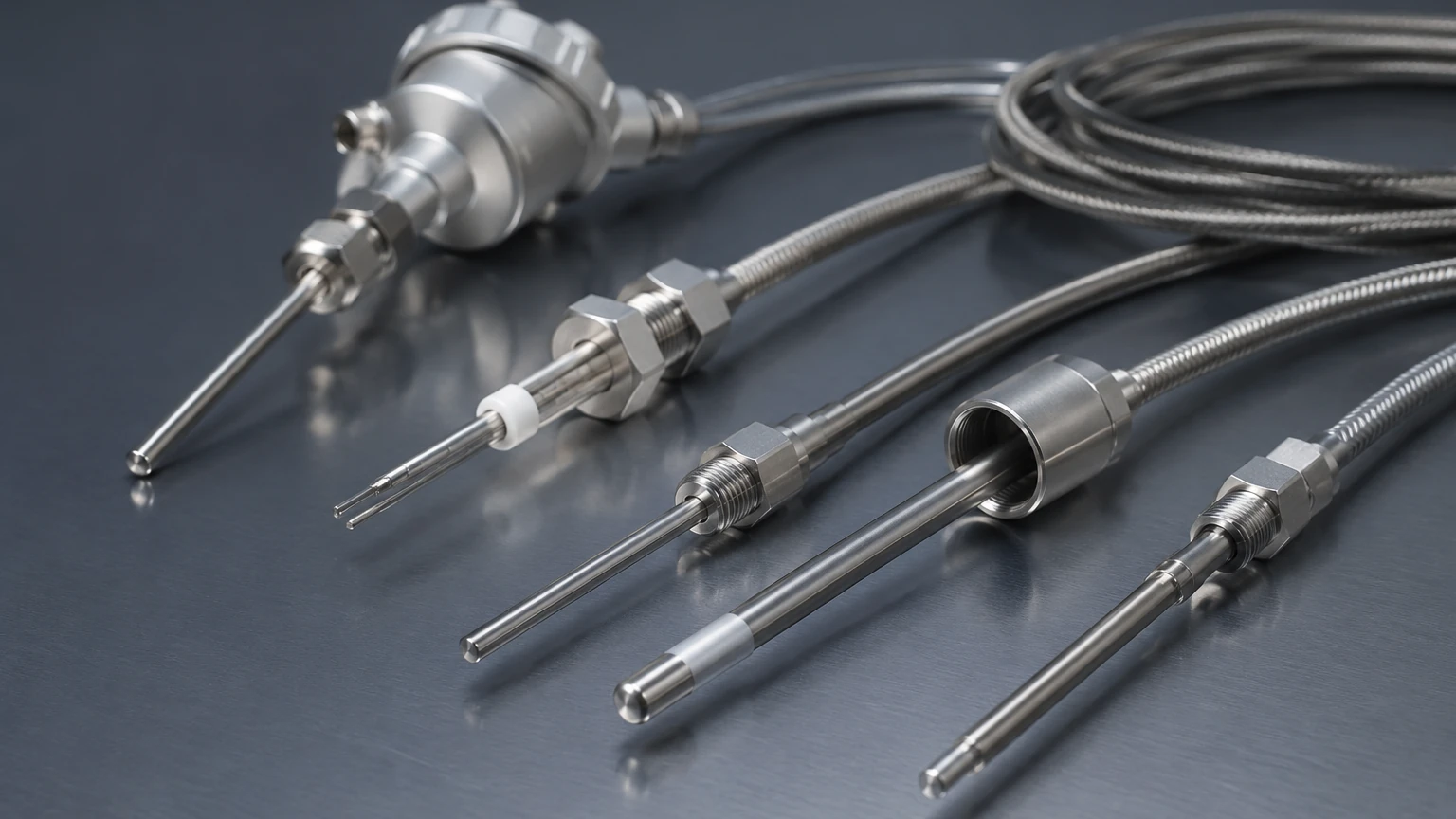
A high temperature thermocouple is rarely used as bare wire. It must be protected from the process environment by a thermowell or protection tube. The choice of sheath material is as critical as the thermocouple type itself.
1. Ceramic Protection Tubes: For temperatures above 1,200°C, metallic sheaths often fail. Alumina (Al₂O₃) is the standard for noble metal thermocouples because it is chemically inert and has a high melting point. However, it is sensitive to thermal shock.
2. Specialty Alloys: Inconel 600 or 601 is frequently used for Type K and N thermocouples in oxidizing environments up to 1,150°C. For extremely corrosive environments, silicon carbide or molybdenum sheaths may be required.
3. Primary and Secondary Insulation: In many high-heat designs, the thermocouple wires are threaded through twin-bore ceramic insulators, which are then placed inside a primary ceramic tube. This "tube-within-a-tube" design provides a redundant barrier against gas permeation that could poison the noble metal wires.
Installation Considerations for Industrial Environments
Proper installation is vital to ensure the longevity of a high temperature thermocouple and the accuracy of the data it provides.
* Immersion Depth: To avoid conduction errors (where heat travels up the sheath and away from the sensor tip), the thermocouple should be immersed to a depth of at least 10 times the diameter of the protection tube.
* Expansion Allowance: At high temperatures, protection tubes and sheaths will expand. If the sensor is rigidly fixed at both ends, the resulting mechanical stress can snap ceramic tubes or break the thermocouple junction.
* Vertical vs. Horizontal Mounting: In very high-temperature applications, ceramic tubes can sag under their own weight if mounted horizontally. Vertical mounting is always preferred for temperatures above 1,200°C.
* Extension Wire Matching: The wire connecting the thermocouple head to the control room must be "extension grade" wire that matches the thermocouple type. Using standard copper wire will create a new, unintended thermocouple junction at the connection head, leading to massive temperature errors.
Limitations and Common Risks
Engineers must be aware of the inherent limitations of high-temperature sensing:
* Drift: Over time, the chemical composition of the wires changes due to the diffusion of impurities or the loss of alloying elements through evaporation. This causes the sensor to "drift," meaning it reports a different temperature for the same heat level than it did when new.
* Contamination (Poisoning): Noble metal thermocouples (R, S, B) are extremely sensitive to contamination by silicon, phosphorus, or sulfur. If these elements permeate the protection tube, they will alloy with the platinum, changing its EMF characteristics and making the wire brittle.
* Thermal Shock: Ceramic protection tubes are prone to cracking if subjected to rapid temperature changes. Pre-heating the sensors or controlled insertion rates are often necessary.
Integration with Level Measurement Systems
While temperature measurement is a distinct field, it is inextricably linked to industrial level measurement. In many high-temperature processes, such as glass melting or molten metal storage, accurate level data depends on temperature compensation. For instance, hydrostatic level transmitters rely on fluid density, which changes significantly with temperature. Similarly, the speed of sound used in ultrasonic level sensors is temperature-dependent. Understanding the thermal profile of a vessel via a high temperature thermocouple allows for the calibration and accuracy of the broader automation suite. For more information on how these technologies integrate into a complete process control solution, you can Review product options and application support on our Main Page.
Frequently Asked Questions (FAQ)
Q: How often should a high temperature thermocouple be calibrated?
A: This depends on the process. In stable, clean environments, noble metal thermocouples may last a year. In harsh, fluctuating environments, they may need checking every month. Because they drift over time, any critical process should have a scheduled replacement or calibration cycle.
Q: Can I use a Type K thermocouple in a vacuum furnace?
A: It is not recommended for high-vacuum applications at high temperatures because the chromium in the positive leg can sublimate (turn from solid to gas), rapidly changing the calibration. Type N or Type S are much better suited for vacuum environments.
Q: Why is my ceramic protection tube cracking?
A: The most common cause is thermal shock. If a cold ceramic tube is inserted into a hot furnace, the uneven expansion causes it to shatter. Another cause is mechanical stress from the furnace wall as it expands and contracts.
Q: What is the difference between a thermocouple and an RTD for high temperatures?
A: RTDs (Resistance Temperature Detectors) are generally more accurate but are limited to temperatures below 850°C. For anything higher, a high temperature thermocouple is the only viable contact-sensing option.
Conclusion
Deploying a high temperature thermocouple is a balance between material science and practical engineering. By selecting the appropriate thermocouple type—be it a robust Type N for heat treating or a precision Type B for glass manufacturing—and pairing it with the correct ceramic protection, industrial operators can ensure stable and reliable data. This data not only protects the furnace or reactor but also ensures that the final product meets the rigorous standards required in modern B2B industrial sectors.