Silicon Dioxide Dielectric Constant
Silicon Dioxide Dielectric Constant
In the field of industrial process control, the silicon dioxide dielectric constant is a fundamental parameter that dictates the success of level measurement applications. Silicon dioxide ($SiO_2$), commonly encountered as quartz, silica sand, or glass, is a staple material in industries ranging from construction and glass manufacturing to chemical processing and oil and gas. Because many modern level measurement technologies, particularly radar and guided wave radar, rely on the electromagnetic properties of the stored material, understanding the dielectric constant ($\varepsilon_r$) is essential for selecting and calibrating the right instrumentation.
This guide explores the technical nuances of the silicon dioxide dielectric constant, how it influences measurement accuracy, and the practical engineering considerations for monitoring $SiO_2$ in various industrial forms.
Understanding the Role of Dielectric Constant in Level Measurement
Before selecting a sensor, it is necessary to understand the measurement principle of microwave-based instruments. Radar level meters emit high-frequency electromagnetic pulses that travel through the air or a waveguide and reflect off the surface of the material being measured.
The strength of the reflected signal is directly proportional to the dielectric constant of the material. The dielectric constant, also known as relative permittivity, is a measure of a material's ability to store electrical energy in an electric field. In mathematical terms, the reflection coefficient ($R$) at the interface of two media is determined by:
$$R = \frac{\sqrt{\varepsilon_{r2}} – \sqrt{\varepsilon_{r1}}}{\sqrt{\varepsilon_{r2}} + \sqrt{\varepsilon_{r1}}}$$
Where $\varepsilon_{r1}$ is the dielectric constant of the air (approximately 1.0) and $\varepsilon_{r2}$ is the dielectric constant of the material. Materials with a high dielectric constant, such as water ($\varepsilon_r \approx 80$), produce very strong reflections. Conversely, materials with a low dielectric constant, like silicon dioxide, produce much weaker reflections, presenting a challenge for standard level sensors.
What is the Silicon Dioxide Dielectric Constant?
The silicon dioxide dielectric constant is not a single fixed value; it varies significantly depending on the physical state, purity, and density of the material.
1. Crystalline Quartz and Fused Silica
In its solid, high-purity form, such as quartz crystals or fused silica used in laboratory glassware, the dielectric constant typically ranges from 3.7 to 4.5. This is considered a moderate dielectric value, which usually provides a reliable reflection for most high-frequency radar sensors.
2. Silica Sand and Bulk Granular $SiO_2$
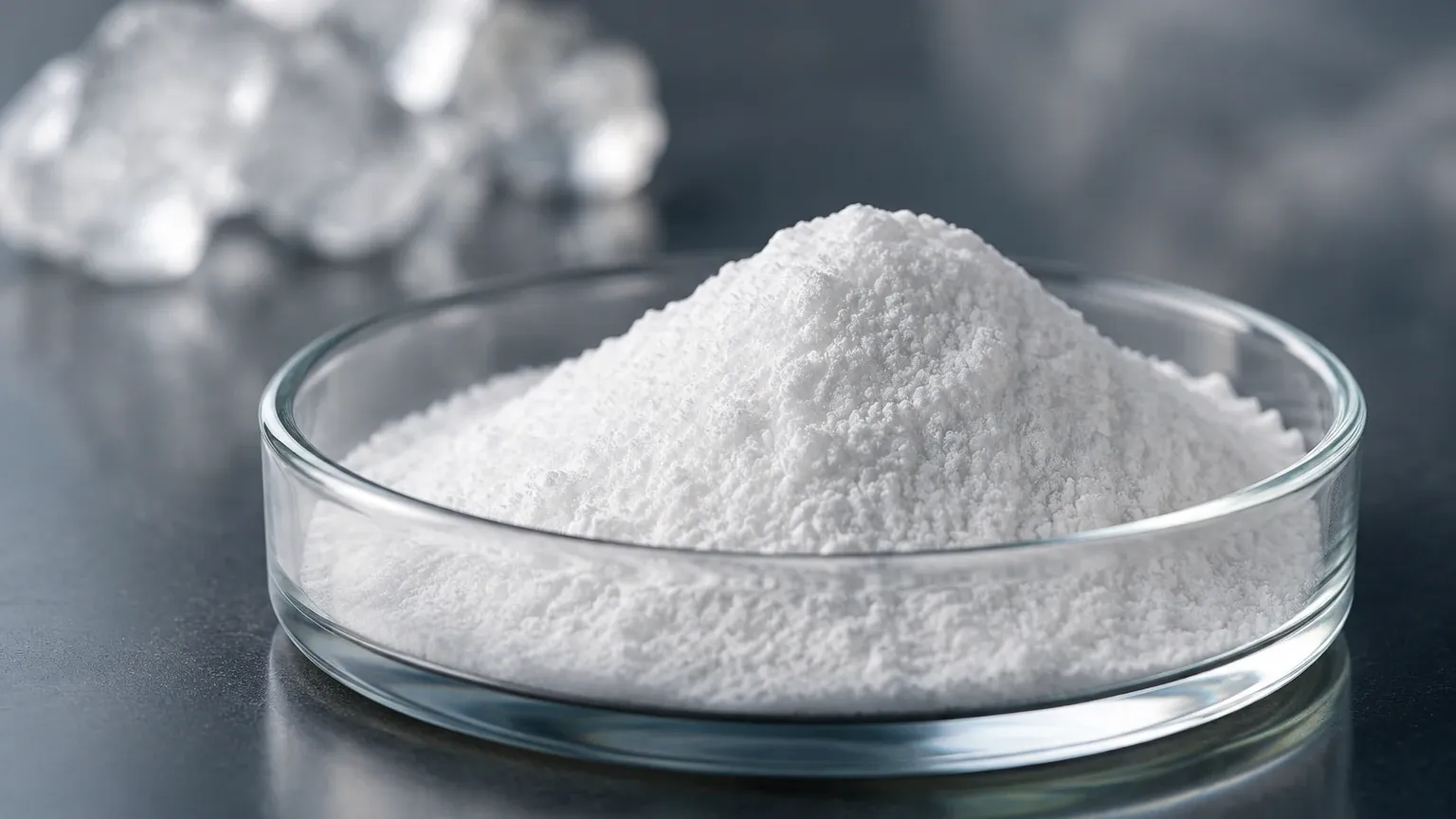
In industrial silos, silicon dioxide is most commonly stored as sand or granular powder. In these bulk forms, the material is a mixture of solid $SiO_2$ particles and air pockets. Since air has a dielectric constant of 1.0, the "effective" dielectric constant of the bulk material is significantly lower than that of the solid crystal. For typical dry silica sand, the effective dielectric constant usually falls between 1.5 and 2.5.
3. Amorphous Silica and Aerogels
Highly porous forms of silicon dioxide, such as fumed silica or silica aerogels, have extremely high air content. In these cases, the dielectric constant can be as low as 1.1 to 1.3. These materials are among the most difficult to measure using non-contact radar because the reflection is extremely faint.
Factors Affecting the Effective Dielectric Constant of Silica
When designing a level measurement system, engineers must account for variables that can alter the perceived silicon dioxide dielectric constant in a real-world environment.
Moisture Content
Water has a very high dielectric constant (approx. 80). Even a small increase in the moisture content of silica sand can drastically increase the effective dielectric constant of the bulk material. For example, sand with 5% moisture may exhibit a dielectric constant of 5.0 or higher, compared to 2.0 when bone-dry. While this makes the reflection stronger, it can also cause signal attenuation if the radar pulse needs to penetrate the material (as in interface measurement).
Bulk Density and Compaction
The dielectric constant of a granular material is a function of its density. As silica sand is packed more tightly at the bottom of a large silo due to the weight of the material above it, the dielectric constant increases slightly. This variation is generally negligible for surface level measurement but is a factor in precision bulk density calculations.
Temperature
For most industrial applications, the dielectric constant of silicon dioxide remains relatively stable across standard temperature ranges. However, at extreme temperatures exceeding 500°C, the molecular structure of the material may shift, leading to minor fluctuations in permittivity. More importantly, high temperatures often require specialized sensor cooling or high-temperature antenna designs.
Selecting Level Measurement Technology for Silicon Dioxide
Choosing the right instrument depends on the specific form of $SiO_2$ and the vessel geometry. For more detailed technical specifications on these instruments, you can visit the Main Page of our product catalog.
1. 80GHz High-Frequency Radar
For non-contact measurement of silica sand or glass cullet, 80GHz radar is often the preferred choice. The high frequency allows for a narrow beam angle, which minimizes interference from silo walls and internal structures. More importantly, modern 80GHz sensors feature advanced signal processing capable of detecting the weak reflections associated with a low silicon dioxide dielectric constant (down to $\varepsilon_r \approx 1.4$).
2. Guided Wave Radar (GWR)
In applications where the material surface is extremely turbulent or where the dielectric constant is at the absolute lower limit (e.g., fumed silica), Guided Wave Radar is highly effective. GWR uses a probe (cable or rod) to guide the microwave pulse directly to the material. Because the energy is concentrated around the probe rather than spreading through free space, GWR can reliably measure materials with dielectric constants as low as 1.2.
3. Ultrasonic Sensors (Limited Use)
Ultrasonic sensors rely on sound waves rather than electromagnetic waves. Therefore, they are not affected by the dielectric constant. However, they are highly sensitive to dust, which is a major byproduct of handling silica. Consequently, ultrasonic technology is generally not recommended for dry silicon dioxide powders unless the environment is dust-free.
Selection Table for $SiO_2$ Applications
| Material Form | Typical $\varepsilon_r$ | Recommended Technology | Key Benefit |
| :— | :— | :— | :— |
| Silica Sand (Dry) | 1.5 – 2.5 | 80GHz Non-contact Radar | Narrow beam, handles dust well |
| Quartz Crystals | 3.7 – 4.5 | 26GHz or 80GHz Radar | Strong reflection, easy to measure |
| Glass Cullet | 2.0 – 3.0 | 80GHz Non-contact Radar | Non-contact avoids abrasive wear |
| Fumed Silica | 1.1 – 1.3 | Guided Wave Radar | High sensitivity for low $\varepsilon_r$ |
| Wet Silica Sand | 5.0 – 15.0 | Non-contact Radar | Very strong signal reflection |
Installation Considerations for Low Dielectric Solids
When installing a level meter in a silica silo, the low silicon dioxide dielectric constant necessitates specific installation practices to ensure a reliable signal-to-noise ratio.
1. Avoid the Filling Stream: Because the reflection from $SiO_2$ is weak, the sensor should never be mounted where the material inflow can obstruct the signal path. The noise generated by falling sand will easily overwhelm the faint reflection from the surface.
2. Angle of Repose: Granular silica forms a cone when loaded. The radar should be positioned at a distance of approximately 1/3 of the silo radius from the wall to get an average level reading. If using non-contact radar, an adjustable flange (swivel holder) can be used to aim the sensor perpendicular to the slope of the material, maximizing the returned signal.
3. Nozzle Height: For low dielectric materials, the mounting nozzle should be as short as possible. Long nozzles can create internal reflections (ringing) that mask the weak signal from the silica surface, especially when the silo is nearly full.
4. Dust Management: Silica handling is notoriously dusty. While radar can penetrate dust, a heavy buildup on the antenna can attenuate the signal. Sensors with a PTFE drop antenna or a flushing connection (air purge) are recommended to keep the lens clean.
Limitations and Troubleshooting
Measuring materials with a low dielectric constant like silicon dioxide comes with inherent risks:
* Signal Loss at the Bottom: As the silo empties, the radar signal may pass through the remaining thin layer of silica and reflect off the metal bottom of the silo. This can cause a "double jump" in the reading or a failure to detect the last 100-200mm of material. Calibrating a "bottom offset" or using a mapping function to ignore the tank bottom reflection is required.
* Abrasive Wear: Silicon dioxide is highly abrasive. For Guided Wave Radar, the probe should be inspected periodically for wear. For non-contact radar, ensure the antenna material (usually PTFE or PEEK) is suitable for the environment.
* Static Electricity: The movement of dry silica particles can generate significant static charges. Level instruments must be properly grounded to prevent electronic interference or damage to the sensor head.
Frequently Asked Questions (FAQs)
Q: Can I use a standard 26GHz radar for silica sand?
A: Yes, but it requires a larger antenna to achieve the necessary gain for low dielectric materials. An 80GHz sensor is generally superior due to its higher sensitivity and smaller footprint.
Q: How does the silicon dioxide dielectric constant affect the "blocking distance"?
A: The dielectric constant doesn't change the blocking distance (dead zone) itself, but because the signal is weak, the sensor may struggle to distinguish the material surface from the antenna's own internal noise near the top of the tank. Choosing a sensor with a small dead zone is critical for full-silo accuracy.
Q: Is it possible to measure the interface between silica sand and water?
A: Yes. Because water has a much higher dielectric constant than dry silica, Guided Wave Radar can detect the top of the sand and the water level, provided the upper layer (the sand) is dry enough to allow the signal to pass through it.
Conclusion
The silicon dioxide dielectric constant is the most critical variable to consider when engineering a level measurement solution for silica-based materials. While the low $\varepsilon_r$ of bulk $SiO_2$ presents challenges for signal reflection, modern high-frequency radar and guided wave technologies provide the sensitivity required for accurate and repeatable monitoring. By accounting for factors like moisture, dust, and silo geometry, operators can ensure long-term reliability in their level measurement systems.
For professional assistance in selecting the correct instrument for your specific silicon dioxide application, please refer to the technical resources available on our Main Page.