Hoseless Sludge Collector
Hoseless Sludge Collector
In modern wastewater treatment and industrial sedimentation processes, the management of settled solids is a critical factor in maintaining effluent quality and operational efficiency. The hoseless sludge collector represents a significant evolution in clarifier design, moving away from traditional systems that rely on cumbersome trailing hoses or telescopic pipes. By eliminating these mechanical vulnerabilities, facilities can reduce maintenance overhead and improve the reliability of sludge removal. However, the successful automation of a hoseless sludge collector is fundamentally dependent on precise level measurement and interface detection.
This guide explores the mechanics of hoseless sludge collection systems, the physical principles of the level measurement technologies that support them, and the engineering criteria required for successful implementation.
Understanding the Hoseless Sludge Collector Mechanism
Traditional sludge collection systems often utilize a traveling bridge or a circular scraper that pulls sludge toward a central hopper. In many designs, a submerged pump or siphon travels with the bridge, requiring a flexible trailing hose to transport the collected sludge to a discharge trough. These hoses are prone to wear, kinking, and entanglement, particularly in large tanks or environments with significant temperature fluctuations.
A hoseless sludge collector eliminates the flexible conduit. Instead, it typically employs one of two configurations:
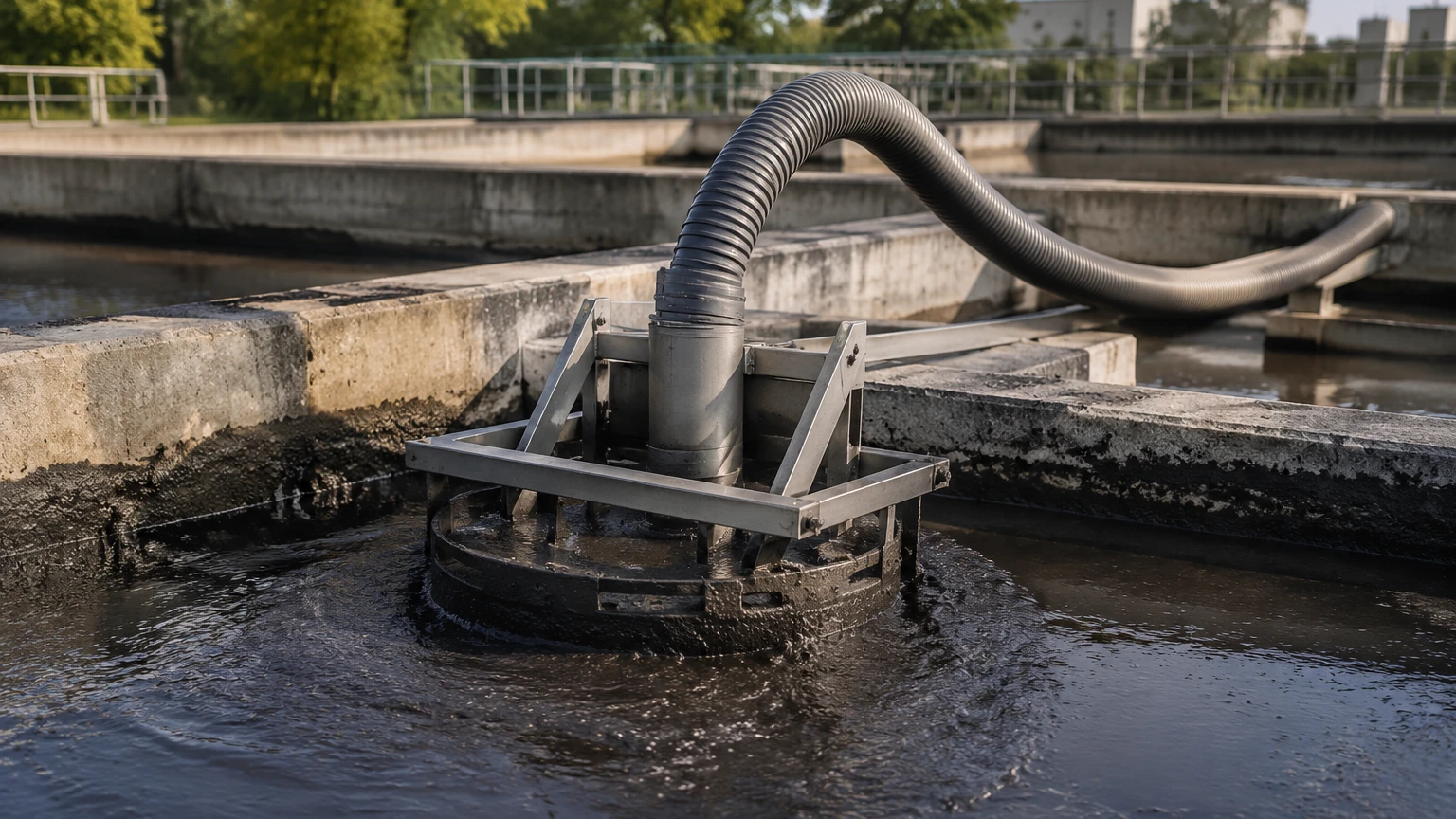
1. Header and Lateral Systems: A series of submerged pipes with orifices (laterals) are fixed to the floor or attached to a moving manifold. The sludge is drawn into the manifold via differential pressure or a pump and discharged into a fixed longitudinal trough or a central collection point through a sliding seal or a submerged valve system.
2. Siphon-Based Traveling Bridges: These systems use a traveling bridge equipped with siphon pipes. The pipes extend into the sludge blanket and discharge into a fixed trough running parallel to the tank wall. The "hoseless" aspect is achieved by using the trough itself as the transport medium, removing the need for a hose to bridge the gap between the moving bridge and the stationary tank structure.
To operate these systems effectively, plant operators must know exactly where the sludge ends and the clarified water begins. This is where advanced level instrumentation becomes indispensable.
Measurement Principles for Sludge Management
Before selecting instrumentation for a hoseless sludge collector, it is essential to understand the measurement principles used to detect the sludge-water interface and the overall liquid level.
Ultrasonic (Sonar) Interface Detection
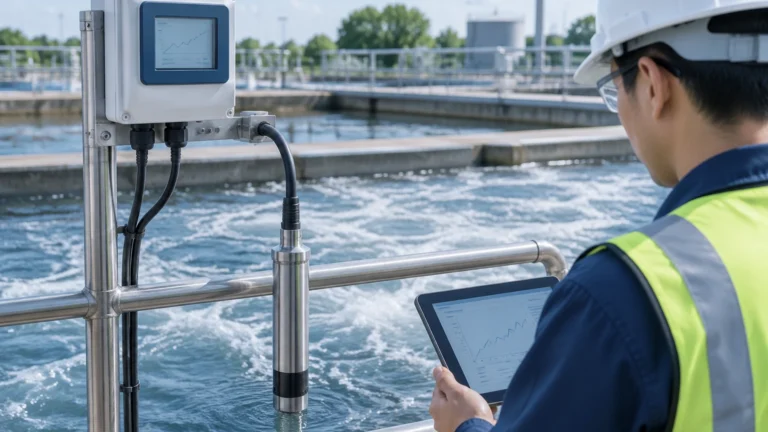
The primary method for monitoring a sludge blanket is ultrasonic or sonar measurement. This technology operates on the "time-of-flight" principle. A transducer, submerged just below the water surface, emits a high-frequency sound pulse directed toward the bottom of the tank.
When the sound wave encounters a change in density—specifically the interface between the clarified liquid and the settled sludge—a portion of the acoustic energy is reflected back to the transducer. By measuring the time interval between the emission of the pulse and the reception of the echo, and knowing the speed of sound in the liquid, the transmitter calculates the distance to the sludge blanket.
In a hoseless sludge collector environment, sophisticated signal processing is required to differentiate between the "fluff layer" (low-density suspended solids) and the "heavy sludge" (compacted solids). Modern sonar systems use frequency-modulated or multi-frequency pulses to penetrate through suspended solids and identify the true blanket level.
Radar Level Measurement
While sonar is used for the internal interface, non-contact radar is often used to monitor the total liquid level in the clarifier. Radar transmitters emit short micro-wave pulses (typically in the 26 GHz or 80 GHz range). These pulses reflect off the surface of the liquid and return to the antenna.
Unlike ultrasonic sensors, radar is unaffected by air temperature gradients, steam, or dust above the water surface. This makes it an ideal redundant system to ensure the tank does not overflow and to provide a reference point for the submerged sonar sensors.
Hydrostatic Pressure Measurement
Hydrostatic transmitters measure the pressure exerted by the column of liquid above a sensing diaphragm. The pressure (P) is proportional to the height of the liquid (h) and its density (ρ), according to the formula: *P = ρgh*. In sludge collection, hydrostatic sensors are often used in the discharge troughs or wet wells to monitor the volume of sludge being removed, ensuring the pump or siphon is operating within its design parameters.
Level Measurement Selection for Sludge Collectors
Choosing the right instrumentation for a hoseless sludge collector requires balancing accuracy, maintenance requirements, and the specific characteristics of the media. The following table provides a comparison of common technologies used in these applications.
| Technology | Primary Application | Advantages | Limitations |
| :— | :— | :— | :— |
| Sonar/Ultrasonic | Sludge Blanket Level (SBL) | Direct interface measurement; no moving parts. | Sensitive to high-density foam or heavy turbulence. |
| Non-Contact Radar | Total Liquid Level | Extremely accurate; unaffected by vapors or wind. | Cannot measure the submerged sludge interface. |
| Hydrostatic | Trough/Well Level | Robust; easy to install in deep sumps. | Requires compensation if liquid density changes significantly. |
| Optical Sensors | Point Level Detection | Low cost; provides specific density trip points. | Prone to fouling; requires frequent cleaning of lenses. |
| Level Switches | High/Low Alarms | Simple integration; high reliability for safety. | Provides point data only, not continuous measurement. |
| Magnetic Gauges | External Tank Monitoring | Visual indication plus electronic output. | Requires a bypass chamber; not suitable for open clarifiers. |
For a comprehensive overview of available technologies and specific product data, engineers should consult the Main Page of professional instrumentation manufacturers to match sensor specifications with tank geometry.
Engineering Considerations for Installation
Successful integration of level sensors with a hoseless sludge collector requires careful planning during the design and installation phases.
1. Transducer Positioning
In traveling bridge systems, the sonar transducer is often mounted directly to the bridge. This allows for a longitudinal profile of the sludge blanket across the entire length of the tank. However, if the bridge moves too quickly, it can create turbulence that introduces air bubbles under the transducer face, which may block the ultrasonic signal. Mounting the transducer in a stilling well or using a trailing arm can mitigate this.
2. Avoiding Obstructions
Hoseless collectors often have complex internal geometries, including header pipes, support struts, and baffles. Level sensors must be positioned to ensure a clear "field of view." For radar and ultrasonic sensors, the beam angle must be calculated to avoid reflecting off these internal structures, which would result in false level readings.
3. Cleaning and Maintenance
Sludge is inherently fouling. Even in "hoseless" designs, the sensors themselves are exposed to biological growth and grease. Automated cleaning systems, such as water sprayers or mechanical wipers for sonar transducers, are highly recommended to ensure long-term accuracy without manual intervention.
4. Integration with VFDs
The data from the sludge blanket level sensor should be used to control the speed of the sludge withdrawal pumps via Variable Frequency Drives (VFDs). If the blanket level rises, the pump speed increases; if the blanket is low, the speed decreases to prevent "rat-holing," where water is drawn into the collector instead of sludge.
Operational Limitations and Risks
While hoseless sludge collectors and advanced level sensors offer many benefits, engineers must be aware of certain limitations:
* Density Stratification: In some industrial processes, the transition between water and sludge is not a sharp line but a gradual increase in density. This can make it difficult for sonar sensors to define a single "level." Calibration against manual core samples (sludge judges) is necessary during commissioning.
* Signal Attenuation: In very thick sludge (above 5-7% solids), the acoustic signal from a sonar sensor may be completely absorbed, preventing a return echo from the tank floor. This is usually managed by setting the system to track the top of the blanket rather than the floor.
* Environmental Factors: For outdoor clarifiers, heavy rain can disturb the surface and the sludge blanket, while extreme cold can affect the speed of sound in air (relevant for non-contact ultrasonic sensors above the water). Radar is generally the preferred solution for total level in these conditions.
Frequently Asked Questions (FAQ)
Q: Can a hoseless sludge collector be retrofitted into an existing rectangular clarifier?
A: Yes, many hoseless header-lateral systems are designed specifically for retrofitting. The key challenge is ensuring the floor is level enough for the collector to operate and that there is a suitable location to mount the level sensors for automation.
Q: How often do sludge blanket level sensors need calibration?
A: Initially, sensors should be checked weekly against manual samples. Once the signal processing parameters are tuned to the specific sludge characteristics of the plant, calibration intervals can often be extended to quarterly or semi-annually.
Q: Is radar better than ultrasonic for measuring sludge?
A: They serve different purposes. Radar is superior for measuring the top surface of the liquid (total level) because it is unaffected by environmental conditions. Ultrasonic (sonar) is the only effective non-contact method for measuring the *submerged* interface between water and sludge.
Q: What is the typical lifespan of a submerged level sensor in a sludge application?
A: With proper maintenance and cleaning, high-quality industrial sensors (such as those from Welk) typically last 5 to 10 years. The primary failure mode is usually cable degradation or diaphragm fouling rather than electronic failure.
Conclusion
The implementation of a hoseless sludge collector significantly improves the mechanical reliability of wastewater treatment processes. However, the move away from manual or semi-automated sludge removal places a higher premium on the accuracy of level measurement. By understanding the physics of sonar and radar technologies and applying rigorous engineering standards to sensor selection and installation, operators can achieve a fully automated, high-efficiency sludge management system. For detailed specifications on the instruments required for these applications, please refer to the Main Page for technical documentation and support.