How Does a Coriolis Flow Meter Work
How Does a Coriolis Flow Meter Work
In the landscape of industrial process control, the ability to measure mass flow directly, rather than inferring it from volume, represents a significant leap in precision. Coriolis flow meters have become the gold standard for applications requiring high accuracy, such as custody transfer, chemical dosing, and complex blending. Understanding how does a coriolis flow meter work is essential for engineers and plant managers who must select the right instrumentation for demanding environments.
While many flow technologies rely on fluid velocity or differential pressure, the Coriolis meter utilizes the physical properties of inertia. This article provides a technical deep dive into the underlying physics, mechanical design, and practical application of these instruments within modern industrial automation.
The Fundamental Physics: The Coriolis Effect
To answer the question, "how does a coriolis flow meter work?" one must first look at the Coriolis effect. Named after the French physicist Gaspard-Gustave de Coriolis, this effect describes the inertial force acting on objects in motion relative to a rotating reference frame.
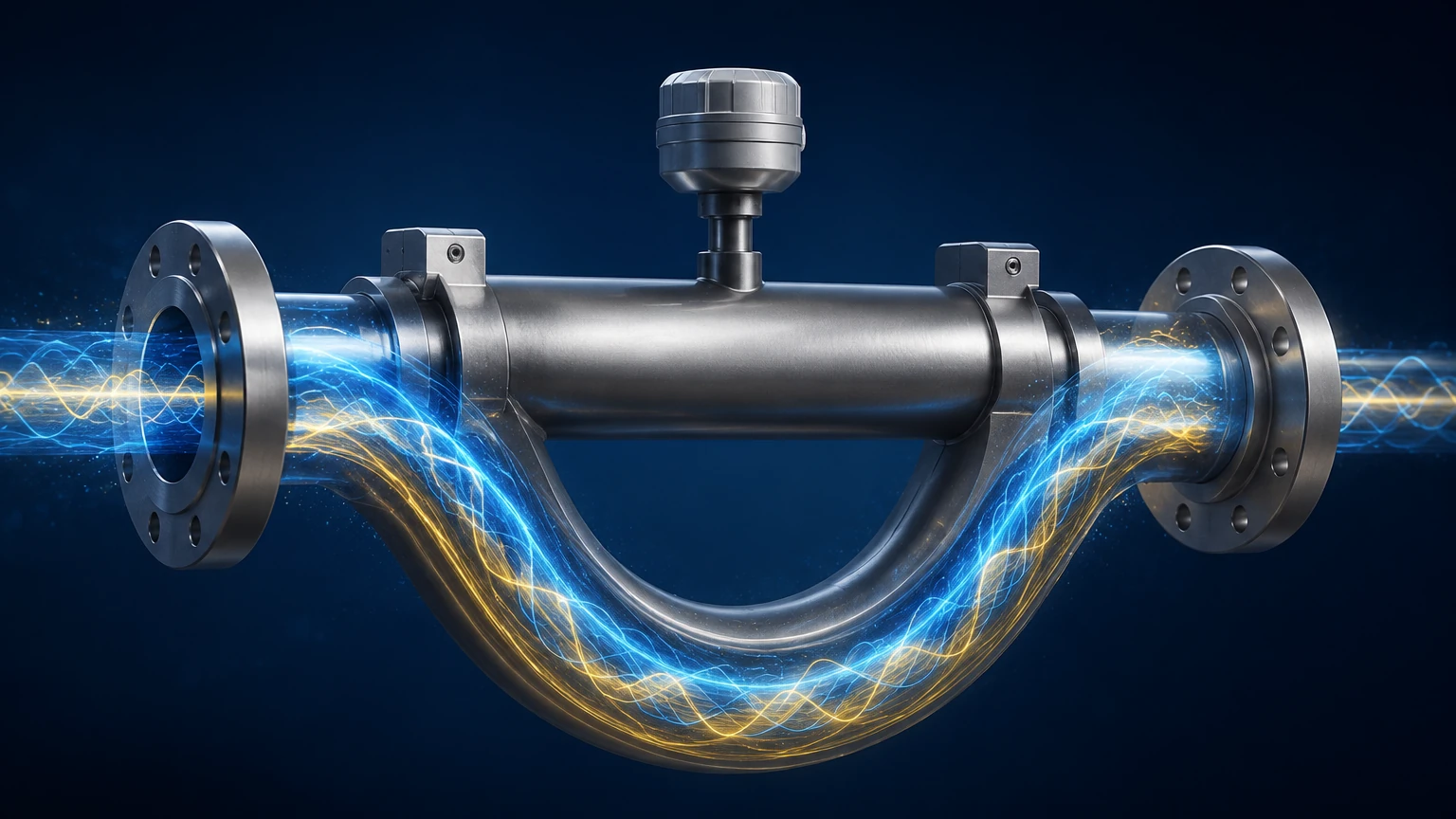
In an industrial flow meter, this "rotation" is simulated by vibrating the internal flow tubes. The meter typically consists of one or two measuring tubes that are vibrated at their resonant frequency by an electromagnetic drive coil.
The Mechanics of Oscillation
When no fluid is flowing, the tubes vibrate in a uniform, symmetrical manner. Sensors located at the inlet and outlet sides of the tube (known as pick-off sensors) detect this vibration as a simple sine wave. Because there is no mass moving through the vibrating tube, the sine waves at the inlet and outlet are perfectly in phase.
However, when a fluid (liquid or gas) begins to flow through the tubes, the mass of the fluid is subjected to the Coriolis force. As the fluid moves toward the point of maximum vibration (the center of the tube loop), it resists being pushed upward and exerts a downward force on the tube. Conversely, as the fluid moves away from the center toward the outlet, it resists the deceleration and exerts an upward force.
This results in a twisting or "phase shift" in the flow tube. The inlet side of the tube lags behind the vibration of the drive coil, while the outlet side leads it. The time delay (delta-T) between the two sine waves is directly proportional to the mass flow rate.
Direct Mass Measurement vs. Volumetric Inference
One of the primary reasons engineers investigate how does a coriolis flow meter work is the quest for mass-based accuracy. Most traditional flow meters, such as turbine or ultrasonic meters, measure volume. Because the volume of a fluid changes with temperature and pressure, volumetric measurements require external compensation to calculate mass.
Coriolis meters measure mass directly. Since mass does not change regardless of temperature or pressure fluctuations, the measurement is inherently more stable and accurate. This is particularly critical in the oil and gas industry and chemical processing, where precise mass balances are required for billing and safety. For comprehensive plant monitoring, integrating these flow systems with reliable level measurement solutions, such as those found on our Main Page, ensures that both dynamic flow and static inventory are accounted for with high precision.
Multivariable Capabilities: Density and Temperature
Beyond mass flow, a Coriolis meter is a multivariable instrument. By analyzing the frequency of the tube's vibration and the internal temperature, the meter can provide several additional data points:
1. Density Measurement: The resonant frequency at which the tube vibrates depends on the total mass of the tube and the fluid inside it. A denser fluid increases the mass of the system, causing the tube to vibrate at a lower frequency. By measuring this frequency, the meter calculates the fluid's density in real-time.
2. Temperature Measurement: Since the elasticity of the flow tubes changes with temperature, Coriolis meters include an internal Resistance Temperature Detector (RTD). This sensor provides a temperature reading used to compensate for the tube's mechanical changes, and this data is also outputted to the control system.
3. Volume Flow: By dividing the measured mass flow by the measured density, the meter can calculate an extremely accurate volumetric flow rate.
Internal Components and Design
A standard Coriolis flow meter system consists of two main parts: the sensor (the wetted part) and the transmitter (the electronics).
The Sensor Assembly
* Flow Tubes: Usually made of 316L stainless steel, Hastelloy, or Titanium. They can be U-shaped, curved, or straight. U-shaped tubes offer a wider turndown ratio and higher sensitivity, while straight tubes are easier to clean and have a lower pressure drop.
* Drive Coil: An electromagnetic assembly that induces the vibration in the tubes.
* Pick-off Sensors: Located at the inlet and outlet, these coils detect the motion of the tubes and send the signal to the transmitter.
* RTD: Monitors the temperature of the tube wall.
The Transmitter
The transmitter acts as the "brain." It provides the power to the drive coil, processes the raw signals from the pick-off sensors, and performs the complex mathematical calculations required to output mass flow, density, and temperature. Modern transmitters support various communication protocols, including 4-20mA HART, Modbus, and Profibus.
Technical Selection Criteria
When selecting a Coriolis meter for an industrial application, several factors must be evaluated to ensure performance and longevity. Welk, as a manufacturer of industrial instrumentation, emphasizes that the meter must be matched to the specific process conditions.
| Criteria | Description | Impact on Performance |
| :— | :— | :— |
| Mass Flow Range | The minimum and maximum flow rates (e.g., 0 to 50,000 kg/h). | Affects accuracy at the low end (turndown ratio). |
| Pressure Drop | The loss of pressure as fluid passes through the meter. | High pressure drop can cause cavitation or require larger pumps. |
| Material Compatibility | The alloy used for the flow tubes (e.g., Stainless Steel vs. Tantalum). | Essential for preventing corrosion in chemical applications. |
| Fluid State | Whether the fluid is a liquid, gas, or contains solids. | Entrained gas in liquids can disrupt the vibration signal. |
| Accuracy Class | Typically ranges from 0.1% to 0.5% for liquids. | Higher accuracy is required for custody transfer. |
Installation Best Practices
Even the most advanced Coriolis meter will fail to perform if installed incorrectly. Understanding how does a coriolis flow meter work involves recognizing its sensitivity to external mechanical noise.
1. Vibration Isolation: Because the meter operates on the principle of internal vibration, external vibrations from pumps or motors can interfere with the measurement. Use flexible connectors or robust piping supports to isolate the meter.
2. Orientation: For liquid applications, the tubes should ideally point downward (in a "U" shape) to prevent gas bubbles from being trapped. For gas applications, the tubes should point upward to prevent condensate from collecting.
3. Zero Calibration: After installation and under full process pressure but zero flow, a "zero trim" must be performed. This accounts for the specific mechanical stresses of the piping on the meter body.
4. Straight Runs: Unlike magnetic or turbine meters, Coriolis meters generally do not require long straight runs of pipe before or after the unit, making them ideal for tight skid-mounted applications.
Limitations and Challenges
While highly versatile, Coriolis meters are not a universal solution for every scenario.
* Initial Cost: They are significantly more expensive than electromagnetic or vortex meters. The ROI is usually found in reduced maintenance and higher process yield.
* Size and Weight: High-capacity Coriolis meters can be extremely heavy and bulky, requiring substantial structural support.
* Entrained Air: If a liquid contains significant amounts of air (slug flow), the vibration of the tubes can become erratic, leading to measurement errors or "stalling" of the drive circuit.
* Pressure Rating: Due to the thin-walled nature of the vibrating tubes required for sensitivity, very high-pressure applications may require specialized, thicker-walled designs which can reduce accuracy.
Applications in Industrial Automation
Coriolis meters are utilized across diverse sectors where precision is non-negotiable:
* Chemical Industry: Accurate dosing of catalysts and reactants where density changes are frequent.
* Food and Beverage: Measuring the mass of ingredients like syrups and oils, which vary in viscosity with temperature.
* Oil and Gas: Custody transfer of crude oil and natural gas, where even a 0.5% error can result in millions of dollars in discrepancies.
* Water Treatment: While Welk provides specialized radar and ultrasonic level sensors for large tanks, Coriolis meters are often used in the same facilities for precise polymer injection and chemical feed monitoring.
Frequently Asked Questions (FAQ)
Q: Can a Coriolis meter measure gas flow?
A: Yes. However, because gas has much lower mass than liquid, the phase shift is smaller. High-sensitivity sensors and specialized transmitters are required for accurate gas measurement.
Q: Does the viscosity of the fluid affect the accuracy?
A: No. One of the greatest advantages of the Coriolis principle is that it is independent of viscosity and Reynolds number. It performs equally well on water and thick resins.
Q: How often does a Coriolis meter need recalibration?
A: Because there are no moving parts to wear out (like bearings in a turbine), the calibration is extremely stable. Many users only perform a zero-check annually, with full wet-calibration every 3 to 5 years depending on regulatory requirements.
Q: What is the difference between a single-tube and dual-tube design?
A: Dual-tube designs are more common because they are easier to balance and are more resistant to external vibration. Single-tube designs are used primarily in food and pharmaceutical applications where a "straight-through" path is required for hygienic cleaning (CIP/SIP).
Conclusion
Mastering the complexities of how does a coriolis flow meter work allows engineers to leverage one of the most powerful tools in fluid mechanics. By measuring mass, density, and temperature simultaneously, these meters provide a level of process insight that volumetric devices cannot match. When integrated into a broader automation strategy—alongside the advanced level measurement technologies discussed on our Main Page—Coriolis meters ensure that industrial processes remain efficient, compliant, and highly productive.