In-line Quality Monitoring
In-line Quality Monitoring
In modern industrial processing, the transition from manual sampling to automated, real-time data acquisition has become a cornerstone of operational efficiency. In-line quality monitoring refers to the continuous assessment of process parameters directly within the production line or storage vessel. For industries ranging from chemical manufacturing to water treatment, maintaining precise control over liquid levels and material interfaces is not merely a matter of inventory management; it is a critical component of quality assurance. When level measurements are inaccurate, it can lead to improper mixing ratios, vessel overflows, or pump cavitation, all of which compromise the final product's integrity.
As a professional manufacturer of industrial level measurement instruments, Welk provides the technical infrastructure necessary for robust in-line quality monitoring. By integrating advanced sensors into automated control loops, facilities can achieve higher repeatability and meet stringent regulatory standards. This guide explores the principles of level measurement technologies and their specific roles in maintaining process quality.
Measurement Principles for In-line Quality Monitoring
Before selecting a sensor for quality-critical applications, it is essential to understand the physics behind different measurement technologies. Each principle offers distinct advantages depending on the physical properties of the media and the environmental conditions of the process.
Radar Level Measurement (FMCW and Pulse)
Radar technology is widely considered the gold standard for in-line quality monitoring due to its non-contact nature and high precision. It operates by emitting electromagnetic waves (typically in the 26GHz or 80GHz range) toward the product surface.
* Principle: The sensor measures the time of flight between the emission of the signal and the reception of the reflected echo. Frequency Modulated Continuous Wave (FMCW) radar, in particular, offers superior accuracy by constantly varying the frequency of the signal, allowing the sensor to resolve small changes in level even in the presence of vapor or light foam.
* Quality Impact: Because radar is independent of density, temperature, and pressure changes, it provides a stable baseline for processes where the chemical composition of the fluid might fluctuate.
Ultrasonic Level Sensing
Ultrasonic sensors are a cost-effective solution for monitoring aqueous liquids in open channels or atmospheric tanks.
* Principle: These devices emit high-frequency sound pulses. The time taken for the sound wave to bounce off the liquid surface and return to the transducer determines the distance. Since the speed of sound is affected by air temperature, high-quality ultrasonic sensors include integrated temperature compensation.
* Quality Impact: In water treatment and simple chemical storage, ultrasonic sensors ensure that reagent tanks are never depleted, preventing the failure of downstream purification stages.
Hydrostatic Pressure Measurement
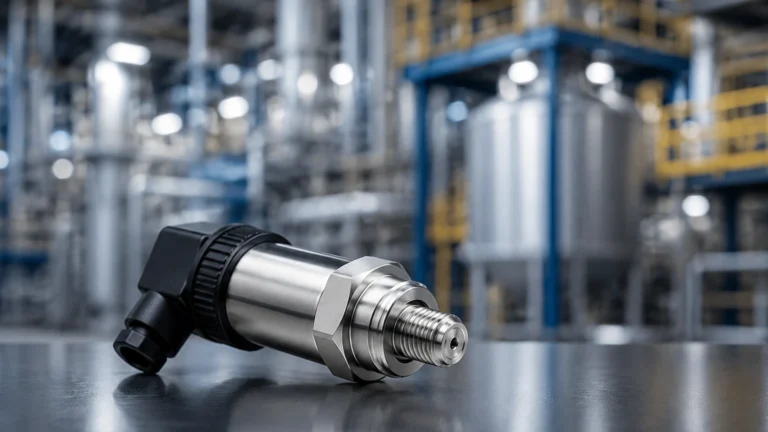
Hydrostatic transmitters are used for continuous level monitoring in vented or sealed vessels by measuring the weight of the liquid column.
* Principle: The pressure at the bottom of a tank is proportional to the height of the liquid multiplied by its density ($P = \rho \cdot g \cdot h$).
* Quality Impact: While highly reliable, hydrostatic measurement is density-dependent. In quality monitoring scenarios where the fluid density changes (e.g., during a fermentation process or chemical reaction), this must be accounted for to maintain volumetric accuracy.
Selecting Technologies for Quality-Critical Applications
Choosing the right instrument for in-line quality monitoring requires an evaluation of the process media and the vessel geometry. The following table provides a comparison of common technologies used in industrial automation.
| Technology | Typical Accuracy | Media Suitability | Environmental Resistance | Best Use Case |
| :— | :— | :— | :— | :— |
| 80GHz Radar | ±1 mm | Corrosive chemicals, hydrocarbons | Excellent (High temp/pressure) | Precision batching and reactors |
| Ultrasonic | ±0.25% of range | Water, wastewater, acids | Moderate (Sensitive to foam/wind) | Open-air sumps and storage |
| Hydrostatic | ±0.1% to ±0.5% | Slurries, oils, water | Good (Submersible options) | Deep wells and pressurized tanks |
| Magnetic Gauge | ±5 mm to ±10 mm | Clean liquids, LPG | Good (Visual + Electronic) | Boiler drums and bypass chambers |
For engineers seeking to optimize their process control loops, reviewing the full range of instrumentation is a necessary step. You can Review product options and application support on our Main Page to identify the specific sensor configurations that align with your facility's quality standards.
Practical Application Engineering
In-line quality monitoring is most effective when the level measurement is integrated into a wider SCADA or PLC system. Here are three common industrial scenarios where Welk’s solutions enhance quality:
1. Chemical Dosing and Batching
In the production of specialty chemicals, the ratio of reactants must be exact. Radar level meters with an 80GHz narrow beam angle are ideal here because they can ignore internal tank structures like agitators or heating coils. By providing a precision of ±1 mm, these sensors ensure that the exact volume of a precursor is added to the mix, directly impacting the chemical yield and purity.
2. Wastewater Treatment and Environmental Compliance
Quality monitoring in wastewater involves tracking the level of sludge and the dosage of flocculants. Ultrasonic level sensors are frequently deployed in open basins. By maintaining consistent levels in sedimentation tanks, the system prevents the carryover of solids into the effluent, ensuring the facility stays within environmental discharge limits.
3. Oil and Gas Interface Monitoring
In separation tanks, quality monitoring involves identifying the interface between oil and water. Guided wave radar (GWR) is particularly effective here. The probe remains in contact with the media, and the signal reflects differently off the low-dielectric oil and the high-dielectric water. This allows for precise control of the separation process, ensuring that the oil sent for refining contains minimal water content.
Installation Considerations for Data Integrity
Even the most advanced sensor will fail to provide quality data if installed incorrectly. To ensure the reliability of in-line quality monitoring, engineers must consider the following:
* Blocking Distance (Dead Zone): Every non-contact sensor has a minimum distance it cannot measure (the "dead zone"). For ultrasonic sensors, this is typically 0.25 m to 0.5 m (approx. 10 to 20 inches). For radar, it is much smaller, often less than 0.1 m. Ensure the maximum liquid level never enters this zone.
* Nozzle Geometry: For radar and ultrasonic sensors, the mounting nozzle should be as short and wide as possible. Internal welds or narrow pipes can cause parasitic reflections (false echoes) that interfere with the true level signal.
* Agitators and Turbulence: If a tank has a stirrer, the liquid surface will be turbulent. In these cases, using a stilling well or a bypass pipe can provide a calm surface for the sensor to measure, significantly improving the stability of the quality data.
* Environmental Factors: In outdoor installations, sun shields should be used to prevent the sensor electronics from overheating, which can cause signal drift and affect the accuracy of the quality monitoring loop.

Limitations and Mitigation Strategies
While in-line quality monitoring significantly improves process outcomes, it is important to recognize the limitations of various sensors:
1. Dielectric Constant (DK) Limits: Radar sensors rely on the dielectric constant of the material. If a liquid has a very low DK (e.g., liquid nitrogen or certain solvents), the reflection may be too weak. In these instances, Welk recommends using guided wave radar or high-sensitivity 80GHz units designed for low-reflectivity media.
2. Heavy Foam: Thick, dense foam can absorb ultrasonic and radar signals. For processes involving heavy surfactants, hydrostatic pressure transmitters or magnetic level gauges are often more reliable, as they are unaffected by surface conditions.
3. Vapor and Condensation: High-pressure steam or heavy chemical vapors can slow down ultrasonic waves, leading to measurement errors. Radar is generally immune to these effects, making it the preferred choice for high-temperature reactors.
Frequently Asked Questions (FAQs)
Q: What is the difference between accuracy and repeatability in quality monitoring?
A: Accuracy refers to how close the measured value is to the actual level. Repeatability refers to the sensor's ability to provide the same measurement under identical conditions. For many in-line quality monitoring applications, repeatability is more critical than absolute accuracy, as it ensures batch-to-batch consistency.
Q: How often should in-line level sensors be calibrated?
A: This depends on the industry. In regulated pharmaceutical or food processes, calibration may be required every 6 to 12 months. For general water treatment, an annual check is usually sufficient. Welk sensors are designed for long-term stability to minimize the need for frequent recalibration.
Q: Can these sensors be used in hazardous (Ex) zones?
A: Yes. Most industrial radar and hydrostatic sensors are available with ATEX, IECEx, or UL certifications for use in explosive atmospheres, which is a common requirement in oil, gas, and chemical quality monitoring.
Conclusion
Effective in-line quality monitoring is built on the foundation of reliable data. By selecting the appropriate level measurement technology—whether it be the precision of 80GHz radar or the robustness of hydrostatic pressure—industrial operators can ensure their processes remain efficient, safe, and compliant. Welk’s commitment to advanced engineering and strict quality control provides the tools necessary for global customers to achieve superior process transparency. For detailed specifications and technical guidance on integrating these solutions into your facility, visit the Main Page to explore our comprehensive product portfolio.