Industrial Digital Thermometer
Industrial Digital Thermometer
In the landscape of industrial process control, the accurate measurement of temperature is as fundamental as the measurement of pressure or flow. An industrial digital thermometer is a precision instrument designed to convert thermal energy into a digital signal, providing real-time data for monitoring, safety, and automation. Unlike traditional liquid-in-glass or bimetallic thermometers, digital variants offer higher resolution, faster response times, and the ability to integrate directly with Programmable Logic Controllers (PLCs) and Distributed Control Systems (DCS).
For engineers and plant managers, selecting the correct industrial digital thermometer involves understanding the underlying sensor physics, the environmental constraints of the facility, and the specific requirements of the medium being measured. Whether monitoring a chemical reactor, a water treatment facility, or a high-pressure steam line, the choice of digital thermometry impacts both product quality and operational safety.
Measurement Principles and Sensor Technologies
Industrial digital thermometers rely on various sensor technologies to detect thermal changes. The choice of sensor determines the instrument's range, sensitivity, and durability.
Resistance Temperature Detectors (RTDs)
RTDs operate on the principle that the electrical resistance of a metal increases as temperature rises. The most common material used is platinum, specifically the Pt100 sensor (which has a resistance of 100 ohms at 0°C) or the Pt1000 sensor.
* Accuracy: RTDs are known for high stability and accuracy, often used in applications where precision is critical.
* Range: Typically effective from -200°C to 650°C (-328°F to 1202°F).
* Linearity: They provide a very linear output across their range, making digital conversion straightforward.
Thermocouples
Thermocouples consist of two dissimilar metal wires joined at one end (the sensing junction). When there is a temperature gradient between the sensing junction and the reference junction, a voltage is produced (the Seebeck effect).
* Durability: These are robust and can withstand extreme temperatures and mechanical vibrations.
* Range: Depending on the type (K, J, T, E, N, S, R, B), they can measure from -270°C up to 1800°C (-454°F to 3272°F).
* Response Time: Because the sensing tip can be very small, thermocouples react quickly to temperature changes.
Thermistors
Thermistors are ceramic-like semiconductors that exhibit a large change in resistance for a small change in temperature.
* Sensitivity: Highly sensitive but generally limited to a narrower temperature range, usually -50°C to 150°C (-58°F to 302°F).
* Applications: Often found in handheld industrial digital thermometers or localized electronic monitoring where extreme heat is not present.
Key Components of an Industrial Digital Thermometer
A complete industrial digital thermometer system consists of more than just the sensor. To provide a reliable reading in a B2B environment, several components must work in unison:
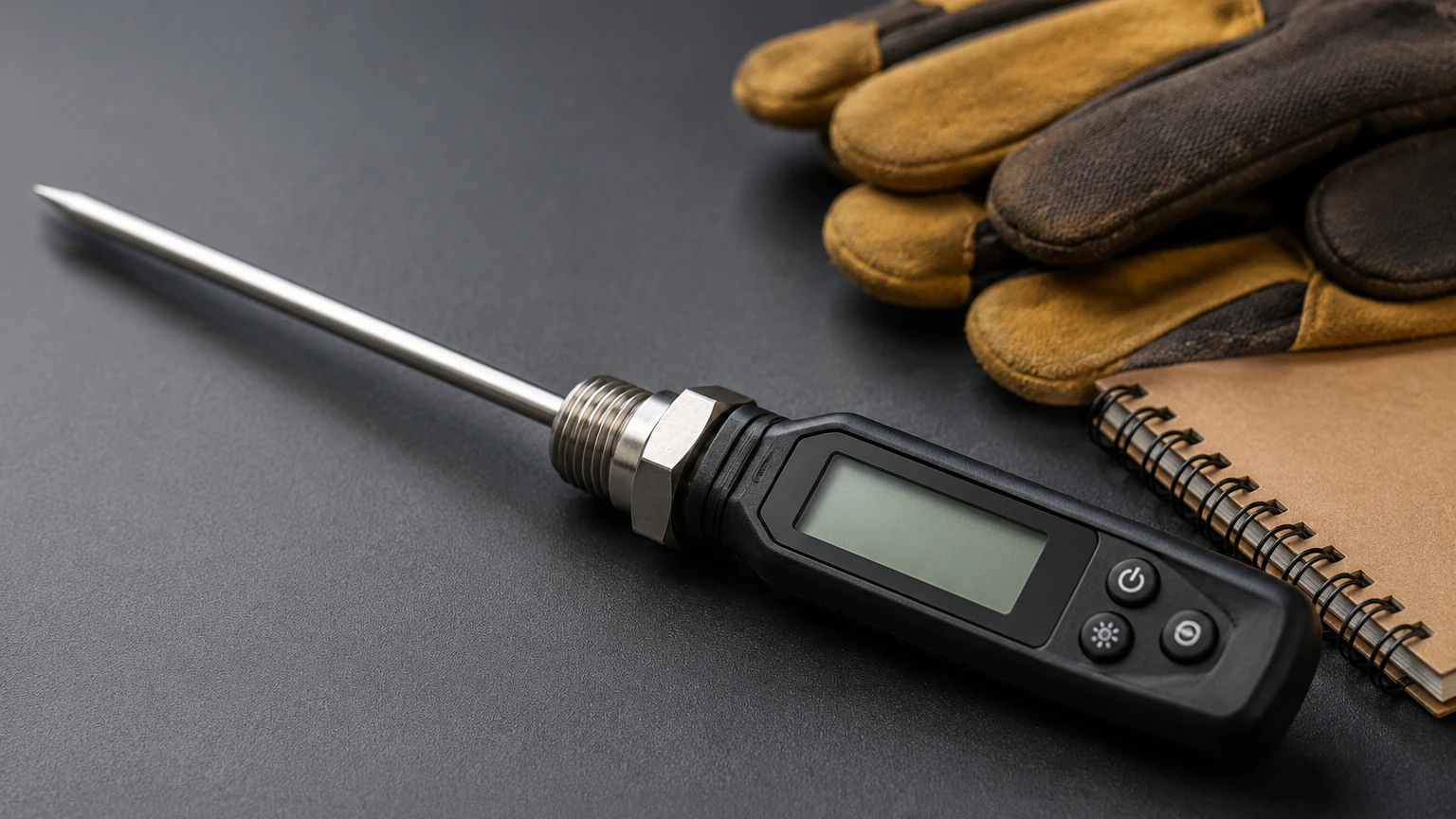
1. The Probe/Sheath: Usually made of 316L stainless steel or specialized alloys like Inconel, the probe protects the sensor from corrosive media and high pressures. In many industrial setups, the probe is inserted into a thermowell, allowing for sensor replacement without breaching the process vessel.
2. Analog-to-Digital Converter (ADC): The raw signal (voltage from a thermocouple or resistance from an RTD) is analog. The ADC converts this into a digital bitstream. High-resolution ADCs (24-bit) are preferred for industrial precision.
3. Microprocessor: This component applies calibration coefficients and linearization algorithms to the digital data. It also manages the user interface and communication protocols.
4. Display/Indicator: For local monitoring, an LED or LCD screen displays the temperature. Industrial displays are often backlit and designed for high visibility in low-light plant environments.
5. Signal Output: In an automated facility, the thermometer often outputs a 4-20mA signal, a 0-10V signal, or digital protocols such as HART, Modbus, or Profibus.
Selection Criteria for Process Environments
When evaluating an industrial digital thermometer for a specific application, engineers must look beyond the basic temperature range.
Environmental Protection
Industrial environments are often harsh. Instruments should have an appropriate Ingress Protection (IP) rating. For instance, an IP67 rating ensures the device is dust-tight and can withstand temporary immersion in water. In chemical plants, the housing must be resistant to corrosive vapors.
Response Time (T90)
The T90 value indicates the time it takes for the thermometer to reach 90% of a step change in temperature. In fast-moving processes or safety-critical cooling loops, a low T90 value is essential. Probes with smaller diameters generally have faster response times but lower mechanical strength.
Accuracy and Calibration
Accuracy is typically defined as a percentage of the full scale or a specific degree value (e.g., ±0.1°C). For B2B applications, it is vital to confirm that the instrument comes with a calibration certificate traceable to national standards (like NIST or DKD). Regular recalibration is necessary to account for sensor drift over time.
Practical Selection Table: RTD vs. Thermocouple
| Feature | RTD (Pt100/Pt1000) | Thermocouple (Type K/J) | Digital Integrated Sensor |
| :— | :— | :— | :— |
| Temperature Range | -200°C to 650°C | -270°C to 1260°C+ | -50°C to 150°C |
| Accuracy | Excellent (Class A/AA) | Moderate | High (within range) |
| Long-term Stability | High | Low (drifts over time) | High |
| Response Speed | Moderate | Fast | Moderate |
| Cost | Higher | Lower | Moderate |
| Best Use Case | Precision labs, food/pharma | High-heat furnaces, kilns | HVAC, electronics cooling |
Installation Guidelines and Best Practices
Proper installation is critical to ensuring that an industrial digital thermometer reflects the true temperature of the process rather than the ambient environment.
* Immersion Depth: A general rule of thumb is that the probe should be immersed to a depth of at least 10 times its diameter (for liquids) or 15 times its diameter (for gases) to minimize stem conduction errors.
* Thermowell Usage: In high-velocity pipes or high-pressure tanks, always use a thermowell. This protects the sensor from mechanical stress and allows for maintenance without shutting down the process. Ensure the gap between the sensor and the thermowell wall is minimized, often by using thermal paste.
* Wiring and Interference: Digital thermometers, especially those using RTDs or thermocouples with long cable runs, are susceptible to Electromagnetic Interference (EMI). Use shielded cables and keep signal wires away from high-voltage power lines.
* Mounting Orientation: In horizontal pipes, the probe should ideally be installed vertically or at a 45-degree angle against the flow to ensure constant contact with the fluid.
Limitations and Common Challenges
While highly effective, the industrial digital thermometer is not without its limitations:
1. Self-Heating: In RTDs, the current passed through the sensor to measure resistance generates a small amount of heat. If the medium is not flowing or has low thermal conductivity, this can result in an artificially high reading.
2. Hysteresis: Sensors may show different readings for the same temperature depending on whether the temperature is increasing or decreasing. High-quality industrial sensors minimize this effect through advanced material science.
3. Vibration Fatigue: In heavy machinery applications, constant vibration can lead to mechanical failure of the sensor wires or the digital display. In such cases, vibration-resistant probes or remote-mounted displays are required.
4. Calibration Drift: Over time, the physical properties of the sensor change. Thermocouples, in particular, suffer from "decalibration" due to atmospheric contamination of the metal wires at high temperatures.
The Role of Temperature in Level Measurement Accuracy
In many industrial applications, temperature measurement is not an isolated task but a critical component of accurate level measurement. As a professional manufacturer of industrial instruments, Welk provides comprehensive solutions where temperature and level data are integrated for process optimization.
For example, in hydrostatic level measurement, the pressure at the bottom of a tank is used to calculate the liquid height. However, the density of the liquid changes with temperature. Without an accurate industrial digital thermometer providing compensation data, the level reading would fluctuate as the tank warms or cools. Similarly, in ultrasonic level measurement, the speed of sound is highly dependent on the air temperature between the sensor and the liquid surface. Advanced level systems often incorporate temperature sensors directly into the transducer to provide real-time compensation.
To explore how these technologies integrate into a complete process control strategy, you can visit the Main Page for detailed product specifications and application support across various industrial sectors.
Frequently Asked Questions
Q: What is the difference between a 2-wire, 3-wire, and 4-wire RTD?
A: A 2-wire RTD is the simplest but least accurate because the lead wire resistance adds to the sensor resistance. A 3-wire RTD uses a third wire to cancel out the lead resistance, which is the industrial standard. A 4-wire RTD provides the highest precision by completely eliminating lead wire effects, typically used in laboratory or high-precision B2B applications.
Q: Can I use a digital thermometer in explosive atmospheres?
A: Yes, but the device must be rated as Intrinsically Safe (IS) or Explosion-Proof (XP). Look for certifications such as ATEX (Europe), IECEx (Global), or UL/FM (North America) to ensure the electronics cannot provide an ignition source in hazardous environments.
Q: How often should an industrial digital thermometer be calibrated?
A: The frequency depends on the criticality of the process and the sensor type. Most industrial facilities perform a calibration check annually. However, for high-accuracy pharmaceutical or food processes, semi-annual or even quarterly checks may be required.
Q: What is the advantage of a digital output (like Modbus) over a 4-20mA signal?
A: Digital outputs are less susceptible to noise over long distances and can carry more information, such as device diagnostics, sensor health status, and multiple process variables, over a single pair of wires.
By understanding these technical nuances, procurement and engineering teams can ensure they select an industrial digital thermometer that provides the reliability and accuracy required for modern industrial automation.