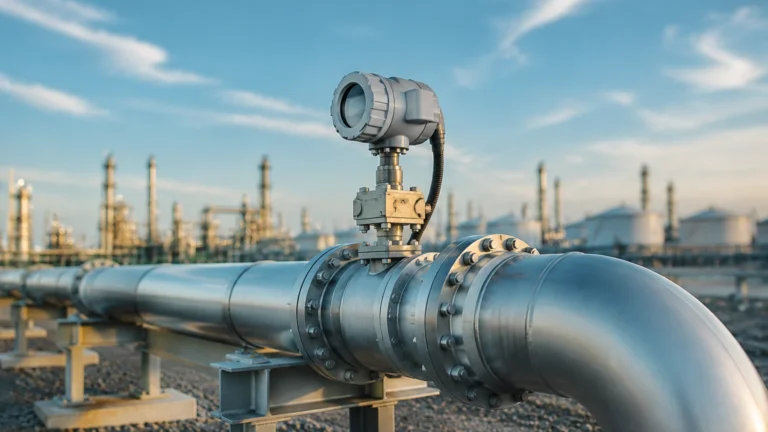
Industrial Temperature Monitoring
Industrial Temperature Monitoring
Industrial temperature monitoring is a fundamental requirement across almost every process industry, from chemical manufacturing and oil refining to water treatment and food processing. Temperature is not merely a standalone variable; it is a critical factor that influences chemical reaction rates, material viscosity, pressure, and the accuracy of other measurements, such as liquid level. In industrial automation, maintaining precise thermal control ensures product quality, equipment longevity, and operational safety.
Effective monitoring requires an understanding of the underlying physics of thermal measurement, the specific characteristics of different sensor technologies, and the environmental factors that can introduce error into a control loop.
Fundamentals of Industrial Temperature Measurement
Temperature measurement in industrial settings typically relies on the conversion of thermal energy into a measurable electrical signal. This is achieved through several distinct physical principles, each suited to different process conditions.
Resistance Temperature Detectors (RTDs)
RTDs operate on the principle that the electrical resistance of a metal increases as its temperature rises. Most industrial RTDs utilize platinum (Pt) due to its stability and linear resistance-to-temperature relationship. The most common type is the Pt100, which has a resistance of 100 ohms at 0°C (32°F).
RTDs are known for their high accuracy and repeatability. They are typically used in applications where precision is paramount and the temperature range is within -200°C to +600°C (-328°F to 1112°F). To compensate for lead wire resistance, these sensors are often configured in 3-wire or 4-wire circuits.
Thermocouples
Thermocouples function based on the Seebeck effect, where a voltage is generated at the junction of two dissimilar metals when subjected to a temperature gradient. Different combinations of metals (Types J, K, T, E, R, S, B) provide varying ranges and sensitivities. For example, Type K (Chromel-Alumel) is a general-purpose sensor capable of measuring up to 1260°C (2300°F).
Thermocouples are preferred for high-temperature applications and environments where physical durability is required. However, they are generally less accurate than RTDs and require cold-junction compensation at the transmitter or controller.
Infrared (IR) Thermometers
Non-contact temperature monitoring utilizes infrared sensors to detect the thermal radiation emitted by a surface. This is essential for moving parts, extremely high temperatures, or corrosive media where a physical probe cannot be submerged. The accuracy of IR monitoring depends heavily on the emissivity of the target material and the presence of atmospheric interference such as steam or dust.
The Role of Temperature in Level Measurement Accuracy
In the context of industrial automation, industrial temperature monitoring is inextricably linked to level measurement. Many level sensing technologies require temperature data to provide an accurate reading.
1. Hydrostatic Pressure: The density of a liquid changes with its temperature. Since hydrostatic level transmitters calculate level based on the pressure exerted by a liquid column ($P = \rho gh$), a change in temperature that alters the density ($\rho$) will result in an incorrect level reading if not compensated for by a temperature sensor.
2. Ultrasonic and Radar: In ultrasonic level measurement, the speed of sound is highly dependent on the temperature of the gas medium through which it travels. Without integrated temperature monitoring, the calculated distance to the liquid surface will drift as the ambient air or vapor space heats up. Even in radar level measurement, while the speed of light is constant, extreme temperature fluctuations can affect the dielectric constant of certain vapors, necessitating compensation for high-precision applications.
3. Mechanical Gauges: Magnetic level gauges and float switches rely on buoyancy. As temperature increases and liquid density decreases, the float may sit lower in the liquid, introducing a slight offset in the indicated level.
Engineers looking to integrate these variables often consult the Main Page to find level measurement solutions that include integrated temperature compensation features.
Selection Criteria for Process Applications
Choosing the correct instrument for industrial temperature monitoring involves balancing technical requirements with cost and environmental constraints. The following table provides a comparison of the primary contact-based technologies:
| Feature | RTD (Pt100/Pt1000) | Thermocouple (General) | Thermistor |
| :— | :— | :— | :— |
| Temperature Range | -200°C to +600°C | -200°C to +1800°C | -90°C to +130°C |
| Accuracy | High | Medium to Low | Medium |
| Stability | Excellent | Fair | Poor |
| Response Time | Slow (0.5 to 5s) | Fast (0.1 to 1s) | Fast (0.1 to 2s) |
| Linearity | Good | Fair | Exponential |
| Durability | Fragile (vibration sensitive) | Very Rugged | Fragile |
Key Evaluation Factors
* Process Media: Is the medium corrosive, abrasive, or under high pressure? This dictates the material of the thermowell (e.g., 316L Stainless Steel, Hastelloy, or Ceramic).
* Required Precision: If the process requires a tolerance of ±0.1°C, an RTD is the only viable choice. For general monitoring where ±2.0°C is acceptable, a thermocouple is more cost-effective.
* Environmental Interference: In areas with high electromagnetic interference (EMI), 4-20mA transmitters are preferred over raw millivolt signals from thermocouples to prevent signal degradation.

Installation Best Practices and Thermowell Design
The accuracy of industrial temperature monitoring is often limited not by the sensor itself, but by how it is installed. Proper mechanical integration ensures that the sensor reflects the true process temperature rather than the temperature of the vessel wall or the ambient environment.
Thermowell Selection
A thermowell is a pressure-tight receptacle that protects the temperature sensor from the process fluid.
* Insertion Length: The probe should be long enough to reach the center of the pipe or at least one-third of the way into the vessel to avoid "wall effect" cooling. A common rule of thumb is an insertion length of 10 times the thermowell diameter for liquids and 15 times for gases.
* Lagging Extensions: For insulated pipes or vessels, a lagging extension is required to move the transmitter head away from the insulation, preventing the electronics from overheating or being buried under the insulation layer.
* Velocity Stress: In high-flow pipelines, thermowells must be designed to withstand wake frequency oscillations. If the fluid velocity matches the natural frequency of the thermowell, it can lead to mechanical failure.
Wiring and Signal Transmission
For long-distance signal transmission, raw signals (Ω for RTDs or mV for Thermocouples) should be converted to a 4-20mA current loop or a digital protocol like HART or Modbus. This reduces the impact of wire resistance and electrical noise. When using thermocouples, specific extension wires made of the same alloys as the sensor must be used to prevent the creation of unintended junctions.
Limitations and Common Challenges
Despite advancements in sensor technology, industrial temperature monitoring faces several persistent challenges:
* Sensor Drift: Over time, the physical properties of the sensor elements change due to thermal cycling and contamination. Regular calibration against a known standard (such as a dry-block calibrator) is necessary to maintain system integrity.
* Response Lag: The mass of the thermowell introduces a thermal delay. In processes with rapid temperature swings, thin-walled thermowells or direct-insertion sensors may be required, though this compromises the ability to replace the sensor without shutting down the process.
* Calibration in Situ: Calibrating a sensor while it is installed in a pressurized vessel is difficult. Using "double-element" sensors allows one element to be used for control while the other is used for periodic verification.
* Hazardous Areas: In environments with explosive dust or gases, sensors must be rated as intrinsically safe (IS) or explosion-proof. This requires the use of specialized barriers and enclosures to prevent electrical sparks from entering the hazardous zone.
Frequently Asked Questions
Q: When should I choose a 4-wire RTD over a 3-wire RTD?
A: A 4-wire RTD should be used when the highest possible accuracy is required, especially when the lead wire distance is long. The 4-wire configuration completely cancels out the resistance of the lead wires, whereas a 3-wire configuration only assumes the lead wires have identical resistance.
Q: Can I use a temperature sensor to detect dry-run conditions in a pump?
A: Yes. Industrial temperature monitoring is often used as a secondary safety measure. If a pump runs dry, friction increases the temperature of the pump casing or the fluid remaining in the seal chamber, triggering an automated shutdown.
Q: How often should industrial temperature sensors be calibrated?
A: Most industrial standards recommend an annual calibration. However, in critical safety applications or high-temperature processes where drift is more aggressive, semi-annual or quarterly checks may be necessary.
Q: What is the impact of high vibration on temperature sensors?
A: High vibration can cause mechanical fatigue in RTD elements, leading to open circuits. In high-vibration environments, thermocouples or specialized vibration-resistant RTDs with thin-film elements are preferred over wire-wound versions.
By carefully selecting the appropriate sensor technology and adhering to rigorous installation standards, facilities can ensure that their industrial temperature monitoring systems provide the reliable data necessary for efficient and safe process control. For more information on how temperature data integrates with broader process instrumentation, users can review product options and application support on the Main Page.