Keve Sencer
Keve Sencer
In the landscape of industrial automation and process control, the accurate measurement of liquid and solid levels is a fundamental requirement. Whether managing water treatment facilities, chemical processing plants, or oil and gas refineries, the deployment of a reliable level sensor—often searched for and identified in technical procurement as a keve sencer—is critical for operational safety and efficiency. This guide provides a comprehensive technical overview of modern level measurement technologies, their operating principles, and the criteria necessary for selecting the appropriate instrument for specific industrial applications.
Industrial level measurement is not a one-size-fits-all discipline. The physical properties of the media, the environmental conditions of the storage vessel, and the required precision all dictate which technology should be employed. By understanding the underlying physics of these devices, engineers can ensure long-term reliability and minimize maintenance overhead.
Core Measurement Principles of Level Instrumentation
To select the right keve sencer, one must first understand the primary methods used to detect the interface between two media (typically a liquid and a gas, or a solid and a gas).
Radar Level Measurement (ToF)
Radar technology is widely considered the gold standard for high-precision industrial level measurement. It operates on the Time-of-Flight (ToF) principle. The sensor emits high-frequency microwave pulses (typically in the 26 GHz or 80 GHz range) that travel at the speed of light. When these pulses hit the surface of the medium, they are reflected back to the sensor antenna.
* Non-Contact Radar: The sensor is mounted at the top of the tank and does not touch the medium. This is ideal for corrosive or hygienic applications. The 80 GHz models offer a narrow beam angle, which is particularly useful in tanks with internal obstructions like agitators or heating coils.
* Guided Wave Radar (GWR): This version uses a probe (cable or rod) to guide the microwave pulse directly to the surface. GWR is highly effective for liquids with low dielectric constants or applications involving heavy foam and turbulence, as the probe ensures the signal reaches the surface and returns with minimal loss.
Ultrasonic Level Sensors
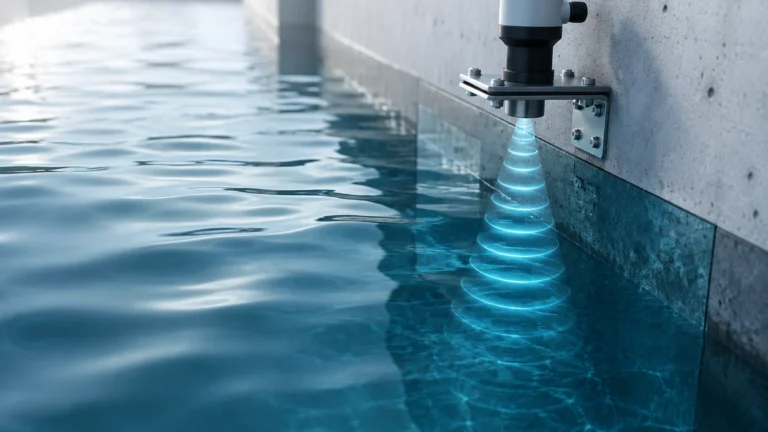
Ultrasonic sensors also use the ToF principle but utilize sound waves instead of electromagnetic waves. The transducer emits an ultrasonic pulse (usually between 20 kHz and 200 kHz) which bounces off the surface of the material.
While cost-effective and easy to install, ultrasonic technology is sensitive to the medium through which the sound travels. Factors such as air temperature, humidity, and the presence of heavy vapors or dust can alter the speed of sound, potentially affecting accuracy. Most modern ultrasonic units include integrated temperature compensation to mitigate these effects.
Hydrostatic Level Measurement
Hydrostatic sensors measure the pressure exerted by a liquid column at a specific point. The relationship is defined by the formula $P = \rho gh$, where $P$ is pressure, $\rho$ is the density of the liquid, $g$ is the gravitational constant, and $h$ is the height of the liquid.
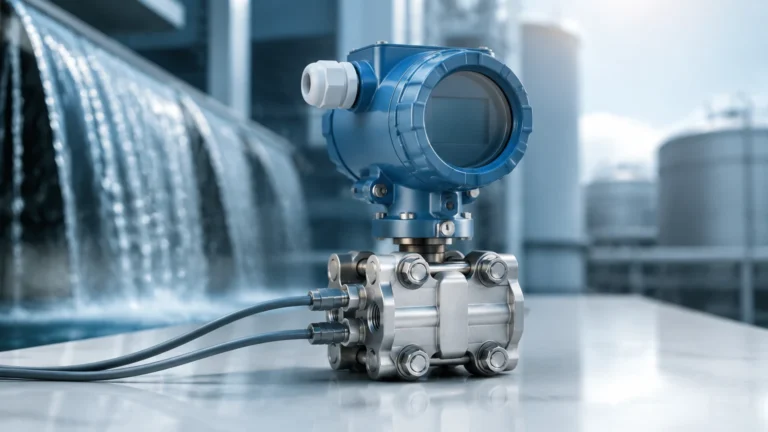
In open tanks, a simple pressure transmitter at the bottom of the vessel is sufficient. In pressurized or closed tanks, a differential pressure (DP) approach is required to subtract the overhead gas pressure from the total pressure measured at the bottom. This method is exceptionally reliable for constant-density liquids and is a staple in water and wastewater management.
Magnetic Level Gauges
Magnetic level gauges are mechanical-optical systems that provide both local visual indication and remote electronic signals. They consist of a bypass chamber attached to the side of a tank. Inside the chamber, a float containing a permanent magnet moves with the liquid level. This magnet flips colored flaps on an external scale and can also trigger reed switches or continuous transmitters. Because the liquid is contained within a rugged metal chamber, this is a preferred choice for high-pressure and high-temperature hazardous fluids.
Practical Selection Criteria for a Keve Sencer
Choosing the correct keve sencer requires a detailed analysis of the process environment. Engineers should confirm the following parameters before procurement:
1. Media Characteristics: Is the liquid corrosive, viscous, or prone to coating? Does it have a low dielectric constant (which affects radar) or varying density (which affects hydrostatic)?
2. Process Temperature and Pressure: Standard sensors may fail under extreme heat or vacuum conditions. For instance, high-frequency radar can handle temperatures exceeding 200°C, whereas standard ultrasonic sensors are often limited to 80°C.
3. Tank Geometry: The presence of internal structures, the height-to-width ratio of the tank, and the mounting location (nozzle height and diameter) significantly influence signal integrity.
4. Accuracy Requirements: For inventory custody transfer, high-accuracy radar (±1mm) is necessary. For simple pump control or overfill protection, a hydrostatic or ultrasonic sensor with ±0.25% to ±0.5% accuracy is usually sufficient.
Technology Comparison Table
| Technology | Typical Accuracy | Max Range | Best For | Limitations |
| :— | :— | :— | :— | :— |
| Radar (Non-contact) | ±1 mm to ±5 mm | Up to 120m | Corrosive liquids, solids, high temp | High cost, dielectric sensitivity |
| Ultrasonic | ±0.25% of range | Up to 30m | Water, wastewater, simple liquids | Affected by foam, dust, and vapor |
| Hydrostatic | ±0.1% to ±0.5% | Dependent on head | Constant density liquids | Density changes affect accuracy |
| Guided Wave Radar | ±2 mm | Up to 75m | Low dielectric, foam, turbulence | Contact with media, probe coating |
| Magnetic Gauge | ±5 mm to ±10 mm | Up to 6m | High pressure, hazardous chemicals | Mechanical wear, bypass piping needed |
Installation Considerations and Best Practices
Proper installation is as important as selecting the right technology. Even the most advanced keve sencer will provide inaccurate data if mounted incorrectly.
Avoiding the Dead Zone
Every non-contact sensor (radar and ultrasonic) has a "dead zone" or blocking distance near the face of the transducer. If the liquid level enters this zone, the sensor cannot process the return signal correctly. It is vital to mount the sensor high enough so that the maximum possible liquid level remains below this threshold.
Nozzle Mounting
When mounting a sensor on a nozzle, ensure the nozzle is as short and wide as possible. Long, narrow nozzles can create internal reflections (ringing) that the sensor might mistake for the liquid level. For radar sensors, the antenna should ideally extend slightly beyond the bottom of the nozzle into the tank space.
Obstruction Management
In tanks with agitators, ladders, or inflow pipes, the sensor should be positioned to avoid these structures. If avoidance is impossible, many modern instruments offer "false echo suppression" or "background subtraction" software. This allows the user to map out static reflections so the sensor ignores them and only tracks the moving surface of the medium.
Environmental Protection
For outdoor installations, sensors should be equipped with sunshields to prevent extreme temperature fluctuations from affecting the electronics or the speed-of-sound calculations in ultrasonic devices. Furthermore, ensure the cable entry points are sealed with appropriate glands to maintain the IP66/IP67/IP68 rating and prevent moisture ingress.

Limitations and Common Risks
Understanding the boundaries of your keve sencer technology prevents costly downtime.
* Foam: Heavy, dense foam can absorb ultrasonic and radar signals, leading to a "loss of echo" error. In these cases, Guided Wave Radar or hydrostatic pressure sensors are more reliable.
* Vapor and Condensation: In closed tanks, condensation can form on the sensor face. While some radar antennas are designed to shed droplets, heavy buildup can attenuate the signal. Air purging systems are sometimes required.
* Vacuum Conditions: Ultrasonic waves require a medium (air or gas) to travel. In a vacuum, ultrasonic sensors will not work. Radar, which uses electromagnetic waves, is unaffected by vacuum.
* Turbulence: Rapidly moving surfaces can scatter signals. Using a stilling well or a bypass pipe can provide a calm surface for the sensor to measure accurately.
Frequently Asked Questions (FAQ)
Q: Can a keve sencer be used for both liquids and solids?
A: Yes, but the technology choice differs. Radar is excellent for both. Ultrasonic can work for solids but requires higher power to overcome the uneven, non-reflective surface of powders and grains.
Q: How often should these sensors be calibrated?
A: This depends on the industry. For water treatment, annual checks are standard. In the pharmaceutical or chemical industry, calibration may be required every six months to ensure compliance with safety and quality standards.
Q: What is the difference between a level transmitter and a level switch?
A: A level transmitter (like a radar or hydrostatic sensor) provides continuous measurement (e.g., 4-20mA or Modbus signal) across the entire range. A level switch only detects when the material reaches a specific point, used primarily for high-level alarms or low-level pump protection.
Conclusion and Engineering Support
Selecting the right industrial level measurement solution requires a balance of technical performance and cost-effectiveness. By analyzing the physical properties of the process and the environmental constraints, engineers can deploy a keve sencer that provides accurate, maintenance-free data for years.
As a professional manufacturer, Welk offers a wide array of instruments, including radar, ultrasonic, and hydrostatic solutions tailored to specific industrial needs. For comprehensive technical specifications and to explore the full range of industrial measurement tools, professionals often visit the Main Page of leading manufacturers to review product options and application support. Ensuring you have the correct data before purchase is the most effective way to guarantee project success in industrial automation.