Laser Liquid Level Sensor
Laser Liquid Level Sensor
In the landscape of industrial process control, the laser liquid level sensor represents a specialized solution for non-contact measurement. While ultrasonic and radar technologies dominate many general-purpose applications, laser-based systems are often selected for their high precision, narrow beam divergence, and ability to measure in confined spaces where other technologies might fail due to signal interference. This guide provides an engineering-focused overview of laser level measurement principles, selection criteria, and practical installation considerations for B2B procurement and system integration.
Principles of Laser Level Measurement
Laser liquid level sensors operate using light-based distance measurement, typically employing one of two primary methods: Time-of-Flight (ToF) or Phase Shift measurement. Understanding these principles is essential for determining if a laser sensor is suitable for a specific liquid medium.
Time-of-Flight (ToF) Principle
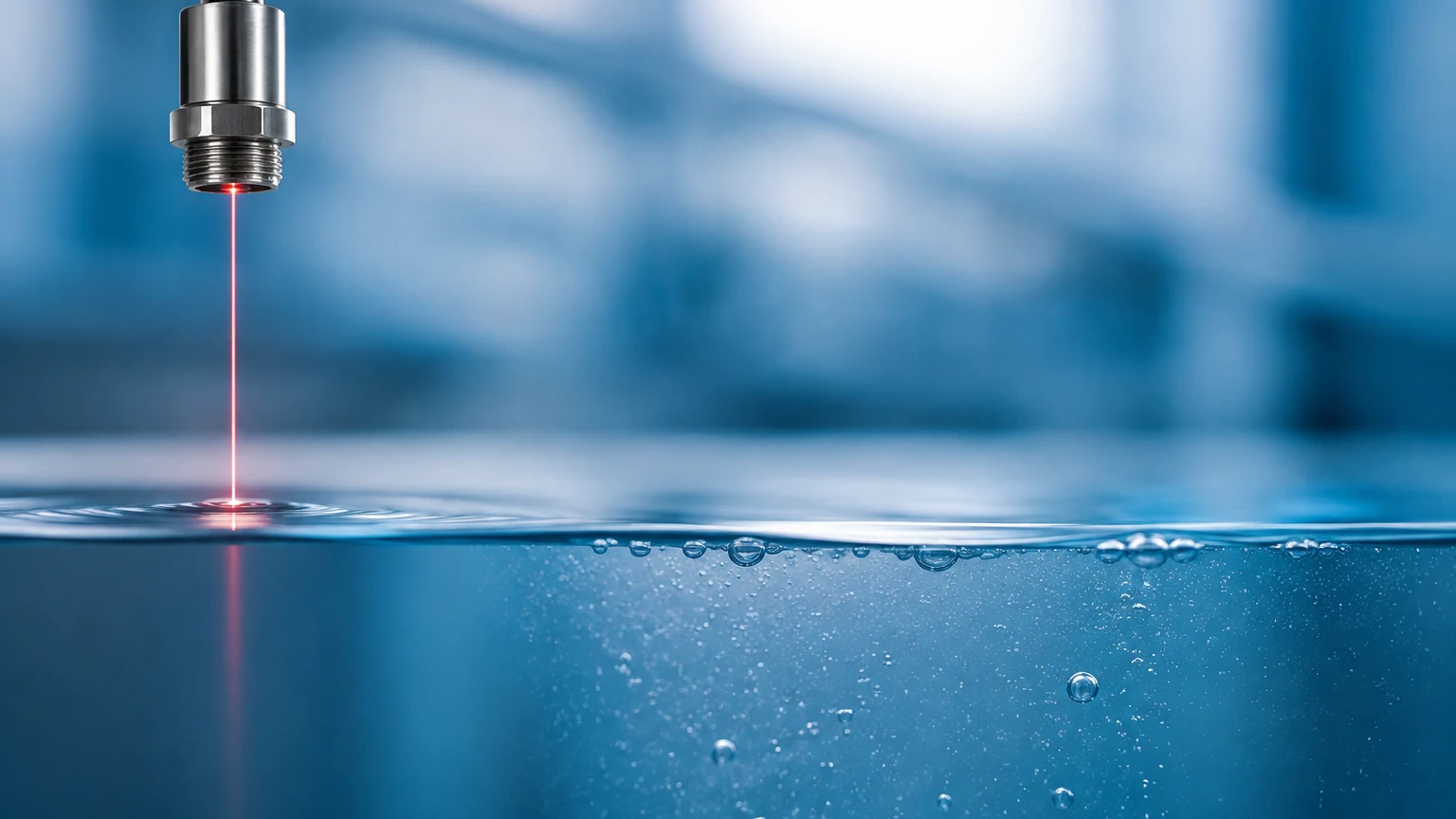
The sensor emits a short pulse of laser light toward the liquid surface. This light travels at the speed of light ($c \approx 300,000$ km/s). When the pulse hits the liquid surface, a portion of the light is reflected back to the sensor's receiver. The instrument measures the time interval between the emission and the reception. The distance ($D$) is calculated using the formula:
$D = (c \times t) / 2$, where $t$ is the elapsed time.
ToF is generally preferred for long-range measurements, often reaching up to 30 meters or more on reflective surfaces, though liquid applications typically operate within a 0.5 to 15-meter range to maintain accuracy.
Phase Shift Principle
Instead of a single pulse, the sensor emits a continuous laser beam modulated by a specific frequency. The sensor compares the phase of the reflected light wave with the phase of the transmitted wave. The phase difference is proportional to the distance. This method is highly accurate, often reaching sub-millimeter precision, making it ideal for high-precision batching or small-scale laboratory vessels.
Reflection Characteristics
Unlike radar waves, which react to the dielectric constant of a material, laser sensors rely on the optical reflectivity of the liquid surface. The measurement success depends on whether the reflection is "specular" (mirror-like) or "diffuse" (scattered). Most liquids provide a specular reflection, which requires the laser beam to be perpendicular to the surface to ensure the signal returns to the receiver.
Technical Evaluation and Selection Criteria
Selecting a laser liquid level sensor requires a detailed analysis of the process environment. Engineers must evaluate several parameters to ensure long-term reliability and accuracy.
Beam Divergence and Spot Size
One of the primary advantages of a laser liquid level sensor is its extremely narrow beam, typically with a divergence angle of less than 0.3 degrees. This creates a very small "spot size" even at significant distances. For example, at a distance of 10 meters, a laser might have a spot size of only 30 mm to 50 mm. This allows the sensor to measure through narrow nozzles, past internal tank obstructions (like agitators or heating coils), and in small-diameter pipes where an ultrasonic or radar sensor would experience "false echoes" from the walls.
Surface Conditions and Reflectivity
The optical properties of the liquid are critical.
- Opaque Liquids: Dark or opaque liquids generally provide excellent reflection for laser sensors.
- Transparent Liquids: Clear water or chemicals may allow the laser to penetrate the surface, potentially reflecting off the bottom of the tank rather than the surface. In these cases, specialized high-sensitivity receivers or specific wavelengths are required.
- Turbulent Surfaces: If the liquid surface is agitated, the laser beam may be reflected away from the receiver. In such scenarios, a stilling well (a vertical pipe) is often used to provide a calm surface for measurement.
Environmental Factors
Laser sensors are sensitive to atmospheric conditions within the tank. Heavy dust, dense steam, or thick foam can attenuate the laser signal or cause premature reflections. If the application involves significant vapor, a radar level meter might be a more robust choice. For a comparison of various measurement technologies, engineers can consult the Main Page of technical documentation provided by industrial manufacturers.
Comparison with Other Non-Contact Technologies
To assist in the selection process, the following table compares laser liquid level sensors with ultrasonic and radar alternatives.
| Feature | Laser Level Sensor | Radar Level Meter | Ultrasonic Level Sensor |
| :— | :— | :— | :— |
| Measurement Medium | Light (Optical) | Microwaves (Electromagnetic) | Sound Waves (Mechanical) |
| Beam Angle | Very Narrow (< 1°) | Narrow to Wide (3° to 25°) | Wide (10° to 15°) |
| Accuracy | High (±1 mm to ±5 mm) | High (±2 mm to ±10 mm) | Moderate (±0.25% of range) |
| Vacuum Performance | Excellent | Excellent | Not Applicable (Requires air) |
| Dust/Vapor Resistance | Low to Moderate | High | Low |
| Foam Sensitivity | High (Often fails) | Moderate | High |
| Cost | Premium | Moderate to High | Low to Moderate |
Installation Considerations and Best Practices
Proper installation is the most significant factor in the performance of a laser liquid level sensor. Because the beam is so narrow, alignment is critical.
Mounting and Alignment
The sensor must be mounted perfectly perpendicular to the liquid surface. Even a slight tilt can cause the reflected light to miss the receiver lens, resulting in a "signal lost" error. Many industrial laser sensors come with adjustable mounting flanges or swivel brackets to facilitate fine-tuning during commissioning.
Avoiding Obstructions
While the narrow beam helps avoid obstructions, the sensor should still be placed away from the fill inlet to avoid measuring the falling liquid stream. It should also be positioned to avoid any internal ladders or structural braces that could intersect the beam path.
Lens Maintenance and Protection
The optical lens is the most vulnerable part of the sensor. In environments with splashing or condensation, the lens can become obscured.
- Air Purge: Many sensors include an air purge connection. A constant stream of clean, dry air across the lens prevents dust and moisture from settling.
- Optical Windows: In high-pressure or high-temperature tanks, the sensor may be mounted behind a specialized glass or quartz window, allowing the sensor to remain in a safe, ambient environment while measuring the process.
Electrical Integration
Most B2B-grade laser sensors provide standard industrial outputs, such as 4-20 mA (analog), RS-485 (Modbus), or digital protocols like HART. When integrating into a PLC or SCADA system, it is advisable to program a signal damping factor to account for minor surface ripples that might cause rapid fluctuations in the reading.
Operational Limitations
While highly effective in specific niches, laser liquid level sensors have distinct limitations that must be acknowledged during the engineering phase:
1. Foam Interference: Most foams are highly absorbent or scatter light in unpredictable directions. If a thick layer of foam is present, the laser will likely measure the top of the foam or fail to return a signal.
2. Ambient Light: Although modern sensors use modulated light to filter out sunlight or factory lighting, extreme ambient light conditions can occasionally saturate the receiver.
3. Refractive Index Changes: In very high-pressure gas phases, the speed of light can change slightly, though this effect is usually negligible compared to the speed of sound changes in ultrasonic applications.
4. Cost vs. Benefit: Laser sensors are typically more expensive than ultrasonic sensors. They should be specified when the precision or the narrow beam requirement justifies the higher capital expenditure.
Frequently Asked Questions (FAQs)
Q: Can a laser liquid level sensor measure through a glass window?
A: Yes, provided the window is clean and made of a material transparent to the specific wavelength of the laser (often infrared or visible red). The sensor should be mounted at a slight angle to the window (but perpendicular to the liquid) to prevent the window's own reflection from interfering with the measurement.
Q: How does liquid color affect the measurement?
A: Generally, darker liquids reflect less light but are easier to detect because they prevent the beam from passing through to the tank bottom. Very clear, transparent liquids are the most challenging for laser sensors.
Q: Is the laser beam dangerous to operators?
A: Most industrial level sensors use Class 1 or Class 2 lasers. Class 1 is eye-safe under all conditions. Class 2 is safe for accidental viewing due to the blink reflex but should not be stared into intentionally. Always check the manufacturer's safety rating before installation.
Q: What is the typical maintenance requirement?
A: If an air purge is used, maintenance is minimal. Without an air purge, the lens may require periodic cleaning with a soft cloth and isopropyl alcohol, depending on the volatility and cleanliness of the process.
Conclusion and Project Confirmation
Before proceeding with the procurement of a laser liquid level sensor, project managers and engineers should confirm the following data points:
- Minimum and Maximum Range: Ensure the sensor's dead zone (near-range limit) does not interfere with high-level alarms.
- Liquid Characteristics: Confirm the opacity and expected surface turbulence.
- Tank Geometry: Identify the nozzle diameter and any internal obstructions.
- Environmental Conditions: Assess the presence of steam, foam, or dust.
For those seeking reliable, accurate, and cost-effective level measurement solutions, comparing laser technology against other industrial standards is a necessary step in process optimization. Detailed technical specifications and product options for various industrial level instruments can be found by visiting the Main Page of the manufacturer's resource center.