Level Switch Sensor
Level Switch Sensor
In the landscape of industrial automation and process control, the level switch sensor serves as a critical component for safety, efficiency, and inventory management. Unlike continuous level transmitters that provide a constant stream of data regarding the exact volume or height of a substance, a level switch sensor is designed for point-level detection. It identifies when a material—whether liquid, powder, or granular solid—reaches a specific predetermined height, triggering a discrete output signal to start or stop pumps, open or close valves, or activate alarms.
Reliable point-level detection is the backbone of overfill protection and dry-run prevention. For engineers and facility managers, selecting the correct technology requires a deep understanding of the physical properties of the media and the environmental conditions of the process vessel. As a professional manufacturer, Welk provides a diverse range of industrial level measurement instruments tailored to these demanding applications.
Core Measurement Principles of Level Switch Sensors
Before selecting a device, it is essential to understand the physical principles that govern different sensing technologies. Each method interacts with the process media differently, offering specific advantages depending on the application.
Float and Magnetic Level Switches
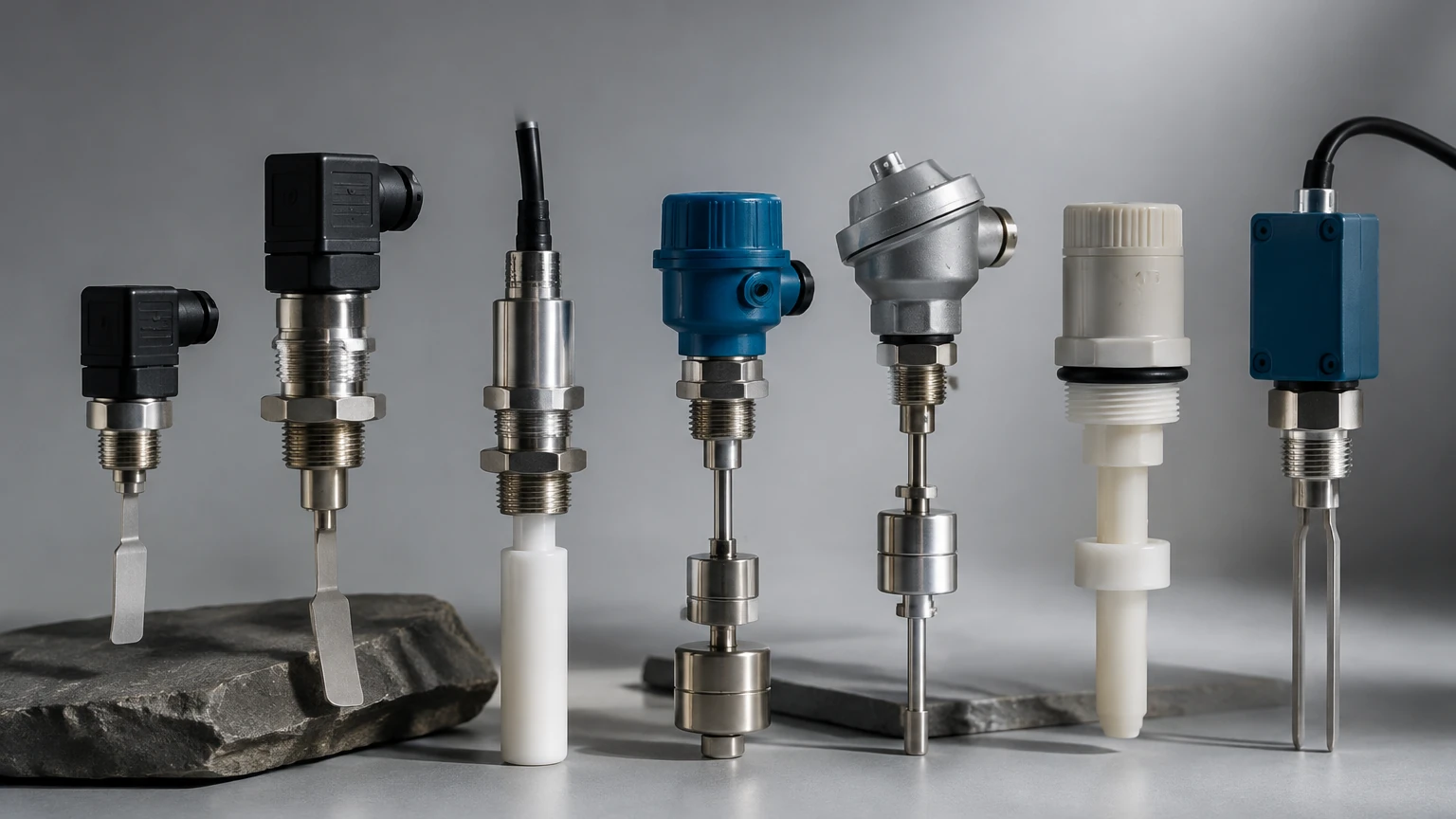
The most traditional form of level switch sensor relies on buoyancy. A float, containing a permanent magnet, moves up and down a stem as the liquid level changes. Inside the stem, a hermetically sealed reed switch is positioned at the trigger point. When the magnet in the float reaches the reed switch, the magnetic field causes the switch to open or close. This technology is simple, highly reliable for clean liquids, and requires no external power to operate the sensing element itself.
Vibrating Tuning Fork Sensors
Vibrating level switches utilize a tuning fork-shaped element that is piezoelectrically energized to vibrate at its natural resonance frequency in air. When the fork is immersed in a medium (liquid or solid), the frequency of vibration shifts or the amplitude is dampened. An internal electronic circuit detects this change and converts it into a switching signal. Tuning fork sensors are highly versatile, as they are largely unaffected by flow, turbulence, bubbles, or foam.
Capacitive Level Switches
Capacitive sensors operate based on the electrical capacitance formed between the sensor probe and the vessel wall (or a reference electrode). Every material has a specific dielectric constant. When the media replaces the air around the probe, the capacitance changes. This change is measured by the electronics to determine the presence of the material. These sensors are excellent for detecting powders, granules, and liquids, though they may require calibration to account for the specific dielectric properties of the media.
Conductivity Level Switches
Designed exclusively for conductive liquids (such as water or acids), conductivity switches use a low-voltage AC signal between two or more electrodes. When the liquid touches the electrodes, it completes an electrical circuit. This is a cost-effective solution for multi-point detection in wastewater treatment and chemical processing, provided the liquid has a minimum conductivity level (typically >10 µS/cm).
Ultrasonic Level Switches
Ultrasonic point-level switches utilize a pair of piezoelectric crystals separated by a gap. One crystal transmits an ultrasonic signal, and the other receives it. When the gap is filled with air, the signal is attenuated. When the gap is filled with liquid, the signal transmits efficiently, triggering the switch. Because they rely on the transmission of sound through the media, they are ideal for non-contact or gap-sensing applications where mechanical moving parts are undesirable.
Technical Selection Criteria for Industrial Applications
Choosing a level switch sensor is not a "one-size-fits-all" process. Engineers must evaluate several technical parameters to ensure long-term reliability and accuracy.
1. Media Characteristics: Consider the density, viscosity, and chemical compatibility of the substance. For example, highly viscous liquids may cause float switches to stick, making a tuning fork or capacitive sensor a better choice.
2. Process Temperature and Pressure: Standard sensors may operate up to 80°C (176°F), but high-temperature variants can withstand over 250°C (482°F). Similarly, pressure ratings can range from atmospheric to over 100 bar (1450 psi).
3. Output Requirements: Determine if the system requires a relay output (SPDT/DPDT), a transistor output (PNP/NPN), or a two-wire current loop. Integration with a PLC or DCS is a primary consideration for industrial automation.
4. Material Buildup: In applications involving sticky liquids or slurries, material may coat the sensor. Capacitive sensors with "active shield" technology or tuning forks with high-frequency vibration are designed to ignore such buildup.
For a comprehensive overview of available technologies and detailed product specifications, professionals can consult the Main Page of Welk’s technical catalog.
Comparative Selection Table
The following table provides a quick reference for matching sensor technology with common industrial requirements.
| Technology | Media Type | Recommended Application | Key Limitation |
| :— | :— | :— | :— |
| Float Switch | Clean Liquids | Water tanks, fuel storage | Sensitive to debris/scaling |
| Tuning Fork | Liquids & Solids | Overfill protection, dry-run | Not for very high viscosity sticky media |
| Capacitive | Liquids, Powders | Grain silos, chemical tanks | Requires dielectric constant > 1.5 |
| Conductivity | Conductive Liquids | Sumps, wastewater pits | Only for conductive media |
| Ultrasonic | Clean/Dirty Liquids | Chemical dosing, oil-water interface | Affected by heavy foam or aeration |
Engineering Installation Guidelines
Correct installation is as vital as selecting the right technology. Improper mounting is the leading cause of false triggers and premature sensor failure in industrial environments.
Mounting Position and Orientation
Most level switch sensors can be mounted either horizontally (from the side of the tank) or vertically (from the top). Vertical mounting is preferred for high-level alarms to ensure the sensor is not damaged by falling material during filling. Horizontal mounting is common for low-level detection to protect pumps from running dry.
Avoiding Turbulence and Fill Streams
Sensors should never be installed directly in the path of the incoming material flow. The force of the material can cause mechanical damage or lead to false switching due to turbulence. If the tank is agitated, a stilling well (a perforated pipe surrounding the sensor) should be used to provide a calm area for measurement.
Wiring and Ingress Protection
In outdoor or wash-down environments, ensure the sensor has an appropriate Ingress Protection (IP) rating, such as IP67 or IP68. Always install a "drip loop" in the cabling to prevent moisture from traveling down the wire and entering the housing through the cable gland.
Dead Zones and No-Go Areas
For ultrasonic or radar-based switches, be aware of the "dead zone" or "blocking distance" near the sensor face. If the material enters this zone, the sensor will fail to provide an accurate reading. Ensure the mounting nozzle height is calculated to keep the maximum level below this threshold.
Operational Limitations and Risk Mitigation
While industrial level switch sensors are robust, they are not immune to environmental challenges. Understanding these risks allows for better system design.
* Fouling and Coating: In wastewater or chemical mixing, sensors can become coated in film or solids. Regular maintenance schedules or the use of non-contact sensors can mitigate this risk. Welk's tuning fork sensors are specifically engineered to shed material and resist coating.
* Vibration and Shock: In heavy industrial machinery, excessive vibration can cause mechanical fatigue in float switches or interfere with the resonance of tuning forks. Using dampened mounts or remote electronics can solve these issues.
* Gas Bubbles and Foam: Foam can be interpreted as a liquid level by some sensors (like ultrasonic) while being ignored by others (like tuning forks). It is critical to define whether you need to detect the top of the foam or the true liquid level below it.
Frequently Asked Questions (FAQs)
Q: Can a level switch sensor be used for continuous measurement?
No. A level switch is a binary device (on/off). For continuous measurement (0-100%), you would require a level transmitter, such as a radar or hydrostatic pressure sensor.
Q: What is the difference between a PNP and NPN output?
These refer to the type of transistor output used to communicate with a PLC. PNP (Source) provides a positive voltage when triggered, while NPN (Sink) connects the load to the ground. The choice depends on the input requirements of your control system.
Q: How do I handle hazardous environments?
For applications involving flammable gases or dust, you must use sensors with Intrinsically Safe (IS) or Explosion-Proof (Ex) certifications. These devices are designed to limit electrical energy to levels that cannot ignite the atmosphere.
Q: Is calibration required for all level switches?
Float and tuning fork switches generally do not require calibration. Capacitive and ultrasonic switches may require sensitivity adjustments during commissioning to account for the specific properties of the media and the vessel geometry.
Conclusion
The selection of a level switch sensor is a foundational decision in process engineering. By matching the measurement principle—whether it be buoyancy, vibration, or capacitance—to the specific needs of the application, operators can ensure high levels of safety and process uptime. From water treatment to complex chemical automation, Welk offers the technical expertise and product range to meet these challenges. For detailed engineering support and to explore our full range of level measurement solutions, visit our Main Page to connect with our application specialists.