Liquid Level Control Switch
Liquid Level Control Switch
In industrial process automation, a liquid level control switch serves as a critical component for point-level detection. Unlike continuous level transmitters that provide a constant stream of data regarding the exact volume or height of a liquid, a level switch is designed to trigger a discrete output—typically an electrical signal—when a specific level is reached. These devices are fundamental for preventing tank overfills, protecting pumps from dry running, and maintaining inventory within specified operational bounds.
As a professional manufacturer, Welk provides a range of measurement technologies integrated into these switches to ensure reliability across diverse sectors, including water treatment, chemical processing, and oil and gas. Selecting the correct liquid level control switch requires a deep understanding of the underlying physical principles and the specific environmental constraints of the application.
Measurement Principles of Level Switches
To select the appropriate instrument, engineers must first evaluate the physical properties of the liquid and the vessel. Different technologies utilize different physical interactions to detect the presence or absence of a medium.
1. Buoyancy-Based Float Switches
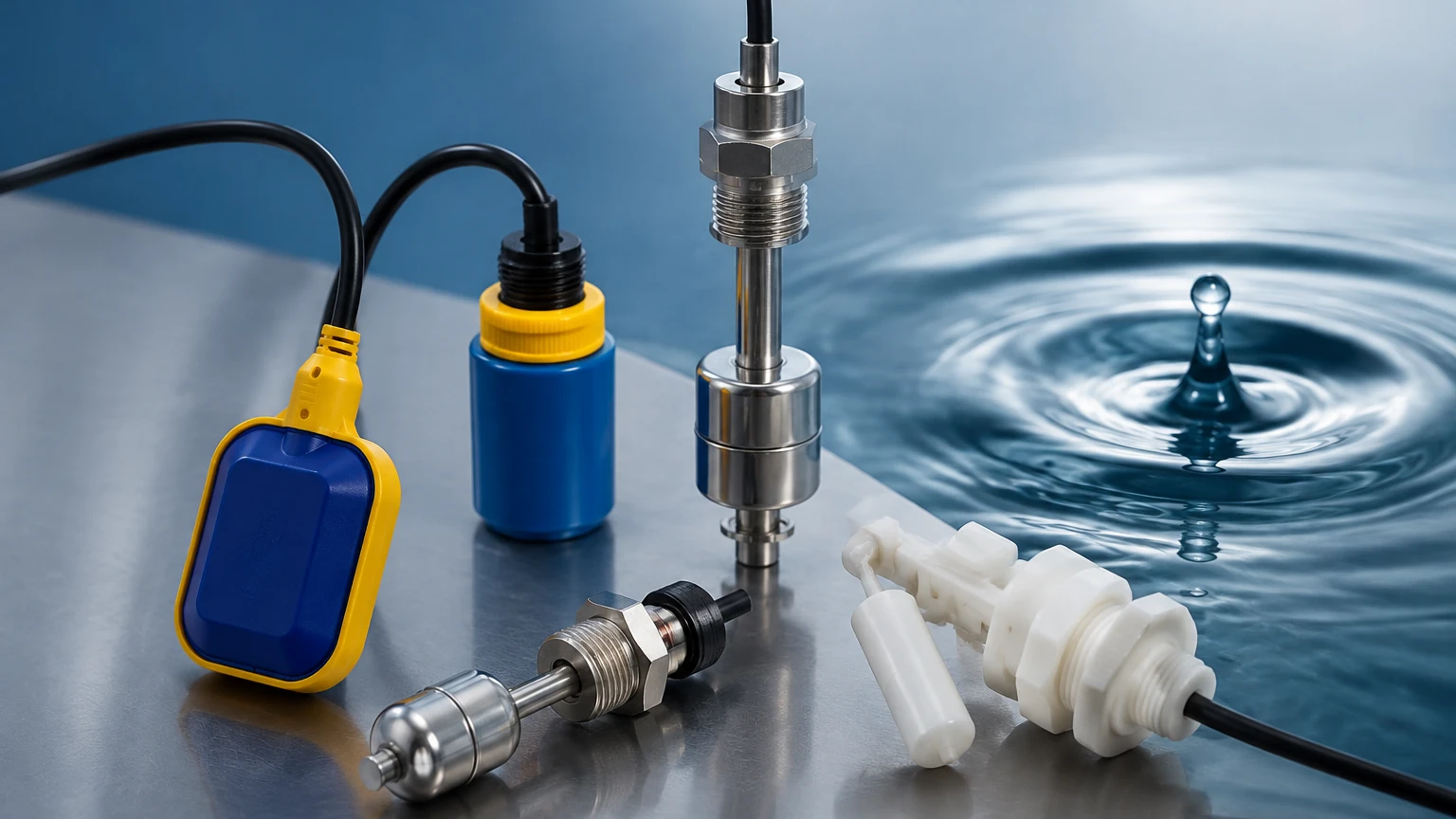
The float switch is one of the most established technologies for liquid level control. It operates on the principle of buoyancy. A hollow float, weighted to a specific gravity lower than the liquid, moves vertically along a stem or pivots on a hinge as the liquid level rises or falls. Inside the float or the hinge, a permanent magnet is housed. When the float reaches a predetermined position, the magnetic field actuates a hermetically sealed reed switch or a microswitch within the housing.
* Pros: Cost-effective, simple to understand, and requires no external power for the sensing element itself.
* Cons: Moving parts are susceptible to mechanical wear and can be jammed by debris or viscous coatings.
2. Vibrating Level Switches (Tuning Forks)
Vibrating switches utilize a fork-shaped sensor that is vibrated at its resonant frequency by internal piezoelectric crystals. When the fork is immersed in a liquid, the frequency of vibration changes or is damped. The internal electronics detect this frequency shift and convert it into a switching signal.
* Pros: Highly reliable, unaffected by bubbles, foam, or vibration in the tank. They require no calibration and have no moving parts to wear out.
* Cons: Generally more expensive than basic float switches; performance can be hindered by extremely high-viscosity liquids that "bridge" the tines.
3. Conductive Level Switches
Conductive switches are used for liquids that conduct electricity, such as water, acids, or caustic solutions. The system consists of a low-voltage power source and two or more electrodes. When the liquid touches the electrodes, it completes an electrical circuit. The resulting current flow is detected by a controller, which then toggles the switch state.
* Pros: Extremely simple, no moving parts, and very low cost.
* Cons: Cannot be used with non-conductive liquids (like oils or distilled water); electrodes may suffer from corrosion or scaling over time.
4. Capacitive Level Switches
Capacitance switches work by measuring the change in electrical capacitance between a probe and the tank wall (or a reference probe). As the liquid displaces air around the probe, the dielectric constant changes, which in turn changes the capacitance. This technology is versatile and can be used for both conductive and non-conductive media.
* Pros: Suitable for high temperatures and pressures; can be used for solids and liquids.
* Cons: Requires calibration for the specific medium; can be prone to false triggers if the liquid leaves a conductive coating on the probe.
5. Ultrasonic and Optical Switches
These are non-contact or minimally invasive technologies. Optical switches use an infrared LED and a light receiver; the liquid's presence changes the refraction of light at the sensor tip. Ultrasonic switches use a small gap in a sensor head where ultrasonic waves are transmitted; when liquid fills the gap, the waves are transmitted more efficiently, triggering the switch.
Technical Selection Criteria
Choosing a liquid level control switch involves matching the instrument's specifications to the process conditions. The following table provides a comparison of common technologies based on typical industrial requirements.
Selection Comparison Table
| Technology | Typical Application | Max Pressure (Approx.) | Max Temp (Approx.) | Media Compatibility |
| :— | :— | :— | :— | :— |
| Float Switch | Water tanks, bilge pumps | 20 bar (2.0 MPa) | 120°C | Clean, low-viscosity liquids |
| Vibrating Fork | Chemical dosing, overflow | 40 bar (4.0 MPa) | 150°C | Most liquids, including foam |
| Conductive | Wastewater, acid sumps | 10 bar (1.0 MPa) | 100°C | Conductive liquids only |
| Capacitive | Oil/Water interface, silos | 60 bar (6.0 MPa) | 200°C+ | Conductive & non-conductive |
| Optical | Leak detection, OEM | 15 bar (1.5 MPa) | 85°C | Clean liquids, no coating |
Installation and Engineering Considerations
Correct installation is as vital as selecting the right technology. Even the most advanced liquid level control switch will fail if placed in an environment that interferes with its sensing mechanism.
Orientation and Placement
* Top Mounting: Standard for conductive probes and long-stem float switches. Ensure there is enough overhead clearance for removal and maintenance.
* Side Mounting: Common for vibrating forks and small float switches. These are ideal for detecting specific high or low points in a vessel.
* Avoid the Fill Stream: Never install a level switch directly under the inlet pipe. The turbulence and force of the incoming liquid can cause false triggers or mechanical damage.
Turbulence and Agitation
In tanks with agitators or high turbulence, float switches may "chatter," causing the relay to rapidly cycle on and off. This can be mitigated by using a stilling well—a vertical pipe that surrounds the sensor to provide a calm liquid surface—or by selecting a vibrating fork switch, which is inherently more resistant to turbulence.
Material Compatibility
The wetted parts of the switch must be chemically compatible with the media. While Stainless Steel 316L is the industry standard for many applications, corrosive chemicals may require plastics like Polypropylene (PP), PTFE, or specialized alloys like Hastelloy.
Common Risks and Limitations
Engineering teams should be aware of the following risks when deploying level switches:
1. Media Coating and Buildup: In applications involving wastewater or sticky chemicals, material can build up on the sensor. Capacitive and conductive switches are particularly sensitive to this, potentially indicating a "full" state even when the tank is empty. Tuning forks with specialized coatings or "active shield" capacitive probes can help alleviate this.
2. Specific Gravity (SG) Sensitivity: Float switches are dependent on the density of the liquid. If a float is designed for water (SG 1.0) but used in a light oil (SG 0.7), it may not rise sufficiently to trigger the switch. Always verify the SG of the liquid during the specification phase.
3. Electrical Load: Level switches often have limited current-carrying capacity. Directly wiring a high-power pump to a small reed switch will lead to immediate failure. Always use an intermediate relay or contactor to handle the motor load.
Frequently Asked Questions (FAQ)
Q: Can a liquid level control switch be used for solids?
A: Certain types, like vibrating forks and capacitive switches, are designed to work with both liquids and granular solids (like powders or grains). However, float switches and conductive probes are strictly for liquid applications.
Q: What is the difference between N.O. and N.C. contacts?
A: N.O. (Normally Open) means the circuit is open when the switch is in its "rest" state (e.g., tank empty). N.C. (Normally Closed) means the circuit is closed at rest. Most industrial switches allow you to choose or invert this logic during installation.
Q: How do I prevent false alarms caused by foam?
A: Vibrating fork switches are generally the best choice for applications with foam, as they can be tuned to ignore the low-density foam and only trigger when they contact the actual liquid surface.
Q: Is maintenance required for level switches?
A: Yes. Contact-type switches should be inspected periodically for scaling, corrosion, or mechanical fatigue. Non-contact or vibrating switches require less frequent maintenance but should still be checked for signal integrity.
Conclusion and Next Steps
Implementing a robust liquid level control switch is a fundamental step in ensuring the safety and efficiency of industrial processes. By understanding the physics of the application—whether it requires the simplicity of a float or the precision of a vibrating fork—engineers can prevent costly downtime and equipment damage.
For a comprehensive overview of available technologies and technical specifications, engineers can visit the Main Page to review product options and application support. When selecting a device, always confirm the process temperature, pressure, chemical composition, and the desired electrical output to ensure a long-lasting and accurate installation.