Liquid Level Transmitter
Liquid Level Transmitter
In modern industrial automation, the ability to monitor and control the volume of liquids in tanks, vessels, and open channels is fundamental to operational efficiency and safety. A liquid level transmitter is an instrument designed to provide continuous level measurement, converting the physical height of a liquid into an electrical signal—typically 4-20mA, HART, or Modbus—that can be processed by PLC or DCS systems. Unlike simple level switches that only indicate whether a specific point has been reached, a transmitter offers real-time data across the entire measurement range.
Selecting the appropriate liquid level transmitter requires a deep understanding of both the physics of measurement and the specific characteristics of the process media. This guide examines the primary technologies used in the industry, their operating principles, and the engineering considerations necessary for successful deployment.
Core Measurement Principles
Before selecting an instrument, it is essential to understand how different technologies interact with the liquid and the surrounding environment. Measurement methods are generally categorized into contact and non-contact technologies.
1. Radar Level Measurement (ToF)
Radar transmitters utilize Time-of-Flight (ToF) technology. They emit high-frequency electromagnetic pulses (typically in the 26GHz or 80GHz range) that travel at the speed of light. When these pulses hit the surface of the liquid, they are reflected back to the sensor.
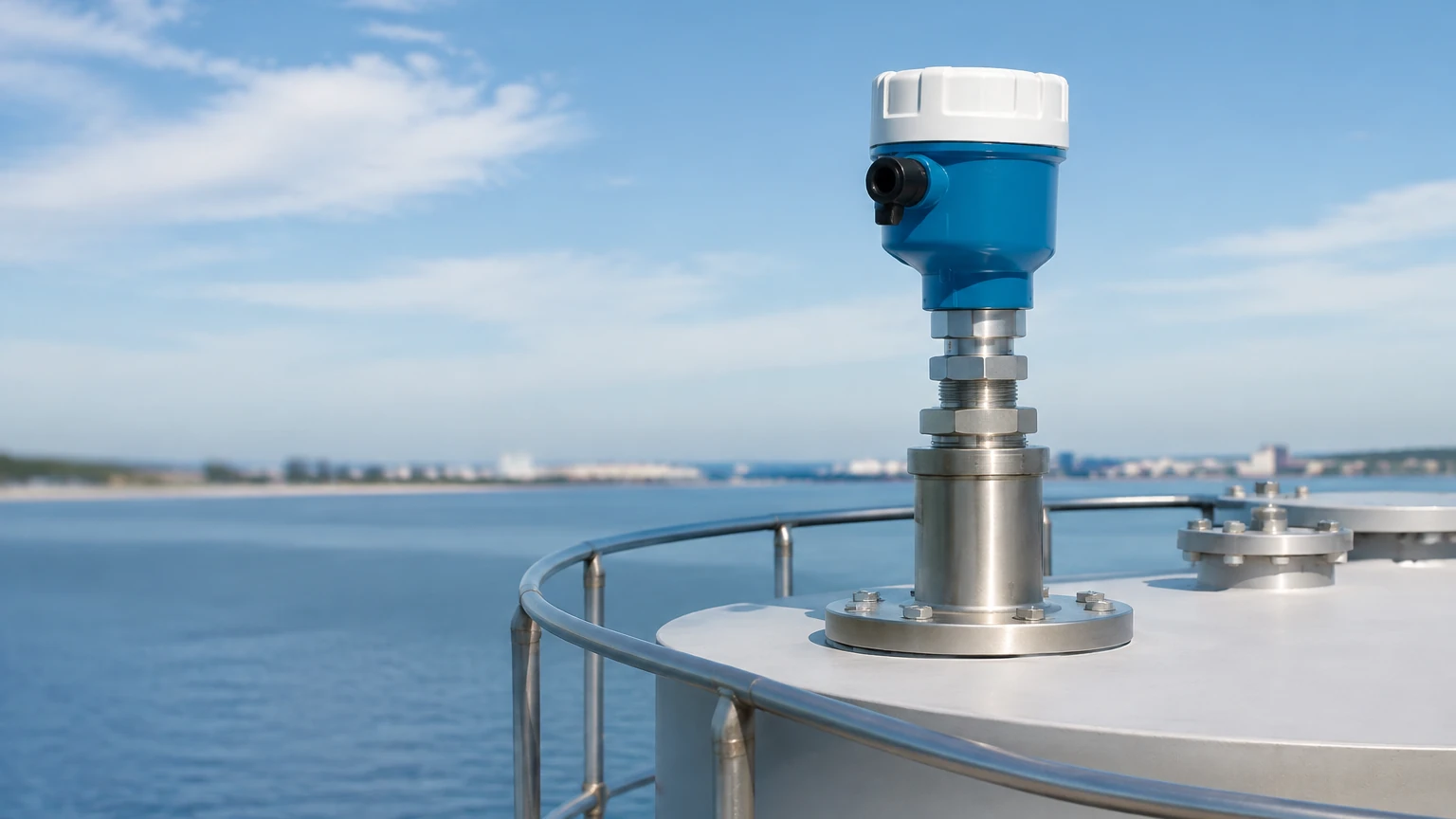
* Non-Contact Radar: The sensor is mounted at the top of the tank and does not touch the liquid. It is ideal for corrosive or hygienic applications. 80GHz radar, in particular, offers a narrow beam angle, which minimizes interference from internal tank obstructions like agitators or ladders.
* Guided Wave Radar (GWR): This technology uses a physical probe (cable or rod) to guide the microwave pulse to the liquid surface. GWR is highly effective for liquids with low dielectric constants or in applications with heavy foam and turbulence, as the probe concentrates the signal energy.
2. Ultrasonic Level Measurement
Ultrasonic transmitters operate similarly to radar but use sound waves instead of electromagnetic waves. The transducer emits an ultrasonic pulse that reflects off the liquid surface. The transmitter calculates the distance based on the time it takes for the echo to return.
Since sound requires a medium to travel, ultrasonic sensors are sensitive to air temperature, vapor layers, and vacuum conditions. Most modern units include integrated temperature compensation to maintain accuracy despite fluctuations in the ambient air temperature within the tank headspace.
3. Hydrostatic Pressure Measurement
This principle is based on the relationship between the height of a liquid and the pressure it exerts at the bottom of a vessel. The formula used is $P = \rho \cdot g \cdot h$, where $P$ is pressure, $\rho$ is the density of the liquid, $g$ is gravity, and $h$ is the height.
For open tanks, a simple submersible pressure transducer or a flange-mounted transmitter at the bottom is sufficient. In pressurized vessels, a differential pressure (DP) transmitter is required to subtract the overhead gas pressure from the total pressure measured at the bottom, ensuring only the liquid head is accounted for.
4. Magnetic and Float-Based Measurement
Magnetic level transmitters often use a float containing a permanent magnet that moves with the liquid level. This float travels along a sensing rod. In magnetostrictive designs, a current pulse is sent down a wire within the rod; the interaction between the pulse's magnetic field and the float's magnetic field creates a mechanical strain wave that travels back to the electronics. This provides extremely high precision (up to 0.1mm) and is widely used for custody transfer and fuel storage.
Key Evaluation Criteria for Selection
Choosing the right liquid level transmitter involves more than just matching a budget. Engineers must evaluate the following technical parameters:
* Media Properties: Is the liquid corrosive, viscous, or prone to coating? For example, highly viscous liquids might foul a guided wave radar probe, making non-contact radar a better choice.
* Process Conditions: What are the maximum operating temperatures and pressures? Hydrostatic transmitters must be rated for the specific gravity of the fluid, while ultrasonic sensors may fail in high-pressure environments where the speed of sound is significantly altered.
* Accuracy Requirements: Does the application require simple inventory monitoring (±10mm accuracy) or high-precision billing/custody transfer (±1mm accuracy)?
* Tank Geometry: The presence of internal heating coils, agitators, or narrow nozzles can create "false echoes" for radar and ultrasonic units. In these cases, instruments with advanced software for "false echo suppression" or narrow beam angles are necessary.
Practical Selection Table
| Technology | Best For | Limitations | Typical Accuracy |
| :— | :— | :— | :— |
| Non-Contact Radar | Corrosive chemicals, high temp, solids | Low dielectric liquids (requires high freq) | ±2mm to ±5mm |
| Guided Wave Radar | Foam, turbulence, low dielectric liquids | Subject to coating/buildup on probe | ±2mm |
| Ultrasonic | Water treatment, open channels | Affected by foam, dust, and vacuum | ±0.25% of range |
| Hydrostatic | Deep wells, vented tanks, constant density | Changes in liquid density affect accuracy | ±0.1% to ±0.5% |
| Magnetostrictive | Fuel tanks, high-precision interfaces | Limited to clean, non-coating liquids | ±0.1mm |
Installation Considerations and Best Practices
Proper installation is critical to the performance of any liquid level transmitter. Even the most advanced sensor will provide unreliable data if mounted incorrectly.
1. Nozzle Dimensions: For radar and ultrasonic sensors, the mounting nozzle should be as short and wide as possible. If the nozzle is too narrow or too long, the signal may reflect off the nozzle walls before reaching the liquid, causing a "near-zone" interference.
2. Avoid the Fill Stream: Never install a transmitter directly above the point where liquid enters the tank. The turbulence and the physical presence of the falling liquid will disrupt the signal or cause physical damage to probes.
3. Stilling Wells and Bypass Chambers: In tanks with heavy agitation or surface foam, installing the transmitter inside a stilling well (a vertical pipe) can provide a calm surface for measurement. This is particularly common for GWR and float-based systems.
4. Orientation: Hydrostatic transmitters should be mounted in a location where sediment cannot accumulate on the diaphragm. If the liquid is prone to solids dropout, use a flush-diaphragm seal.
5. Environmental Shielding: While most industrial transmitters are IP67 or IP68 rated, providing a sunshade for outdoor installations can prevent electronic overheating and reduce temperature-induced drift in ultrasonic sensors.
Operational Limitations and Common Risks
Every technology has its "blind spots" that can lead to measurement errors or device failure.
* Dielectric Constant ($\\epsilon_r$): Radar signals rely on the difference in dielectric constants between the air (or gas) and the liquid. If a liquid has a very low dielectric constant (like certain oils or liquefied gases), the signal may pass through the surface rather than reflecting, leading to lost signals.
* Vapor and Condensation: In high-temperature applications, steam or chemical vapors can attenuate ultrasonic signals. Condensation on the face of a radar antenna can also cause signal scattering, though modern "drip-off" antenna designs mitigate this.
* Density Fluctuations: Hydrostatic transmitters do not measure level directly; they measure pressure. If the process temperature changes significantly, the density of the liquid changes, which will cause a hydrostatic transmitter to report an incorrect level unless compensated by an external temperature sensor or a secondary pressure sensor.
* Foam Interference: Heavy, thick foam can absorb ultrasonic and radar pulses. While Guided Wave Radar is more resistant to foam, extremely dense foam may still be detected as the "liquid level" rather than the actual liquid surface beneath it.
Frequently Asked Questions (FAQs)
Q: How often should a liquid level transmitter be calibrated?
A: This depends on the technology and the criticality of the process. Hydrostatic sensors may drift over time and usually require annual calibration. Radar and ultrasonic units are digital and generally more stable, often only requiring a functional check every 2-3 years unless the process media changes.
Q: Can one transmitter measure the interface between two liquids (e.g., oil and water)?
A: Yes, Guided Wave Radar and certain magnetostrictive transmitters are specifically designed for interface measurement. They rely on the different dielectric constants or different densities of the two liquids to identify the boundary layer.
Q: What is the "Dead Zone" or "Blocking Distance"?
A: This is the area directly below the sensor where it cannot take a measurement. For ultrasonic and radar sensors, this is due to the time required for the transducer to switch from "transmit" to "receive" mode. Users must ensure the maximum liquid level does not enter this zone.
Q: Is 80GHz radar always better than 26GHz?
A: Not necessarily. While 80GHz offers a narrower beam and better resolution, 26GHz radar is often more robust in applications with heavy dust or steam, as the longer wavelength can penetrate these atmospheric obstacles more effectively.
Conclusion
Selecting the right liquid level transmitter is a balance between understanding the physical constraints of the application and the technical capabilities of the instrument. By evaluating the media properties, tank geometry, and required precision, engineers can implement a solution that ensures long-term reliability. For those looking to explore specific hardware options and technical support for industrial applications, you can Review product options and application support to find the most suitable technology for your project requirements. Whether the application involves simple water storage or complex chemical processing, the correct transmitter is the cornerstone of a safe and automated liquid management system.