Promass 300
Promass 300
In the landscape of modern industrial automation, the ability to measure multiple process variables with a single device has become a cornerstone of operational efficiency. The Promass 300 series represents a significant advancement in Coriolis mass flow measurement technology, designed to meet the rigorous demands of the chemical, oil and gas, and food and beverage industries. While many facilities focus heavily on level measurement, the integration of high-precision flow and density data from instruments like the Promass 300 is essential for comprehensive process control and inventory management.
This article provides a technical overview of the Promass 300, exploring its measurement principles, technical specifications, and its relationship with broader industrial instrumentation strategies, including level measurement solutions found on the Main Page.
Measurement Principle: The Coriolis Effect
To understand the capabilities of the Promass 300, one must first grasp the Coriolis principle upon which it operates. Unlike volumetric flowmeters that measure the space a fluid occupies, Coriolis meters measure the actual mass moving through the system. This is critical because mass remains constant regardless of changes in temperature or pressure, whereas volume does not.
Mass Flow Measurement
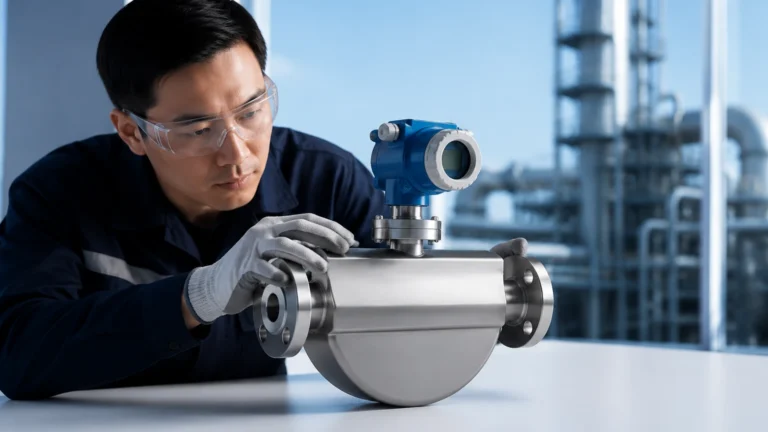
Inside the Promass 300, one or two measuring tubes are induced to oscillate by an electro-magnetic driver. When a fluid flows through these vibrating tubes, the Coriolis force causes them to twist. This twisting motion results in a phase shift between the sensors located at the inlet and outlet of the tubes. The magnitude of this phase shift is directly proportional to the mass flow rate.
Density and Temperature Measurement
The device also measures the resonant frequency of the vibrating tubes. This frequency changes depending on the density of the fluid; a heavier fluid results in a lower frequency, while a lighter fluid results in a higher frequency. By continuously monitoring this frequency, the Promass 300 provides real-time density data. Furthermore, an integrated temperature sensor monitors the tube temperature to compensate for thermal expansion and provide an additional process variable.
Key Features of the Promass 300 Transmitter
The Promass 300 is characterized by its compact transmitter design, which is engineered to simplify integration into existing control systems while providing advanced diagnostic capabilities.
1. Compact Digital Architecture: The transmitter is designed for space-saving installation. It houses the electronics required to process the complex signals from the Coriolis sensor and convert them into standardized outputs such as 4-20 mA HART, Modbus RS485, EtherNet/IP, or PROFINET.
2. Heartbeat Technology: This is a diagnostic and verification suite that allows for continuous self-monitoring. It enables users to perform device verification without interrupting the process, ensuring that the instrument remains within its calibrated accuracy limits and reducing the need for manual inspections.
3. Integrated Web Server: The Promass 300 features an embedded web server, allowing technicians to access device data, configuration settings, and diagnostic information via a standard laptop and a web browser, eliminating the need for specialized proprietary software.
4. Data Storage and Recovery: An integrated HistoROM data management system automatically backs up configuration data and event logs, facilitating quick component replacement and minimizing downtime.
Integration with Level Measurement Systems
While the Promass 300 is primarily a flow and density instrument, its data is invaluable when used in conjunction with level measurement technologies. In many industrial tanks, hydrostatic level transmitters are used to determine the height of a liquid based on the pressure exerted by the fluid column. However, hydrostatic level measurement is density-dependent.
By utilizing the real-time density data from a Promass 300 located in the inlet or outlet line, the control system can dynamically correct the level calculations of a hydrostatic sensor. This synergy ensures that mass-based inventory levels remain accurate even if the fluid composition or temperature fluctuates. For engineers seeking a holistic approach to tank management, reviewing various Main Page options for level sensors alongside mass flow data is a standard best practice.
Sensor Options and Selection Criteria
The Promass 300 transmitter can be paired with several different sensor types, each optimized for specific fluid properties and environmental conditions. Selecting the correct sensor is critical for achieving the desired accuracy and longevity.
Practical Selection Table
| Sensor Type | Primary Application | Typical Line Size (mm) | Max Temperature (°C) | Key Advantage |
| :— | :— | :— | :— | :— |
| Promass F | Universal/High Accuracy | 8 to 250 | +350°C | Robust and versatile for most liquids. |
| Promass G | High Pressure Gas | 8 to 25 | +150°C | Optimized for high-pressure gas applications. |
| Promass I | Viscous/Shear Sensitive | 8 to 80 | +150°C | Single-tube design, easy to clean (CIP/SIP). |
| Promass O | Oil & Gas (High Pressure) | 80 to 250 | +200°C | High-pressure resistance for offshore use. |
| Promass P | Life Sciences/Sterile | 8 to 50 | +200°C | Designed for hygienic and sterile environments. |
| Promass Q | Entrained Gas/Aerated | 25 to 100 | +200°C | Superior performance with gas bubbles. |
| Promass S | Food & Beverage | 8 to 50 | +150°C | Stainless steel housing, hygienic design. |
| Promass X | Maximum Throughput | 350 | +180°C | Four-tube design for very high flow rates. |

Installation Considerations
To ensure the Promass 300 operates at its specified accuracy (often up to ±0.05% for liquids), proper installation is paramount. Unlike some other flow technologies, Coriolis meters do not strictly require long straight runs of pipe, but they are sensitive to mechanical stress and vibration.
* Support and Bracing: The meter must be securely supported. The piping should be braced near the inlet and outlet flanges to prevent the weight of the meter or pipe vibrations from interfering with the tube oscillation.
* Orientation: For liquid applications, the tubes should ideally point downward (in a horizontal pipe) to prevent gas bubbles from becoming trapped. For gas applications, the tubes should point upward to prevent condensate buildup.
* Avoid Cavitation: Ensure that the system pressure remains high enough to prevent liquids from flashing into gas inside the meter, which can cause significant measurement errors.
* Zero Point Calibration: After installation and under full-pipe, zero-flow conditions, a zero-point adjustment should be performed to account for the specific mechanical stresses of the piping system.
Limitations and Practical Risks
Despite its versatility, the Promass 300 is not a universal solution for every application. Engineers must be aware of the following limitations:
1. Cost: Coriolis meters generally have a higher initial capital cost compared to magnetic or ultrasonic flowmeters. The investment must be justified by the need for mass flow accuracy or density measurement.
2. Pressure Drop: The internal geometry of the measuring tubes can cause a higher pressure drop than full-bore technologies like electromagnetic flowmeters. This must be accounted for in pump sizing.
3. Entrained Gas: While sensors like the Promass Q are designed to handle some gas entrainment, excessive air or gas in a liquid stream can dampen the tube vibrations, leading to "stalling" or measurement inaccuracies.
4. Size Constraints: Coriolis meters become significantly heavier and more expensive as pipe diameters increase, making them less common for very large water distribution lines compared to other technologies.
Frequently Asked Questions (FAQ)
Q: Does the Promass 300 require regular recalibration?
A: While the Promass 300 is highly stable, many industries require periodic verification. Heartbeat Technology allows for in-situ verification, which can extend the intervals between formal laboratory recalibrations.
Q: Can the Promass 300 measure the level of a tank?
A: No, it is a flowmeter. However, it provides the density data necessary to make hydrostatic level measurements accurate. For dedicated level measurement instruments, users should consult the Main Page.
Q: Is the Promass 300 suitable for hazardous areas?
A: Yes, the Promass 300 is available with various international explosion-proof certifications (ATEX, IECEx, cCSAus) suitable for use in Zone 1 and Zone 2 environments.
Q: How does the Promass 300 handle bi-directional flow?
A: The Coriolis principle naturally supports bi-directional measurement. The transmitter can be configured to report flow in both directions, which is useful for loading and unloading applications.
Conclusion
The Promass 300 is a sophisticated instrument that offers more than just flow measurement; it provides a window into the physical properties of the process fluid. By delivering accurate mass flow, density, and temperature data in a compact and digitally integrated package, it serves as a vital component in modern industrial ecosystems. When combined with reliable level measurement solutions, it enables operators to achieve a high degree of precision in both process control and inventory management. Before proceeding with an installation, project teams should confirm fluid compatibility, required accuracy levels, and the specific communication protocols of their existing control infrastructure.