Mccrometer Ultramag
Mccrometer Ultramag
In the landscape of industrial fluid management, the Mccrometer Ultramag stands as a specialized electromagnetic flowmeter designed to address the challenges of water, wastewater, and reclaimed water applications. Engineers and facility managers often prioritize this technology for its durability and its ability to maintain accuracy in the presence of solids or debris. While electromagnetic flowmeters are a staple in process control, the Ultramag distinguishes itself through specific material engineering and design choices that minimize maintenance and extend service life in harsh environments.
Understanding the technical nuances of this instrument is essential for integrating it into a broader process automation system. Often, flow data from devices like the Ultramag is synchronized with level measurement data to provide a complete picture of system efficiency. For those seeking comprehensive information on level measurement technologies to complement their flow systems, the Main Page offers a detailed look at radar, ultrasonic, and hydrostatic solutions.
Measurement Principles of Electromagnetic Flowmeters
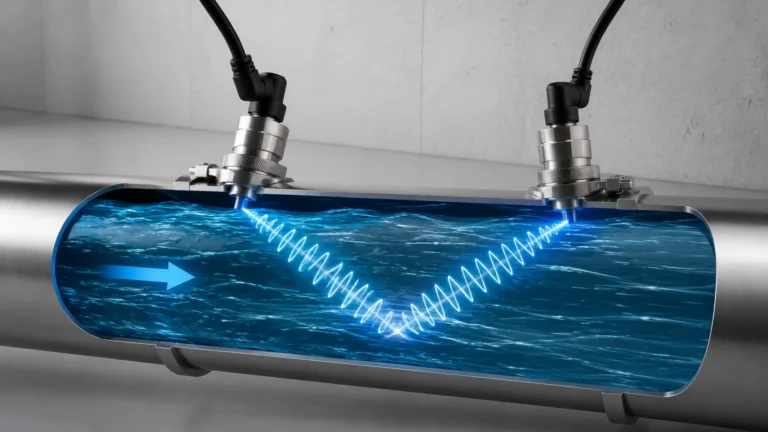
The Mccrometer Ultramag operates based on Faraday’s Law of Electromagnetic Induction. This physical principle states that a conductor moving through a magnetic field produces an electrical voltage. In the context of a flowmeter, the "conductor" is the process fluid itself.
The Faraday Equation
The voltage ($E$) generated is directly proportional to the velocity of the fluid ($V$), the strength of the magnetic field ($B$), and the distance between the electrodes ($D$). The relationship is expressed as:
$$E = kBDV$$
Where:
* E: The induced voltage.
* k: A constant of proportionality.
* B: The magnetic field strength.
* D: The distance between electrodes (essentially the pipe diameter).
* V: The average velocity of the fluid.
As the conductive fluid flows through the meter’s magnetic field, the electrodes pick up the induced voltage. The transmitter then converts this low-voltage signal into a flow rate (e.g., cubic meters per hour or gallons per minute). Because the magnetic field is uniform across the entire cross-section of the pipe, the meter provides an average velocity measurement, which is highly accurate even if the flow profile is not perfectly symmetrical.
Conductivity Requirements
For this principle to function, the fluid must have a minimum level of electrical conductivity. Generally, a conductivity of at least 5 μS/cm (microsiemens per centimeter) is required. This makes the technology ideal for water-based fluids but unsuitable for hydrocarbons, distilled water, or non-conductive chemicals.
Key Design Features: The UltraLiner
One of the most significant technical advantages of the Ultramag is its liner technology. In many electromagnetic flowmeters, the liner is a separate component (often PTFE or rubber) that is inserted or "dropped" into the metal tube. These liners can be prone to delamination, tearing, or collapsing under vacuum conditions.
Fusion-Bonded Epoxy
The Ultramag utilizes the UltraLiner, a high-performance, fusion-bonded epoxy. During the manufacturing process, the epoxy is heat-fused directly to the interior of the flow tube. This creates a seamless, high-strength bond that eliminates the risk of liner separation. The resulting surface is exceptionally smooth, which prevents the buildup of fats, oils, and greases (FOG) and reduces friction loss.
Durability in Slurry Applications
The fusion-bonded epoxy is specifically engineered to resist abrasion. In applications involving sand, grit, or suspended solids—common in wastewater treatment—the UltraLiner maintains its integrity far longer than traditional soft rubber liners. This makes the Ultramag a preferred choice for influent lines and sludge processing.
Practical Selection Table
When evaluating the Ultramag for a specific project, engineers must consider pipe size, flow range, and pressure requirements. The following table provides a general reference for standard configurations.
| Feature | Specification (Metric) | Specification (Imperial) |
| :— | :— | :— |
| Pipe Sizes | 50 mm to 1200 mm | 2 inches to 48 inches |
| Accuracy | ±0.5% of flow rate | ±0.5% of flow rate |
| Max Pressure | Up to 20.6 bar | Up to 300 psi |
| Fluid Temperature | -10°C to 77°C | 14°F to 170°F |
| Liner Material | Fusion-Bonded Epoxy | Fusion-Bonded Epoxy |
| Electrode Material | 316 Stainless Steel / Hastelloy C | 316 Stainless Steel / Hastelloy C |
| Certifications | NSF/ANSI 61, CE | NSF/ANSI 61, CE |
Installation Considerations
While electromagnetic flowmeters are generally more forgiving than turbine or vortex meters, proper installation is critical to achieving the rated ±0.5% accuracy.
Straight Pipe Requirements
The Ultramag is designed to handle turbulent flow better than many competitors, but it still requires a minimum run of straight pipe. A common guideline is to have 1 to 3 diameters of straight pipe upstream and 0 to 2 diameters downstream, depending on the specific upstream disturbances (such as valves or elbows). If space is extremely limited, the use of flow conditioners may be necessary.
Grounding and Electrical Noise
Because the meter measures very small voltages, it is sensitive to electrical noise. Proper grounding is non-negotiable. In plastic or lined piping systems, grounding rings must be installed to ensure the fluid is at the same electrical potential as the meter body. Failure to ground the system correctly often results in erratic readings or "signal drift."
Orientation and Filling
The meter must always be installed in a location where the pipe remains completely full. If the pipe is only partially full, the meter will over-calculate the flow rate. Vertical installation with upward flow is often preferred, as this ensures the pipe is full and helps prevent the settling of solids on the electrodes.

Limitations and Common Risks
Despite its robustness, the Mccrometer Ultramag has specific limitations that must be addressed during the design phase.
1. Conductivity Thresholds: As mentioned, the fluid must be conductive. It cannot measure the flow of oil, steam, or pure gases.
2. Temperature Constraints: The fusion-bonded epoxy liner is rated for temperatures up to approximately 77°C (170°F). For high-temperature chemical processes or steam-cleaned lines, alternative liner materials like PFA may be required.
3. Vacuum Conditions: While the fusion-bonded liner is excellent at resisting vacuum compared to drop-in liners, extreme vacuum conditions should still be reviewed with the manufacturer to ensure the structural integrity of the bond.
4. Chemical Compatibility: While epoxy is resistant to a wide range of chemicals found in water treatment, highly concentrated acids or bases may require specialized electrode materials like Tantalum or Platinum to prevent corrosion.
Integration with Level Measurement Systems
In modern industrial automation, flow measurement is rarely an isolated data point. It is frequently used in conjunction with level measurement to manage inventory, prevent tank overflows, and calculate mass balance. For instance, in a water treatment plant, the Ultramag measures the influent flow, while a radar level sensor monitors the height of the water in the primary clarifier.
Integrating these sensors requires a centralized control strategy. Most Ultramag transmitters offer 4-20mA, HART, or Modbus outputs, allowing them to communicate seamlessly with the same PLC (Programmable Logic Controller) that manages level transmitters. For technical guidance on selecting the right level instruments to pair with your flowmeters, visit the Main Page for expert engineering resources.
Frequently Asked Questions (FAQ)
Q: Does the Ultramag require periodic recalibration?
A: Because there are no moving parts to wear out, the Ultramag maintains its factory calibration for a long period. However, many regulatory agencies require annual verification. This can often be done in-situ using a signal simulator without removing the meter from the line.
Q: Can the meter be buried?
A: Yes, the Ultramag is available with an IP68 (NEMA 6P) rating, making it suitable for vault installations or direct burial, provided the appropriate cable potting and coating options are selected.
Q: How does the Ultramag handle air bubbles?
A: Small amounts of entrained air will be measured as fluid, leading to a slight over-reading. Large slugs of air can disrupt the magnetic field and cause the signal to drop out. It is always best to install the meter in a section of pipe where air is unlikely to collect.
Q: Is the UltraLiner safe for drinking water?
A: Yes, the fusion-bonded epoxy used in the Ultramag is NSF/ANSI 61 certified, meaning it is approved for use in potable water systems and will not leach harmful substances into the water supply.
Q: What is the minimum flow velocity required?
A: While the meter can detect very low flows, accuracy typically degrades below 0.1 m/s (0.3 fps). For optimal performance, the meter should be sized so that the normal operating flow falls between 1 m/s and 5 m/s (3 fps and 15 fps).