Raman Spectroscopy Systems
Raman Spectroscopy Systems
In the landscape of industrial process automation and chemical analysis, Raman spectroscopy systems have emerged as indispensable tools for real-time, non-destructive molecular identification. While physical sensors—such as the radar and ultrasonic instruments found on the Main Page—monitor the volume and level of substances within a vessel, Raman spectroscopy provides deep insights into the chemical composition and molecular structure of those same substances. This synergy between physical level measurement and chemical analysis allows for a holistic approach to process control in industries ranging from pharmaceuticals to oil and gas.
Fundamental Principles of Raman Spectroscopy
Raman spectroscopy is based on the inelastic scattering of monochromatic light, typically from a laser source. When laser light interacts with molecular vibrations, phonons, or other excitations in a system, the energy of the laser photons is shifted up or down. This shift provides information about the vibrational modes in the system, acting as a structural fingerprint by which molecules can be identified.
The Raman Effect
When a sample is irradiated with a high-intensity laser, the majority of the scattered photons possess the same frequency as the incident light; this is known as Rayleigh scattering. However, a tiny fraction of the light (approximately 1 in 10 million photons) is scattered at different frequencies.
1. Stokes Scattering: The scattered photon has less energy than the incident photon. This occurs when the molecule absorbs energy, moving to a higher vibrational state.
2. Anti-Stokes Scattering: The scattered photon has more energy than the incident photon. This occurs when the molecule is already in an excited vibrational state and loses energy to the photon.
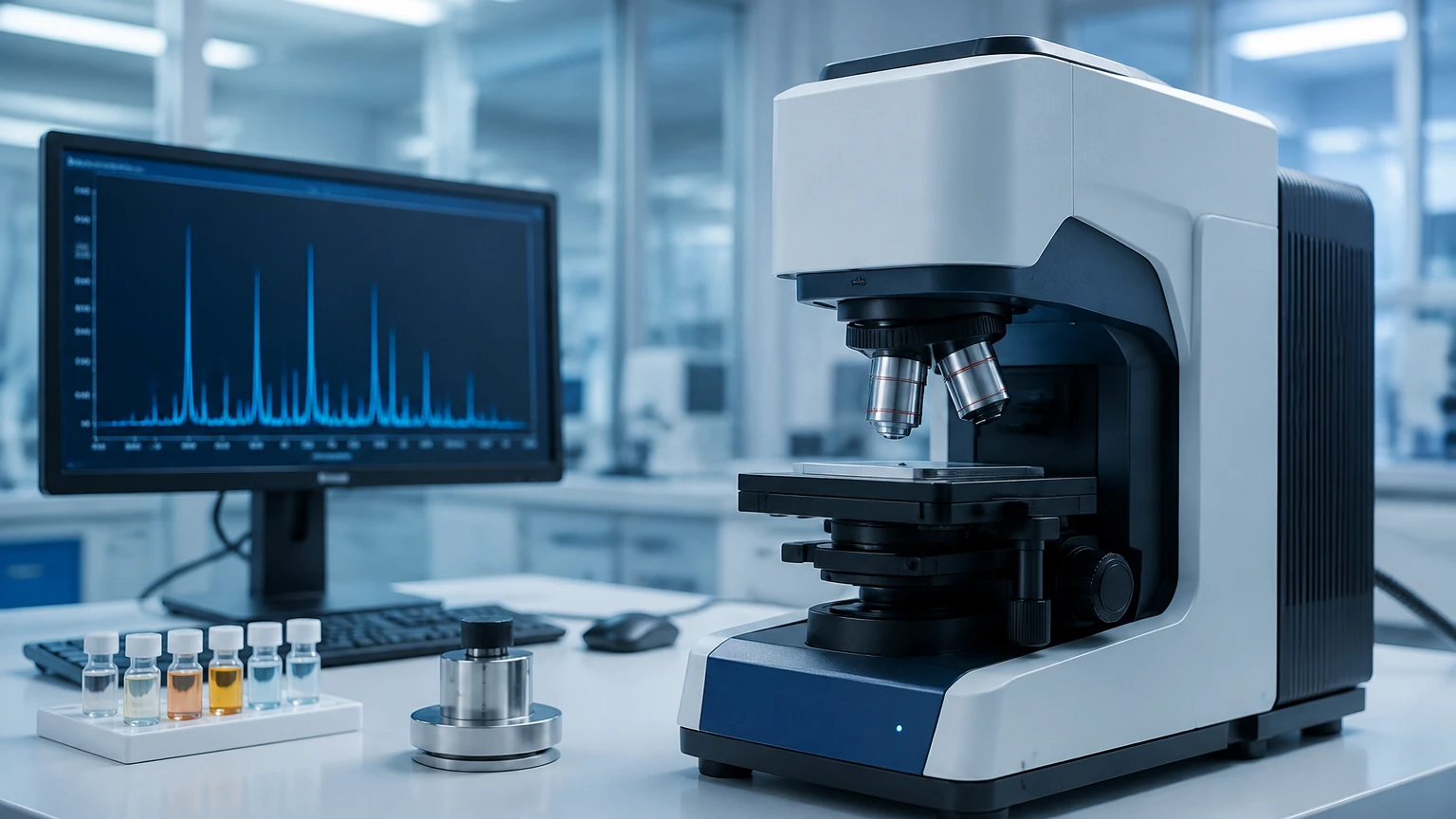
Industrial raman spectroscopy systems primarily measure Stokes scattering because, at room temperature, most molecules reside in the ground vibrational state. The resulting Raman spectrum is a plot of intensity versus the "Raman shift," measured in wavenumbers (cm⁻¹), which is independent of the excitation wavelength.
System Components
A standard industrial Raman system consists of four primary modules:
* Excitation Source (Laser): Common wavelengths include 532 nm, 785 nm, and 1064 nm. The choice of wavelength is a balance between signal strength and the avoidance of fluorescence.
* Sampling Interface: This includes fiber optic probes, immersion probes, or non-contact optics that deliver the laser to the sample and collect the scattered light.
* Spectrograph: An optical device that separates the collected light into its constituent wavelengths using a diffraction grating.
* Detector: Usually a high-sensitivity Charge-Coupled Device (CCD) cooled to low temperatures to reduce electronic noise.
Industrial Applications and Process Monitoring
Raman spectroscopy systems are utilized across various sectors to ensure product quality and process efficiency. Unlike laboratory-based systems, industrial Raman units are designed for ruggedness and integration into existing control loops.
Chemical and Petrochemical Processing
In chemical manufacturing, Raman systems monitor reaction kinetics in real-time. This allows engineers to determine the exact point of reaction completion, reducing cycle times and energy consumption. In the petrochemical sector, these systems analyze fuel properties, such as octane ratings and aromatics content, directly in the pipeline.
Water and Wastewater Treatment
While hydrostatic and ultrasonic sensors monitor the levels in treatment tanks, Raman spectroscopy can be deployed to detect trace pollutants or monitor the concentration of treatment chemicals. This dual-monitoring approach ensures that both the quantity and the quality of the water meet regulatory standards.
Pharmaceutical Manufacturing
In the pharmaceutical industry, Raman is a cornerstone of Process Analytical Technology (PAT). It is used for raw material identification, monitoring blending uniformity, and ensuring the correct polymorphic form of active pharmaceutical ingredients (APIs) during crystallization.
Key Evaluation Criteria for Raman Spectroscopy Systems
Selecting the right Raman system requires a technical evaluation of the application's specific environment and the chemical nature of the sample.
1. Laser Wavelength Selection:
* 532 nm: Provides high signal intensity but often triggers significant fluorescence in organic samples.
* 785 nm: The most common industrial choice, offering a balance between signal strength and reduced fluorescence.
* 1064 nm: Minimizes fluorescence almost entirely but requires more sensitive (and expensive) InGaAs detectors and higher laser power to achieve a usable signal.
2. Spectral Resolution: For complex mixtures, a higher resolution (e.g., 4 cm⁻¹) is necessary to distinguish between overlapping peaks. For simple identification, lower resolution (8-10 cm⁻¹) may suffice.
3. Stability and Repeatability: In a B2B industrial setting, the system must remain calibrated despite temperature fluctuations and mechanical vibrations. Look for systems with internal calibration standards.
4. Integration Capabilities: The system should support standard industrial protocols such as Modbus, OPC UA, or 4-20mA analog outputs to communicate with the facility's PLC or DCS.
Practical Selection Table for Raman Systems
| Feature | Portable/Handheld Systems | In-line Process Systems | Laboratory/Benchtop Systems |
| :— | :— | :— | :— |
| Primary Use | Raw material ID, field inspection | Continuous reaction monitoring | R&D, complex sample analysis |
| Environment | Varied (IP65/67 rated) | Industrial Plant (ATEX/Ex-proof) | Controlled Lab Environment |
| Sampling | Point-and-shoot | Fiber optic immersion probes | Cuvettes or microscope stages |
| Data Output | Local screen, WiFi, USB | Modbus, 4-20mA, Ethernet | High-speed PC interface |
| Maintenance | Battery charging, periodic cal | Probe cleaning, laser cooling | Optical alignment, calibration |
Installation and Integration Considerations
Successful deployment of raman spectroscopy systems involves more than just hardware placement; it requires careful consideration of the optical and safety environment.
Laser Safety
Most industrial Raman systems utilize Class 3B or Class 4 lasers. When installed in an open-path configuration, strict safety protocols, including interlocks and warning lights, must be implemented. In-line systems using fiber optic probes are generally safer as the laser light is contained within the process piping.
Probe Placement
The probe must be placed where the sample is representative of the entire process. In flowing pipes, the probe should be installed in a turbulent zone to avoid stratification. For tanks, the probe should be positioned away from agitator blades but close enough to the mixing zone to capture real-time changes. It is often beneficial to install the Raman probe near level measurement devices, such as those detailed on the Main Page, to correlate chemical changes with volume changes.
Fiber Optic Cable Management
Fiber optic cables are the lifeline of the Raman system. They must be protected from extreme heat, sharp bends (maintaining a minimum bend radius), and mechanical stress. In hazardous areas, armored fiber cables are recommended to prevent accidental breakage that could release laser energy into an explosive atmosphere.
Limitations and Challenges
Despite its versatility, Raman spectroscopy is not a universal solution. Engineers must be aware of its technical boundaries:
* Fluorescence: This is the most significant challenge. Fluorescence occurs when a sample absorbs the laser light and re-emits it at a similar frequency, often swamping the much weaker Raman signal. Using a longer wavelength laser (1064 nm) can mitigate this.
* Sample Opacity and Dark Colors: Very dark or black samples (like crude oil or carbon black) can absorb the laser energy, leading to localized heating or even sample burning. This requires lower laser power and longer integration times.
* Detection Limits: Raman is generally not suitable for trace analysis below 0.1% to 1% concentration unless specialized techniques like SERS (Surface-Enhanced Raman Spectroscopy) are used, which are rarely practical for in-line industrial processes.
Comparing Raman Spectroscopy with Level Measurement Technologies
In industrial automation, it is helpful to distinguish between analytical systems and physical measurement systems. While raman spectroscopy systems analyze *what* is in the tank, level meters analyze *how much* is in the tank.
| Feature | Raman Spectroscopy | Radar/Ultrasonic Level Meters |
| :— | :— | :— |
| Measurement Type | Chemical/Molecular | Physical/Spatial |
| Contact Requirement | Often contact (probes) | Often non-contact |
| Primary Data | Concentration, Purity, ID | Distance, Level, Volume |
| Complexity | High (Requires chemometrics) | Moderate (Configuration/Calibration) |
| Cost | High ($20k – $100k+) | Low to Moderate ($500 – $5,000) |
For a complete engineering solution, these technologies are often used in tandem. For example, in a chemical reactor, a Welk radar level meter ensures the vessel does not overfill, while a Raman system ensures the reaction has reached the desired molecular conversion.
Frequently Asked Questions (FAQ)
Q: Can Raman spectroscopy measure gases?
A: Yes, but the molecular density of gases is much lower than liquids or solids, resulting in a very weak signal. Specialized high-pressure cells or long-pathlength cells are typically required.
Q: How often do Raman systems need calibration?
A: Industrial systems should have their wavelength scale checked daily using an internal standard (like a neon lamp or a silicon wafer). A full photometric calibration is usually performed annually by the manufacturer.
Q: Is Raman spectroscopy affected by water?
A: One of the greatest advantages of Raman over Infrared (IR) spectroscopy is that water is a very weak Raman scatterer. This makes Raman ideal for analyzing aqueous solutions and wet samples without interference from the water signal.
Q: What is the typical maintenance for an in-line Raman probe?
A: The primary maintenance task is ensuring the sapphire window of the probe remains clean. In fouling environments, automated cleaning systems (such as ultrasonic cleaners or solvent flushes) may be integrated into the probe assembly.
By understanding both the chemical insights provided by raman spectroscopy systems and the physical data provided by traditional level instrumentation, process engineers can design more robust, efficient, and safer industrial operations. For more information on the physical measurement side of process control, including radar and ultrasonic sensors, visit the Main Page.