Mining Well
Mining Well
In the demanding environment of the extractive industries, the management of a mining well—whether used for dewatering, groundwater monitoring, or chemical leaching—requires precise and reliable level measurement. Effective monitoring ensures the safety of the mining operation, protects expensive pumping equipment from dry-running, and maintains compliance with environmental regulations regarding groundwater levels. This article examines the technical principles, selection criteria, and installation best practices for level measurement instrumentation within mining well applications.
Principles of Level Measurement in Mining Wells
Measuring the liquid level in a mining well presents unique challenges, including narrow borehole diameters, extreme depths, and the presence of suspended solids or corrosive chemicals. Engineers typically rely on three primary measurement principles: hydrostatic pressure, ultrasonic time-of-flight, and radar (microwave) technology.
Hydrostatic Pressure Measurement
Hydrostatic level transmitters are the most common solution for deep mining wells. The principle is based on the relationship between the height of the liquid column and the static pressure exerted at the bottom. The formula used is:
P = ρ × g × h
Where:
* P is the hydrostatic pressure (Pa)
* ρ (rho) is the density of the liquid (kg/m³)
* g is the local acceleration due to gravity (approx. 9.81 m/s²)
* h is the height of the liquid column (m)
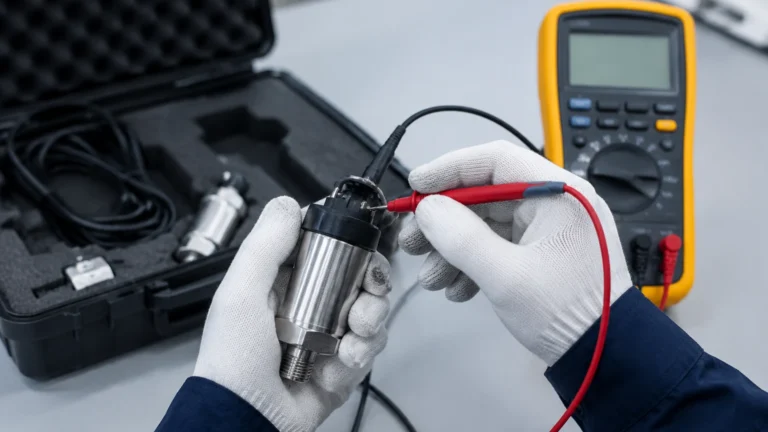
In a mining well, a submersible pressure transducer is lowered into the liquid. It features a sensing diaphragm that detects the pressure of the water column above it. To compensate for atmospheric pressure changes, a vent tube is integrated into the cable, ensuring that the measurement reflects only the liquid height. This method is highly effective for deep boreholes where non-contact methods may struggle with signal dispersion.
Radar Level Measurement
Radar transmitters utilize Frequency Modulated Continuous Wave (FMCW) or pulse technology. A sensor mounted at the top of the mining well emits high-frequency electromagnetic waves (typically in the 26GHz or 80GHz range). These waves reflect off the surface of the liquid and return to the sensor. The distance is calculated based on the time-of-flight or frequency shift. Radar is preferred in mining wells where the liquid may be turbulent or where chemical vapors make contact-based sensors impractical. For a comprehensive overview of available instrumentation, visit the Main Page of our product catalog.
Ultrasonic Level Measurement
Similar to radar, ultrasonic sensors use sound waves. A transducer emits an ultrasonic pulse that bounces off the liquid surface. While cost-effective for shallow wells or open sumps, ultrasonic technology is often limited in deep mining wells because sound waves can be affected by air temperature gradients, heavy dust, or foam on the water surface.
Technology Selection for Mining Well Applications
Selecting the appropriate instrument depends on the specific characteristics of the mining well. Factors such as depth, well diameter, liquid composition, and the presence of pumps must be evaluated.
| Feature | Hydrostatic Submersible | Radar (80 GHz) | Ultrasonic |
| :— | :— | :— | :— |
| Typical Range | Up to 500m+ | Up to 30m – 120m | Up to 15m – 30m |
| Accuracy | ±0.1% to ±0.5% FS | ±1mm to ±5mm | ±0.25% of range |
| Installation | Submerged in liquid | Top-mounted (Non-contact) | Top-mounted (Non-contact) |
| Suitability for Narrow Wells | Excellent | Good (with narrow beam) | Poor (signal interference) |
| Resistance to Foam | Unaffected | High | Low |
| Maintenance Requirement | Moderate (cleaning) | Very Low | Low |
Deep Borehole Dewatering
For dewatering wells that reach depths exceeding 100 meters (328 feet), hydrostatic transmitters are generally the standard. Their ability to remain submerged and provide continuous data despite the narrowness of the well makes them indispensable. However, the cable must be reinforced with Kevlar or stainless steel to prevent stretching under its own weight.
Chemical Leaching and Tailings
In mining wells used for In-Situ Recovery (ISR) or tailings management, the liquid may be highly acidic or alkaline. In these cases, non-contact radar is often superior because it does not come into contact with the corrosive medium. If a hydrostatic sensor is used, it must be constructed from specialized materials like Hastelloy C or Titanium with PTFE-coated cables.
Installation Considerations for Mining Wells
Proper installation is critical to ensuring the longevity and accuracy of level sensors in a mining environment.
1. Stilling Wells: In mining wells where high-capacity pumps create significant turbulence or where the well casing is uneven, a stilling well (a perforated pipe) should be installed. This protects the sensor from physical damage and minimizes the impact of waves or foam.
2. Cable Anchoring: For submersible sensors, the cable should not be allowed to hang freely if there is significant flow. Using a cable clamp at the wellhead and potentially a weighted anchor at the sensor end prevents the transmitter from drifting into pump intakes.
3. Lightning Protection: Mining sites are often in open, elevated areas prone to lightning strikes. Level transmitters should be equipped with surge protection modules at both the sensor head and the control room to prevent damage from induced overvoltages.
4. Signal Interference: When using radar in narrow mining wells, the beam angle is critical. An 80GHz radar offers a much narrower beam (often as small as 3 degrees) compared to older 26GHz models, allowing it to avoid reflections from the well walls or internal piping.
Practical Limitations and Environmental Challenges
While modern instrumentation is robust, certain mining well conditions present persistent challenges:
* Sediment Accumulation: In dewatering wells, silt and sand can accumulate at the bottom. If a hydrostatic sensor is placed too low, the pressure port can become clogged. It is recommended to install the sensor at least 1 to 2 meters above the expected silt line.
* Gas Pockets: Some mining wells may release methane or other gases. This can change the density of the air above the liquid, affecting ultrasonic measurements. Radar is immune to these gas-related density changes.
* Temperature Gradients: In very deep mines, the geothermal gradient can cause significant temperature increases. This affects the density of the water (ρ), which in turn affects hydrostatic calculations. High-end transmitters include integrated temperature compensation to correct these errors in real-time.
Frequently Asked Questions (FAQ)
Q: How often should a mining well level sensor be calibrated?
A: For critical dewatering applications, a yearly calibration check is recommended. However, if the sensor is in a corrosive environment or measuring heavy slurry, semi-annual inspections for material buildup or diaphragm wear are advisable.
Q: Can radar see through foam in a mining well?
A: High-frequency radar (80GHz) can penetrate light foam, but heavy, dense foam may absorb the signal. In cases of extreme foam, a guided wave radar (GWR) or a hydrostatic sensor is a more reliable choice.
Q: What is the benefit of using a digital output (like RS485/Modbus) over 4-20mA?
A: Digital protocols allow for long-distance transmission with less signal degradation and provide additional diagnostic data, such as the internal temperature of the sensor and signal strength, which is vital for remote mining sites.
Q: How do I protect the sensor from pump vibrations?
A: Use dampening mounts for top-mounted sensors and ensure that submersible cables are secured with specialized strain-relief hangers. If using radar, software filters can be configured to ignore high-frequency noise caused by vibration.
Conclusion
Effective monitoring of a mining well is a cornerstone of modern industrial automation in the mining sector. By understanding the physics of hydrostatic pressure and electromagnetic wave reflection, engineers can select the most appropriate technology for their specific depth and liquid conditions. Whether implementing a submersible transmitter for deep dewatering or a non-contact radar for corrosive leaching, following strict installation guidelines and accounting for environmental limitations will ensure reliable data and operational safety. For detailed technical specifications and product selection support, please refer to the Main Page.