Non Contact Ultrasonic Sensors
Non Contact Ultrasonic Sensors
In the landscape of industrial process control, the ability to measure liquid and solid levels without physical contact is a significant advantage. Non contact ultrasonic sensors have emerged as a primary solution for diverse applications ranging from wastewater management to chemical processing. By utilizing sound waves rather than mechanical floats or probes, these instruments minimize maintenance requirements and eliminate the risk of contamination or corrosion from the media being measured.
As a professional manufacturer of industrial level measurement instruments, Welk provides a range of solutions designed to meet the rigorous demands of modern automation. Understanding the underlying physics, selection criteria, and installation nuances of non contact ultrasonic sensors is essential for engineers and procurement professionals seeking to optimize their facility’s performance. For a broader overview of available technologies, including radar and magnetic gauges, technical teams often refer to the Main Page of our primary resource center.
Measurement Principles of Ultrasonic Technology
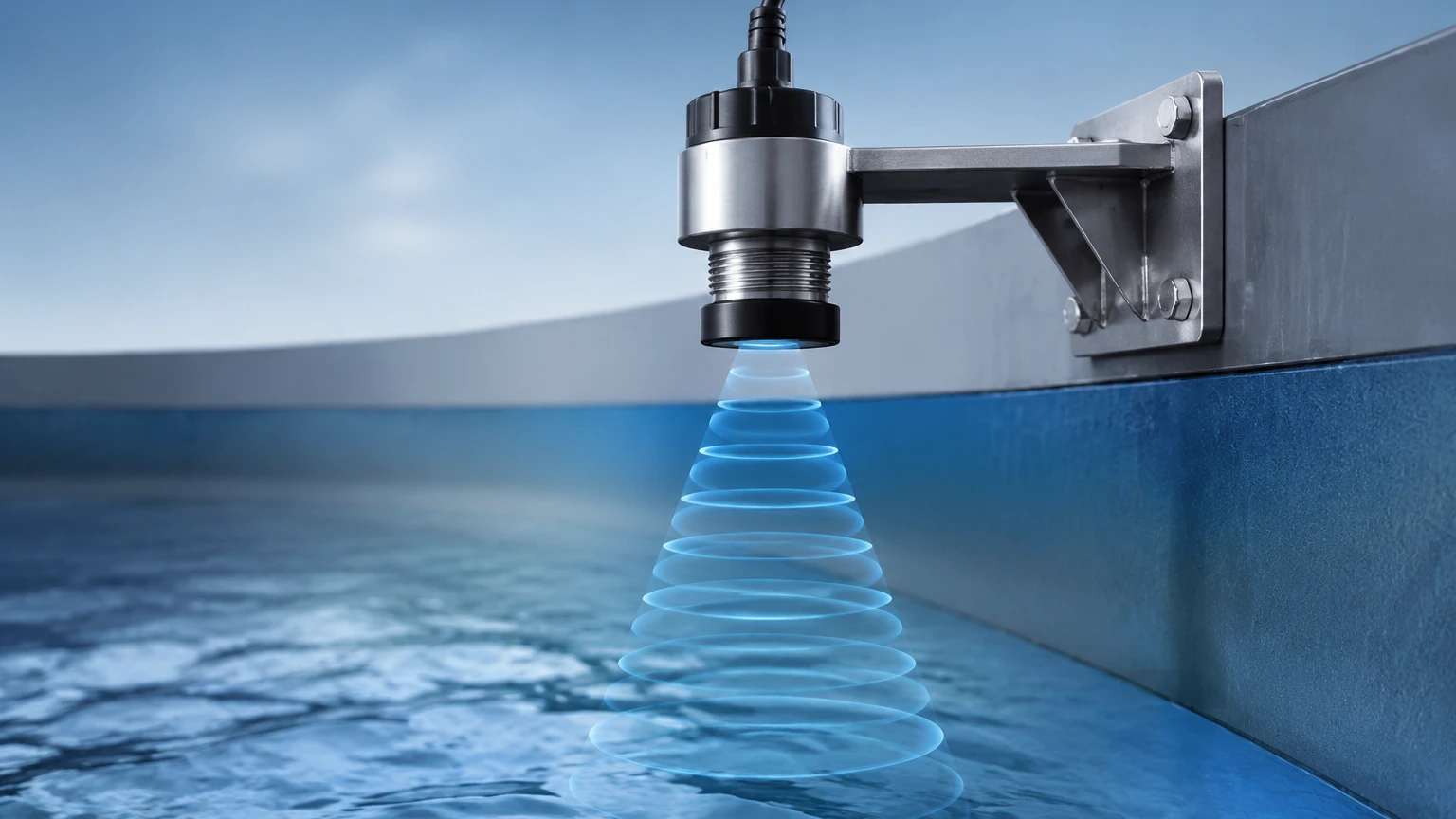
Non contact ultrasonic sensors operate on the "Time-of-Flight" (ToF) principle. The sensor head, which contains a piezoelectric transducer, emits a high-frequency acoustic pulse. This sound wave travels through the air or gas space above the medium, strikes the surface of the material, and reflects back toward the sensor.
The Calculation Formula
The internal electronics of the sensor measure the time interval between the emission of the pulse and the reception of the echo. The distance is calculated using the following fundamental equation:
D = (C × T) / 2
Where:
* D is the distance from the sensor to the material surface.
* C is the speed of sound in the medium (typically air, approximately 344 m/s at 20°C).
* T is the total time elapsed for the pulse to travel to the surface and back.
Since the sensor is mounted at a known height (the tank height or reference point), the level of the material is determined by subtracting the measured distance from the total height of the vessel.
Temperature Compensation
The speed of sound is not constant; it fluctuates based on the temperature of the air through which it travels. An increase in temperature decreases air density, which in turn increases the speed of sound. To maintain accuracy, high-quality non contact ultrasonic sensors from Welk include integrated temperature sensors. These components provide real-time data to the microprocessor, allowing it to automatically adjust the distance calculation based on ambient conditions.
Key Evaluation Criteria for Selection
Selecting the appropriate ultrasonic instrument requires a detailed analysis of the process environment. While these sensors are versatile, their performance is dictated by several technical parameters.
1. Measurement Range and Frequency
Ultrasonic sensors are available in various frequencies, typically ranging from 20 kHz to 200 kHz. Lower frequency sensors have longer wavelengths and can travel further, making them suitable for long-range measurements (up to 30 meters or more). Higher frequency sensors offer better resolution and smaller "blocking distances" but are limited to shorter ranges (usually under 5 meters).
2. Beam Angle
The beam angle defines the spread of the ultrasonic pulse. A narrow beam angle (e.g., 5° to 10°) is preferable in narrow tanks or vessels with internal obstructions like ladders, agitators, or pipes. A wider beam may cause "false echoes" if the pulse reflects off the tank walls or internal structures instead of the liquid surface.
3. Output Signals and Integration
For industrial automation, the sensor must communicate with a PLC, DCS, or SCADA system. Standard options include:
* Analog: 4-20mA (most common for continuous level monitoring).
* Digital: RS485 Modbus, HART protocol.
* Switching: Relay outputs for high/low-level alarms.
4. Process Conditions
Engineers must confirm the operating pressure and temperature. Most non contact ultrasonic sensors are designed for atmospheric pressure or slight overpressure. High-pressure environments (above 0.3 MPa) can alter the density of the gas to a point where sound transmission is inhibited. Similarly, temperatures exceeding 80°C to 100°C often require specialized sensor materials or cooling systems.
Practical Selection Table
The following table provides a general guideline for matching application requirements with sensor specifications.
| Application Type | Recommended Range | Frequency | Key Consideration |
| :— | :— | :— | :— |
| Small Chemical Tote | 0.25m – 4m | High (70-100 kHz) | Chemical compatibility of the transducer face. |
| Wastewater Wet Well | 0.5m – 10m | Medium (40-60 kHz) | IP68 rating for potential submersion/humidity. |
| Large Storage Silo | 1m – 30m | Low (20-30 kHz) | Dust management and high-power pulse. |
| Open Channel Flow | 0.3m – 5m | High (70 kHz) | Integration with flumes/weirs and flow math. |
| Corrosive Acid Tank | 0.25m – 6m | Medium | PTFE or PVDF wetted parts required. |
Installation Considerations and Best Practices
Correct installation is the single most important factor in ensuring the reliability of non contact ultrasonic sensors. Even the most advanced sensor will fail if placed incorrectly.
The Blocking Distance (Dead Zone)
Every ultrasonic sensor has a "blocking distance" directly beneath the transducer face where it cannot measure. This occurs because the transducer needs time to stop vibrating after emitting a pulse before it can listen for the return echo. If the liquid level enters this zone, the sensor will provide erratic readings or a "full" error. Users must ensure the sensor is mounted high enough so that the maximum liquid level never reaches the blocking distance.
Mounting Location and Orientation
* Avoid the Fill Stream: Never mount the sensor directly above the point where material enters the tank. The turbulence and the falling stream will interfere with the ultrasonic pulse.
* Perpendicular Alignment: The sensor face must be perfectly parallel to the liquid surface. A tilt of even a few degrees can cause the reflected signal to bounce away from the transducer, resulting in a "Loss of Echo" (LOE) error.
* Distance from Walls: As a rule of thumb, the sensor should be mounted at a distance from the tank wall equal to at least 1/6th of the tank height to prevent side-wall interference.
* Nozzle Geometry: If the sensor is mounted on a standpipe or nozzle, the inner diameter must be smooth, and the sensor face should ideally extend slightly past the bottom of the nozzle to prevent internal reflections.
Limitations and Environmental Challenges
While non contact ultrasonic sensors are robust, certain environmental factors can attenuate the signal or create measurement errors.
1. Heavy Foam: Some liquids produce thick, dense foam. This foam acts as an acoustic insulator, absorbing the ultrasonic pulse rather than reflecting it. In such cases, radar or contact-based technologies may be more appropriate.
2. Vacuum Conditions: Sound requires a medium (gas) to travel. In a vacuum, ultrasonic sensors cannot function.
3. Heavy Dust or Steam: While light dust is manageable, extremely dense dust (common in grain silos) or heavy steam can scatter the sound waves. High-power, low-frequency sensors are better suited for these environments, but testing is often required.
4. Turbulence and Agitation: Rapidly moving liquid surfaces can scatter the echo. Signal processing algorithms like "echo averaging" can help, but installing a stilling well is often the most effective mechanical solution.
Application Scenarios in Industry
Water and Wastewater Treatment
This is the most common application for non contact ultrasonic sensors. They are used to monitor levels in lift stations, clarifiers, and chemical storage tanks. Because the sensors do not touch the water, they are not affected by the grease, solids, or corrosive gases (like H2S) typically found in sewage.
Chemical Processing
In chemical plants, maintaining the integrity of the vessel is paramount. Non contact sensors allow for level monitoring without adding leak points or using materials that might react with the process fluid. Welk offers sensors with PVDF or PTFE housings to resist aggressive acids and bases.
Industrial Automation and OEM
Many manufacturers integrate ultrasonic sensors into larger machines, such as automated filling lines or cooling systems. Their compact size and standard 4-20mA or Modbus outputs make them easy to integrate into existing control architectures.
Frequently Asked Questions (FAQs)
Q: Can ultrasonic sensors measure the level of solids?
A: Yes, but with caveats. Solids like grain, sand, or plastic pellets do not reflect sound as efficiently as liquids. They also tend to form conical shapes (angle of repose), which can deflect the signal. A higher-power sensor with a narrower beam is usually required for solids.
Q: How does wind affect the measurement?
A: In outdoor applications, such as open reservoirs, strong winds can "blow" the ultrasonic pulse away or create surface ripples that scatter the echo. Using a protective shroud or a stilling well can mitigate these effects.
Q: What is the typical lifespan of a non contact ultrasonic sensor?
A: Since there are no moving parts and no contact with the media, these sensors often last 7 to 10 years or more, provided the electronics are protected from extreme power surges and the transducer face is kept clean.
Q: Can I use an ultrasonic sensor in a pressurized tank?
A: Only if the pressure is relatively low (typically below 3 Bar). High pressure changes the speed of sound and the density of the air, which requires complex compensation that most standard ultrasonic units are not designed to handle.
Conclusion and Next Steps
Non contact ultrasonic sensors represent a cost-effective, reliable, and low-maintenance solution for a vast array of industrial level measurement tasks. By eliminating contact with the process media, facilities can reduce downtime and improve safety. However, the success of the installation depends on a thorough understanding of the vessel geometry, the physical properties of the media, and the potential for environmental interference.
Before proceeding with a purchase, project teams should confirm the following:
* The maximum and minimum measurement distances.
* The presence of foam, dust, or heavy vapors.
* The chemical compatibility of the sensor housing with the process environment.
* The required communication protocol for the existing control system.
For detailed technical datasheets, installation manuals, and customized OEM/ODM service inquiries, please visit the Main Page to connect with a Welk technical specialist. Our team provides the expertise needed to ensure your level measurement solution is accurate, reliable, and tailored to your specific industrial requirements.