On-line Gas Analyzers
On-line Gas Analyzers
In modern industrial process control, the ability to monitor gas compositions in real-time is essential for safety, environmental compliance, and operational efficiency. On-line gas analyzers provide continuous, automated measurement of specific gas components within a process stream or ambient environment. Unlike laboratory analysis, which involves manual sampling and delayed results, on-line systems offer immediate feedback, allowing for rapid adjustments to combustion processes, chemical reactions, and emission control systems.
For engineers and plant managers, selecting the correct analytical technology requires an understanding of the chemical properties of the target gas and the physical conditions of the process. This guide explores the fundamental principles, selection criteria, and installation requirements for on-line gas analyzers in industrial B2B environments.
Understanding On-line Gas Analysis Principles
Before selecting an instrument, it is necessary to understand the physical or chemical principle used to detect the gas. On-line gas analyzers are generally categorized by their sensing mechanism. Each method has specific strengths depending on the gas species and the presence of interfering components.
Infrared Absorption (NDIR and FTIR)
Non-Dispersive Infrared (NDIR) is one of the most common techniques for detecting gases like Carbon Dioxide (CO2), Carbon Monoxide (CO), and various hydrocarbons (CH4, C3H8). The principle relies on the fact that many gases absorb infrared light at specific wavelengths. An NDIR analyzer consists of an IR source, a sample chamber, an optical filter, and a detector. The amount of light absorbed is proportional to the concentration of the gas, following the Beer-Lambert Law.
Fourier Transform Infrared (FTIR) spectroscopy is a more advanced version that can measure multiple gas species simultaneously by analyzing the entire infrared spectrum. While more complex and costly, FTIR is highly effective for complex gas mixtures where cross-sensitivity is a concern.
Electrochemical Sensors
Electrochemical analyzers measure gas concentration by sensing the current generated by a chemical reaction at an electrode. These are widely used for Oxygen (O2) and toxic gases such as Hydrogen Sulfide (H2S) or Carbon Monoxide. They are compact and cost-effective but have a limited lifespan (typically 1–2 years) as the electrolyte or electrodes eventually degrade.
Paramagnetic Detection
Oxygen is unique because it is paramagnetic, meaning it is attracted into a magnetic field. Paramagnetic analyzers use this property to measure O2 concentrations with high precision and stability. Unlike electrochemical sensors, paramagnetic cells do not wear out through chemical reactions, making them ideal for long-term continuous monitoring in high-purity applications or flue gas analysis.
Thermal Conductivity (TCD)
Thermal Conductivity Detectors compare the ability of a sample gas to conduct heat against a reference gas (usually air or nitrogen). This method is effective for gases with thermal conductivities significantly different from the background gas, such as Hydrogen (H2) or Helium (He).
Tunable Diode Laser Absorption Spectroscopy (TDLAS)
TDLAS is a modern, non-contact method where a laser beam is tuned to a specific absorption line of the target gas. This technology is highly selective and can be installed "in-situ" (directly across a stack or pipe), providing extremely fast response times and resistance to harsh, corrosive environments.
Key Technologies and Selection Criteria
Choosing the right on-line gas analyzer involves balancing performance requirements with the realities of the process environment. The following table provides a comparison of common technologies used in industrial applications.
| Technology | Typical Target Gases | Advantages | Limitations |
| :— | :— | :— | :— |
| NDIR | CO, CO2, CH4, SO2 | Stable, long life, cost-effective | Sensitive to moisture and dust |
| Electrochemical | O2, H2S, Cl2, NH3 | Low cost, simple installation | Limited sensor life, cross-sensitivity |
| Paramagnetic | O2 | High accuracy, no consumables | Sensitive to vibration and tilt |
| TDLAS | NH3, HCl, H2O, O2 | In-situ measurement, very fast | Higher initial investment |
| Thermal Cond. | H2, He, Ar | Reliable for binary mixtures | Not selective in complex mixtures |
| Zirconia | O2 (High Temp) | Fast, handles flue gas | Requires high heat, no combustible gases |
Evaluation Factors
1. Measurement Range: Ensure the analyzer’s range (e.g., 0–100 ppm or 0–25% Vol) matches the expected process fluctuations.
2. Response Time (T90): In safety-critical applications, such as detecting explosive limits, a T90 time (the time to reach 90% of the final value) of less than 10 seconds may be required.
3. Cross-Sensitivity: Identify if other gases in the stream absorb light at the same wavelength or react with the same electrode as the target gas.
4. Process Conditions: Consider the temperature (in °C), pressure (in bar or kPa), and moisture content of the gas stream.
Installation and Sampling System Design
The reliability of an on-line gas analyzer is often determined more by the sampling system than the analyzer itself. There are two primary installation methods: Extractive and In-situ.
Extractive Sampling Systems
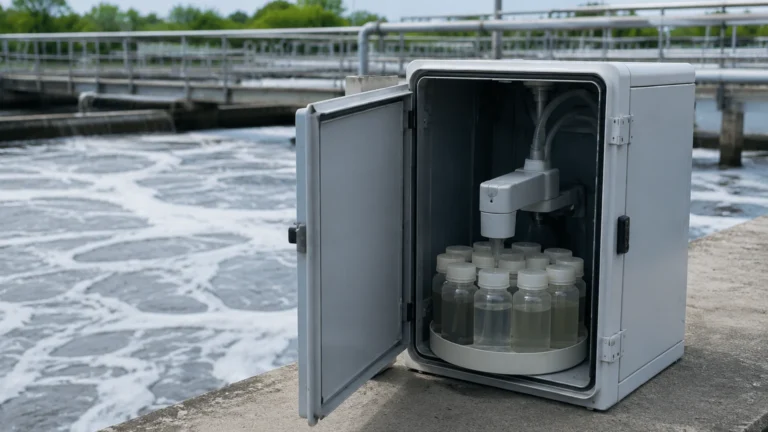
In an extractive system, a sample is pulled from the process pipe via a pump and transported through a sample line to the analyzer. This allows for sample conditioning, which may include:
* Filtration: Removing particulates that could damage the sensor.
* Moisture Removal: Using peltier coolers or membrane dryers to prevent condensation, which can cause measurement errors or corrosion.
* Pressure Regulation: Ensuring the gas enters the analyzer at a constant, low pressure (typically 0.5 to 1.5 bar).
Extractive systems allow the analyzer to be located in a controlled environment (an instrument shed or rack), easing maintenance access. However, they introduce a lag time due to the length of the sample line.
In-situ Measurement
In-situ analyzers, such as TDLAS or Zirconia probes, are mounted directly on the process wall. They measure the gas in its natural state without the need for a sampling system. This eliminates lag time and reduces maintenance associated with pumps and filters. However, the instrument must be robust enough to withstand process temperatures and potential fouling from dust or chemicals.
Probe Placement
Probes should be installed in a representative section of the process. Avoid areas of stagnant flow, such as dead-end pipe sections, or areas immediately following a chemical injection point where the gas may not be fully mixed. For stack monitoring, the probe is typically placed at least eight stack diameters downstream from any bends or obstructions.
Integration with Process Level Control Systems
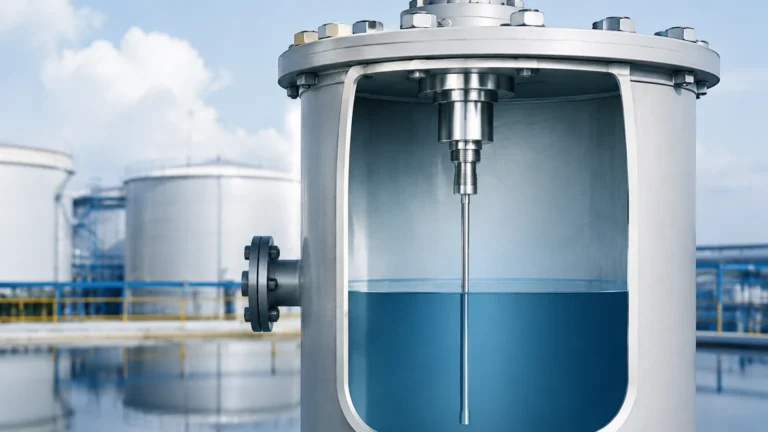
In many industrial B2B applications, gas analysis is not a standalone function but part of a broader vessel management strategy. For example, in chemical storage tanks, monitoring the gas phase (headspace) is critical for preventing vacuum collapse or overpressure.
When a liquid level rises or falls, the volume of the gas headspace changes. If the tank is nitrogen-blanketed to prevent explosion, an on-line oxygen analyzer is used to ensure the O2 levels remain below the Limiting Oxygen Concentration (LOC). This gas data must be synchronized with accurate level data. To explore how high-precision level instrumentation integrates with these safety systems, engineers often consult the Main Page for technical specifications on radar and ultrasonic sensors that function in pressurized, gas-filled environments.
Furthermore, in wastewater treatment, on-line gas analyzers monitor methane (CH4) and hydrogen sulfide (H2S) levels in digesters. These readings are cross-referenced with hydrostatic level transmitters to manage the biomass volume and gas production rates effectively. The coordination between level measurement and gas analysis ensures that the vessel operates within its structural and safety design limits.
Limitations and Operational Risks
While on-line gas analyzers are powerful tools, they are subject to several operational risks that can lead to inaccurate data or equipment failure.
Moisture and Condensation
Moisture is the primary enemy of gas analysis. If water vapor condenses in the sample line, it can absorb water-soluble gases (like SO2 or NH3), leading to falsely low readings. Additionally, liquid droplets can damage NDIR optical cells or coat electrochemical sensors, rendering them non-functional. Heated sample lines and high-efficiency chillers are the standard defense against this risk.
Calibration Drift
All gas sensors experience some degree of drift over time. This can be caused by sensor aging, temperature fluctuations, or environmental contamination. A robust maintenance program must include periodic "zero" and "span" calibrations using certified reference gases. Many high-end on-line systems now feature automated calibration cycles to minimize manual intervention.
Particulate Fouling
In industries like cement manufacturing or coal-fired power generation, gas streams are heavy with dust. If filtration is inadequate, particulates will clog sample probes and damage internal components. Sintered metal filters and automated blow-back systems (using compressed air to clear the probe) are essential in these environments.
Frequently Asked Questions (FAQ)
Q: How often should an on-line gas analyzer be calibrated?
A: This depends on the technology and the application. Electrochemical sensors may require monthly checks, while TDLAS or Paramagnetic systems might only need calibration every six months. Always follow the manufacturer's drift specifications.
Q: What is the difference between a gas detector and a gas analyzer?
A: A gas detector is typically used for safety (e.g., LEL or O2 deficiency) and provides a simple alarm when a threshold is crossed. A gas analyzer provides a continuous, quantitative measurement of the gas concentration for process control or reporting.
Q: Can one analyzer measure multiple gases?
A: Yes, technologies like FTIR, Gas Chromatography (GC), and certain multi-channel NDIR analyzers can measure several gas species simultaneously. This is often more cost-effective than installing individual units for each gas.
Q: What is the impact of pressure changes on measurement?
A: Most gas analyzers are sensitive to pressure because the number of molecules in the sensing chamber changes with pressure. High-quality analyzers include internal pressure compensation or require a regulated sample pressure to maintain accuracy.
Q: Are on-line gas analyzers suitable for hazardous areas?
A: Yes, but they must be specifically rated for the zone (e.g., ATEX/IECEx Zone 1 or 2). This often involves using explosion-proof enclosures or purged cabinets to prevent the electronics from becoming an ignition source.
By carefully considering the measurement principle, the sampling requirements, and the integration with other process variables like level and pressure, industrial operators can ensure their on-line gas analyzers provide the reliable data necessary for modern process automation.