Orgapack or T 450 Manual
Orgapack or T 450 Manual
In the landscape of industrial operations, technical documentation serves as the primary bridge between complex engineering design and daily operational efficiency. Whether a facility is managing end-of-line packaging systems or high-precision fluid processing, the availability of a comprehensive manual—such as the Orgapack or T 450 manual—is critical for maintaining safety standards and equipment longevity. For engineers and procurement specialists, understanding how to interpret these manuals and integrate them into a broader maintenance strategy is essential for minimizing downtime.
This guide explores the technical requirements often found in industrial manuals for tensioning and sealing equipment, while providing a comparative framework for the process control instruments that monitor the raw materials before they reach the packaging stage. By aligning equipment maintenance with precise level measurement, industrial facilities can achieve a seamless transition from bulk storage to finalized product distribution.
Understanding Industrial Equipment Documentation
Industrial manuals like those for the Orgapack OR-T 450 focus heavily on mechanical calibration, battery management, and wear-part replacement. The OR-T 450 is a battery-powered strapping tool used extensively in logistics and heavy-duty industrial packaging. In such manuals, the focus is typically on:
1. Tensioning Force Calibration: Ensuring the tool applies the correct Newton (N) force to secure loads without damaging the substrate.
2. Sealing Parameters: The friction-welding process requires precise timing and pressure, often detailed in the troubleshooting sections of the manual.
3. Operational Safety: Guidelines on handling high-tension straps and lithium-ion battery safety.
While these tools handle the physical movement of goods, the efficiency of the entire production line often depends on the upstream processes. For industries dealing with liquids, chemicals, or granular solids, the "manual" for success starts with accurate level measurement. Just as a strapping tool must be calibrated to a specific tension, a level transmitter must be calibrated to the specific dielectric constant or density of the medium it measures.
The Role of Level Measurement in Process Automation
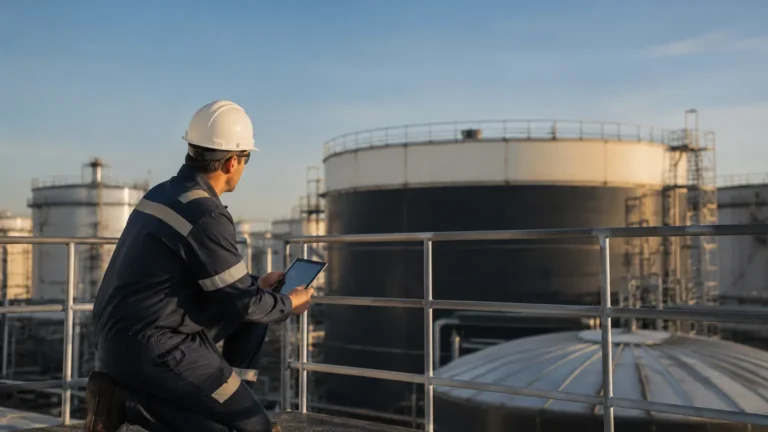
Before products are palletized and strapped using tools described in an Orgapack or T 450 manual, they are typically stored in large tanks or silos. Monitoring these levels is the core of industrial automation. Welk provides a range of instruments designed to ensure that the supply chain never runs dry and that tanks never overflow.
Measurement Principles: Radar vs. Ultrasonic
Before selecting an instrument from the Main Page of a technical catalog, it is vital to understand the physics behind the measurement.
Radar Level Measurement (ToF)
Radar level meters operate on the Time-of-Flight (ToF) principle. The device emits a high-frequency electromagnetic wave (often in the 26GHz or 80GHz range) toward the material surface. The wave reflects off the surface and returns to the sensor. Since the speed of light is constant, the time taken for the signal to return is directly proportional to the distance.
* Advantages: Radar is unaffected by vacuum, high pressure, or temperature fluctuations. It can penetrate dust and steam, making it ideal for chemical reactors and cement silos.
* Limitations: The dielectric constant (εr) of the material must be high enough to reflect the signal. Materials with εr < 1.4 may require guided wave radar.
Ultrasonic Level Measurement
Ultrasonic sensors use sound waves rather than electromagnetic waves. The transducer emits a mechanical pulse that bounces off the product surface.
* Advantages: Highly cost-effective for water treatment and open-channel flow applications.
* Limitations: Sound speed changes with air temperature and density. Ultrasonic sensors are generally unsuitable for vacuum applications or environments with heavy foam, which absorbs the sound energy.
Technical Selection Criteria for Level Instruments
When transitioning from manual packaging tools to automated process monitoring, engineers must evaluate instruments based on the physical properties of the medium and the environment. The following table provides a high-level comparison for selection.
Selection Table: Level Measurement Technologies
| Technology | Typical Range | Accuracy | Best For | Main Limitation |
| :— | :— | :— | :— | :— |
| 80GHz Radar | Up to 120m | ±1mm | Corrosive liquids, solids, narrow tanks | High initial cost |
| Ultrasonic | 0.25m – 15m | ±0.25% FS | Water, wastewater, acids | Foam and vapor interference |
| Hydrostatic | 1m – 200m | ±0.1% – 0.5% | Deep wells, vented tanks | Sensitive to density changes |
| Magnetic Gauge | 0.3m – 6m | ±5mm | High-pressure boilers, oil tanks | Mechanical moving parts |
Installation Considerations and Best Practices
Just as the Orgapack or T 450 manual specifies the correct angle for strap insertion, level sensors have strict installation geometries to ensure accuracy.
1. Nozzle Height and Diameter: For radar and ultrasonic sensors, the nozzle should be as short as possible. If the nozzle is too long or narrow, it can create internal reflections (ringing) that mask the true level signal.
2. The "Dead Zone" (Blocking Distance): Every non-contact sensor has a minimum distance it cannot measure, typically ranging from 100mm to 500mm. The sensor must be mounted high enough so the maximum liquid level never enters this zone.
3. Obstructions: Avoid mounting sensors directly above ladders, heating coils, or agitators. These internal tank structures will create "false echoes." Modern radar sensors use software to "map out" these echoes, but physical avoidance is always the best engineering practice.
4. Environmental Protection: In outdoor installations, sunshields are recommended to prevent temperature-induced electronics drift, even if the sensor has internal temperature compensation.
Limitations of Level Measurement Technologies
No single technology is a universal solution. Understanding the boundaries of each method prevents operational failure:
* Hydrostatic Limitations: These sensors measure the weight of the liquid column. If the density of the fluid changes (due to temperature or concentration changes), the level reading will be inaccurate unless a secondary sensor is used for compensation.
* Radar Limitations in Solids: In silos containing grain or plastic pellets, the material often forms a cone. The radar beam may reflect away from the sensor rather than back to it. Using a gimbal (swivel) mount allows the engineer to aim the beam at the most reflective part of the material slope.
* Ultrasonic Limitations in Pressure: Ultrasonic waves require a medium (air or gas) to travel. In high-pressure environments (above 3 bar), the air density changes significantly, which can lead to measurement errors if not properly calibrated.
Frequently Asked Questions (FAQ)
Q: Can I use a manual strapping tool like the OR-T 450 in the same area as level sensors?
A: Yes. However, if the level sensors are ultrasonic, ensure that high-frequency noise from pneumatic tools or heavy machinery does not interfere with the sensor’s frequency range. Radar sensors are generally immune to acoustic noise.
Q: How often should level transmitters be calibrated compared to manual tools?
A: While manual strapping tools may require daily inspection, modern solid-state level transmitters like Welk’s radar series typically require calibration once every 12 to 24 months, depending on the corrosivity of the environment.
Q: What happens if the manual for my level meter is lost?
A: Most industrial manufacturers provide digital versions of manuals through their main site. For Welk products, technical specifications and wiring diagrams are accessible via the product's specific documentation portal.
Q: Is 80GHz radar better than 26GHz for all applications?
A: 80GHz radar offers a narrower beam angle, which is better for avoiding internal obstructions and measuring through small nozzles. However, 26GHz radar is sometimes preferred for applications with extremely heavy dust or steam where a lower frequency can penetrate the atmosphere more effectively.
Conclusion: Integrating Manual Precision with Automated Accuracy
Maintaining an industrial facility requires a dual focus on the small-scale manual tools used for packaging and the large-scale sensors used for process control. Whether you are consulting an Orgapack or T 450 manual for tool maintenance or selecting a new radar level meter for a chemical tank, the goal remains the same: reliability and precision.
By understanding the measurement principles of radar, ultrasonic, and hydrostatic technologies, engineers can make informed decisions that protect their infrastructure. For those looking to upgrade their facility's monitoring capabilities, reviewing the latest in industrial sensor technology on the Main Page is a critical step toward achieving a fully optimized and automated production cycle.