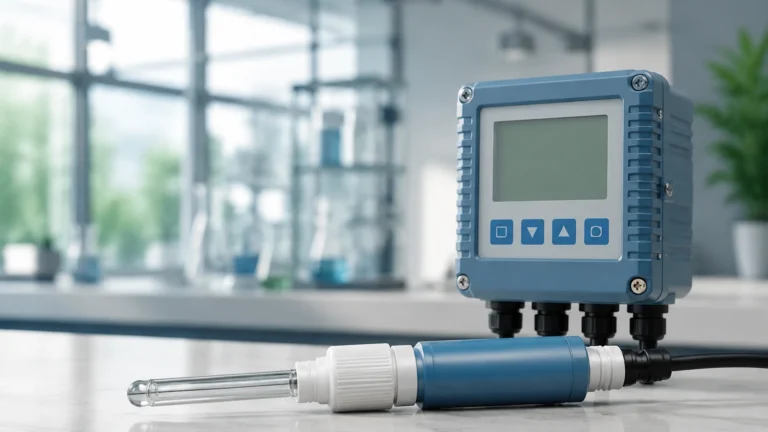
Ph Sensors
Ph Sensors
In industrial process control, the measurement of liquid properties is as critical as the measurement of volume and level. While level measurement instruments—such as radar level meters and ultrasonic sensors—provide data on the quantity of a medium, pH sensors provide essential data on its chemical state. For engineers and plant operators, understanding the integration of these two data points is vital for safety, environmental compliance, and product quality. This guide explores the technical principles of pH sensors, their selection criteria, and their operational relationship with industrial level measurement systems.
Understanding pH Measurement Principles
The term pH stands for "potential of hydrogen," representing the activity of hydrogen ions in a water-based solution. The pH scale is logarithmic, ranging from 0 to 14, where 7 is neutral. Values below 7 are acidic, and values above 7 are alkaline (basic).
The Potentiometric Method
Most industrial pH sensors operate on the potentiometric principle. This method measures the voltage difference between two electrodes submerged in a solution. The system typically consists of a glass electrode (the sensing electrode) and a reference electrode.
1. The Glass Electrode: This electrode features a specialized pH-sensitive glass membrane. When immersed in a liquid, a hydrated layer forms on both the inner and outer surfaces of the glass. Hydrogen ions in the process liquid exchange with ions in the glass membrane, creating a potential difference relative to the internal buffer solution (usually a pH 7 solution).
2. The Reference Electrode: To measure the potential of the glass electrode, a stable reference point is required. The reference electrode provides a constant potential that is independent of the pH of the liquid. It typically uses a silver/silver chloride (Ag/AgCl) internal element and a concentrated potassium chloride (KCl) electrolyte.
3. The Junction: The reference electrode must maintain electrical contact with the process liquid. This is achieved through a porous junction (made of ceramic, Teflon, or wood) that allows a slow leakage of the electrolyte into the medium.
The total voltage measured by the sensor is the difference between the sensing electrode and the reference electrode. This voltage is governed by the Nernst Equation, which states that for every pH unit change, the potential changes by approximately 59.16 mV at 25°C (77°F).
Integration with Level Measurement Systems
In B2B industrial environments, pH sensors are rarely used in isolation. They are frequently installed in tanks and vessels alongside level measurement instruments. For a comprehensive overview of level instrumentation that complements analytical sensing, engineers often refer to the Main Page of specialized manufacturers to select compatible hardware.
The Role of Level Sensors in Analytical Loops
Level measurement is a prerequisite for reliable pH monitoring for several reasons:
* Submergence Protection: pH sensors must remain submerged to function correctly. If a tank level drops below the sensor's installation point, the glass membrane will dry out, leading to sensor failure or sluggish response. Level meters (such as ultrasonic or radar types) provide the logic to disable pH-based dosing pumps when the liquid level is too low.
* Volumetric Dosing: In neutralization systems, the amount of reagent required depends on both the pH value and the total volume of the liquid. Level sensors provide the height data necessary to calculate volume, allowing the control system to determine the exact dosage of acid or base needed to reach the target pH.
* Automated Retraction: In applications with high solids or aggressive chemicals, pH sensors are often mounted in retractable assemblies. These assemblies use level data to ensure the probe is only inserted when the medium is present at the correct height.
Types of Industrial pH Sensors
Selecting the right sensor requires matching the electrode technology to the specific process conditions. Below are the primary types used in industrial automation.
1. Standard Glass Electrodes
These are the most common sensors, suitable for general water treatment and mild chemical processes. They offer high accuracy and a wide measurement range. However, they are fragile and susceptible to breakage from mechanical shock or high-pressure surges.
2. ISFET (Ion-Sensitive Field Effect Transistor)
ISFET sensors use a solid-state chip instead of a glass membrane to measure hydrogen ion activity. They are "glass-free," making them ideal for the food and beverage industry where glass breakage is a significant safety risk. They are more robust but can be sensitive to light and temperature fluctuations.
3. Solid-State and Non-Glass Sensors
Beyond ISFET, some sensors use proprietary conductive polymers or solid-state materials. These are designed for extreme environments, such as high-viscosity slurries or processes containing hydrofluoric acid (HF), which would dissolve standard glass membranes.
Selection Criteria for Industrial Applications
When specifying pH sensors, engineers must evaluate the following technical parameters to ensure longevity and accuracy.
Temperature and Pressure
Temperature affects both the chemical activity of the ions and the physical integrity of the sensor. Most industrial sensors include an integrated temperature element (like a PT100 or PT1000) for automatic temperature compensation (ATC). Pressure is equally important; if the process pressure exceeds the internal pressure of the reference electrolyte, the process medium may be forced into the sensor, poisoning the reference junction.
Chemical Compatibility
The materials of the sensor body (e.g., Ryton, PVDF, or Stainless Steel) and the O-rings (Viton, EPDM) must be compatible with the process medium. For example, in wastewater treatment involving oils or greases, a flat-surface glass membrane is preferred to prevent fouling.
Practical Selection Table
| Application | Recommended Sensor Type | Temperature Range | Pressure Limit | Key Feature |
| :— | :— | :— | :— | :— |
| General Water Treatment | Standard Glass / Ceramic Junction | 0°C to 80°C | 6 bar (87 psi) | Cost-effective, reliable |
| Chemical Processing | High-Temp Glass / PTFE Junction | -5°C to 110°C | 10 bar (145 psi) | Chemical resistance |
| Food & Beverage | ISFET (Glass-Free) | 0°C to 100°C | 6 bar (87 psi) | Sanitary, break-resistant |
| Wastewater (High Solids) | Flat Surface / Open Junction | 0°C to 85°C | 7 bar (101 psi) | Self-cleaning design |
| Power Plant (Pure Water) | Refillable Liquid Junction | 0°C to 60°C | 0.5 bar (7 psi) | High precision in low conductivity |

Installation Considerations
Proper installation is critical to the performance of pH sensors. Unlike level meters, which can often be mounted at the top of a tank (non-contact), pH sensors are contact-based and sensitive to flow dynamics.
1. Mounting Angle: pH sensors should never be installed horizontally or upside down. A minimum angle of 15° above the horizontal is required to ensure that the internal electrolyte stays in contact with the glass membrane and that air bubbles do not get trapped inside the sensing bulb.
2. Flow Velocity: In pipeline installations, the sensor should be placed where the flow is steady. High-velocity flow can cause a "streaming potential," which adds noise to the pH signal. Conversely, too little flow can lead to stagnant pockets that do not represent the bulk process.
3. Immersion Depth: The sensor must be deep enough to be fully submerged even during turbulent conditions, but not so deep that it becomes a trap for debris at the bottom of a tank. Integrating data from level transmitters helps maintain the ideal immersion depth in variable-level tanks.
4. Cable Management: pH signals are high-impedance (very weak). Cables should be kept as short as possible and routed away from high-voltage power lines to prevent electromagnetic interference. Using a pre-amplifier near the sensor head is standard practice for long cable runs.
Limitations and Common Risks
Despite their importance, pH sensors are among the most maintenance-intensive instruments in a plant. Understanding their limitations helps in developing a robust maintenance schedule.
* Reference Poisoning: Chemicals such as sulfides, cyanides, and heavy metals can react with the silver ions in the reference electrolyte, forming precipitates that clog the junction. This leads to a slow response and large measurement offsets.
* Glass Dehydration: If a sensor is left in a dry tank for an extended period, the hydrated layer on the glass membrane will disappear. While some sensors can be rehydrated in a buffer solution, prolonged dehydration often leads to permanent loss of sensitivity.
* Scaling and Coating: In processes like lime softening or mineral precipitation, a layer of scale can form on the sensor. This insulates the glass from the process liquid. Automated cleaning systems (using water jets or ultrasonic transducers) are often necessary in these environments.
* Calibration Drift: All pH sensors drift over time due to the aging of the glass and the depletion of the electrolyte. Regular calibration using standard buffer solutions (typically pH 4, 7, and 10) is mandatory. In B2B operations, this is often scheduled weekly or monthly depending on the criticality of the process.
Frequently Asked Questions (FAQs)
How long does an industrial pH sensor last?
In clean water applications, a sensor may last 1 to 2 years. In harsh chemical environments or high-temperature processes, the lifespan may be reduced to 3 to 6 months. Unlike level meters, which can last a decade, pH sensors are considered consumables.
Can I use a pH sensor to measure non-aqueous solutions?
Standard pH sensors are designed for aqueous (water-based) solutions. Measuring pH in oils or pure solvents requires specialized electrodes with low-resistance glass and specific electrolytes to maintain a stable junction potential.
Why is the pH reading different from a lab sample?
Discrepancies often arise from temperature differences between the process and the lab, or from CO2 absorption in the lab sample, which changes the pH. Always use temperature-compensated values for comparison.
How do I know when to replace the sensor?
During calibration, the transmitter will calculate the "slope" and "offset." A new sensor has a slope near 100% (59.16 mV/pH). When the slope drops below 85% or the offset exceeds ±30 mV, the sensor should be replaced.
Conclusion
pH sensors are vital components of modern industrial process control, providing deep insights into the chemical composition of liquids. By understanding the underlying potentiometric principles and selecting the appropriate sensor type for the specific pressure, temperature, and chemical environment, engineers can ensure accurate and reliable data.
Furthermore, the synergy between analytical sensors and level measurement instruments cannot be overstated. Efficient plant operation relies on the combined data from these systems to manage dosing, ensure safety, and optimize resource usage. For those seeking to integrate these technologies, exploring the comprehensive range of measurement solutions available on the Main Page is a recommended starting point for designing a robust process control architecture.