Oxysen
Oxysen
In industrial gas management and process automation, the storage and monitoring of oxygen—often referred to in technical procurement as oxysen systems—require specialized instrumentation due to the unique physical and chemical properties of the gas. Whether stored as a high-pressure gas or a cryogenic liquid (LOX), maintaining accurate level data is essential for operational continuity, safety, and inventory control. This guide explores the measurement principles, selection criteria, and installation requirements for monitoring oxysen levels in various industrial environments.
Measurement Principles for Oxygen Systems
Selecting the correct level measurement technology for oxysen depends heavily on the physical state of the medium. Liquid oxygen is typically stored in vacuum-insulated cryogenic tanks at temperatures below -183°C (-297°F), while gaseous oxygen is stored in high-pressure cylinders or buffer tanks. The following principles are the most common in modern industrial applications.
Hydrostatic Pressure (Differential Pressure)
Hydrostatic level measurement is the most prevalent method for liquid oxysen tanks. The principle relies on the relationship between the pressure exerted by a liquid column and its height. For a tank at atmospheric pressure, the formula is $P = \rho \cdot g \cdot h$, where $P$ is pressure, $\rho$ is density, $g$ is gravity, and $h$ is the height of the liquid.
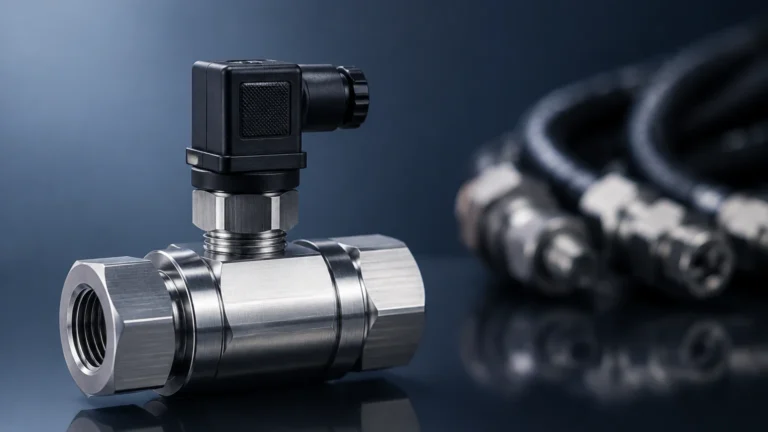
In pressurized cryogenic vessels, a Differential Pressure (DP) transmitter is used. One side of the transmitter measures the total pressure at the bottom of the tank (liquid + gas headspace), while the other side measures only the gas headspace pressure. The transmitter subtracts the headspace pressure to isolate the hydrostatic pressure of the liquid. Because liquid oxygen has a relatively stable density at a constant temperature, this method provides high accuracy for inventory management.
Radar Level Measurement (Non-Contact and Guided Wave)
Radar technology uses electromagnetic pulses to determine the distance to the liquid surface. In non-contact radar, the sensor emits a high-frequency signal (typically 26GHz or 80GHz) that reflects off the surface of the oxysen and returns to the receiver. The time-of-flight is used to calculate the level.
One challenge with liquid oxygen is its low dielectric constant ($ε_r ≈ 1.5$). A low dielectric constant means the material is less reflective to radar waves. Modern 80GHz radar sensors, however, feature high sensitivity and narrow beam angles, allowing them to track the surface of liquid oxygen accurately even in narrow or tall vessels. Guided Wave Radar (GWR), which uses a probe to direct the signal, can also be used, though it is less common in cryogenic applications due to the potential for heat leak through the probe.
Magnetic Level Gauges
Magnetic level gauges provide a clear visual indication and are often used as a redundant safety system. A float containing a permanent magnet moves up and down a bypass chamber connected to the tank. As the float moves, it flips magnetic flaps or rollers on the outside of the chamber, changing their color. This provides a mechanical, power-free reading of the oxysen level. These units can be equipped with reed switches or transmitters to provide a 4-20mA signal to a control room.
Selection Criteria for Oxysen Level Instruments
When evaluating instrumentation for an oxysen project, engineers must consider the specific environmental and chemical constraints of the application. For a comprehensive overview of available hardware and technical specifications, engineers often refer to the Main Page of specialized instrument manufacturers to compare model capabilities.
Material Compatibility and Oxygen Cleaning
The most critical factor in oxysen instrumentation is material compatibility. Oxygen is a powerful oxidant. In the presence of high-pressure oxygen or liquid oxygen, substances like oil, grease, and certain polymers can spontaneously ignite. All wetted parts must be "Oxygen Cleaned" according to standards such as ASTM G93 or ISO 15001. This process ensures that all organic residues are removed before the instrument is installed. Common materials for wetted parts include Stainless Steel 316L, Monel, or specific PTFE grades for seals.
Temperature and Pressure Ranges
Cryogenic storage requires instruments that can withstand extreme cold without becoming brittle. Transmitters used in these applications often utilize capillary tubes or extended necks to move the electronic housing away from the cold source, preventing condensation and electronic failure. For gaseous oxygen, the instrument must be rated for the maximum operating pressure of the vessel, which can often exceed 200 bar in cylinder filling stations.
Selection Table for Oxygen Level Technologies
| Technology | Typical Application | Advantages | Limitations |
| :— | :— | :— | :— |
| Differential Pressure | Cryogenic LOX Tanks | Proven, reliable, cost-effective | Requires density compensation |
| 80GHz Radar | Process Tanks / Buffers | Non-contact, high precision | Low dielectric constant of LOX |
| Magnetic Gauge | Visual Monitoring | No power required, high visibility | Moving parts may wear over time |
| Ultrasonic | Atmospheric Water Treatment | Low cost, easy install | Not for vacuum or high pressure |
Installation Considerations for Oxygen Applications
Proper installation is as important as instrument selection when dealing with oxysen. Failure to follow safety protocols can lead to equipment damage or hazardous conditions.
1. Degreasing and Handling: Personnel must use lint-free, oil-free gloves when handling oxygen-cleaned instruments. Even the oil from a fingerprint can pose a risk in high-concentration oxygen environments.
2. Mounting Position: For radar sensors, the mounting nozzle should be positioned to avoid internal obstructions like cooling coils or ladders. For DP transmitters, the impulse lines should be sloped correctly to prevent gas pockets (in liquid lines) or liquid traps (in gas lines).
3. Sealing and Gaskets: Only approved gaskets, such as expanded PTFE or silver-plated metal seals, should be used. Standard rubber or Viton gaskets are often unsuitable for high-purity oxysen service.
4. Earthing and Grounding: To prevent static discharge, which could act as an ignition source, all instrumentation must be properly grounded to the tank structure.

Limitations and Operational Risks
While modern instrumentation is highly reliable, there are inherent limitations to consider in oxysen monitoring:
* Boiling and Turbulence: Liquid oxygen is often stored at its boiling point. If the tank pressure drops, the liquid may "flash" or boil, creating bubbles and turbulence. This can interfere with ultrasonic and radar signals. High-frequency radar (80GHz) is generally more resistant to these surface disturbances.
* Density Variations: Hydrostatic measurement assumes a constant density. If the temperature of the liquid oxygen fluctuates, the density changes, leading to a level error. In high-precision applications, a temperature sensor (RTD) is integrated into the system to provide real-time density correction.
* Ambient Condensation: In cryogenic applications, ice buildup on the exterior of the tank and nozzles is common. Instruments must be designed with sufficient thermal breaks to prevent ice from reaching the electronics or interfering with the sensor's mechanical movement.
Frequently Asked Questions (FAQs)
Can I use a standard level transmitter for liquid oxygen?
No. Standard transmitters often contain trace amounts of oil from the manufacturing process. For oxysen service, the unit must be specifically certified as "Oxygen Cleaned" and constructed from compatible materials to prevent fire or explosion.
What is the best technology for high-pressure gaseous oxygen?
For gaseous oxygen in a buffer tank, pressure transmitters are the standard for monitoring the amount of gas (using the Ideal Gas Law). If you are measuring a liquid-to-gas interface under high pressure, non-contact radar or DP transmitters are preferred.
How often should oxysen level sensors be calibrated?
Calibration frequency depends on the criticality of the process. For industrial applications, an annual calibration check is standard. However, in medical oxygen supply systems, more frequent verification may be required by local health and safety regulations.
Does the low dielectric constant of liquid oxygen affect radar accuracy?
Yes, it reduces the strength of the reflected signal. However, by using a high-frequency 80GHz radar with a narrow beam and advanced signal processing, these systems can reliably track the surface of liquid oxysen even with low reflectivity.
Are ultrasonic sensors suitable for cryogenic oxygen?
Generally, no. Ultrasonic sensors require a medium (air or gas) to transmit sound. In cryogenic vacuum-insulated tanks, the vacuum or the changing vapor density above the liquid makes ultrasonic measurement unreliable. Radar or DP are much better suited for these conditions.
By understanding these technical requirements and selecting the appropriate measurement principle, industrial operators can ensure the safe and efficient handling of oxysen across water treatment, medical, and metallurgical sectors. For further technical specifications on sensor hardware, reviewing the Main Page of a dedicated manufacturer will provide the necessary data for final system design.