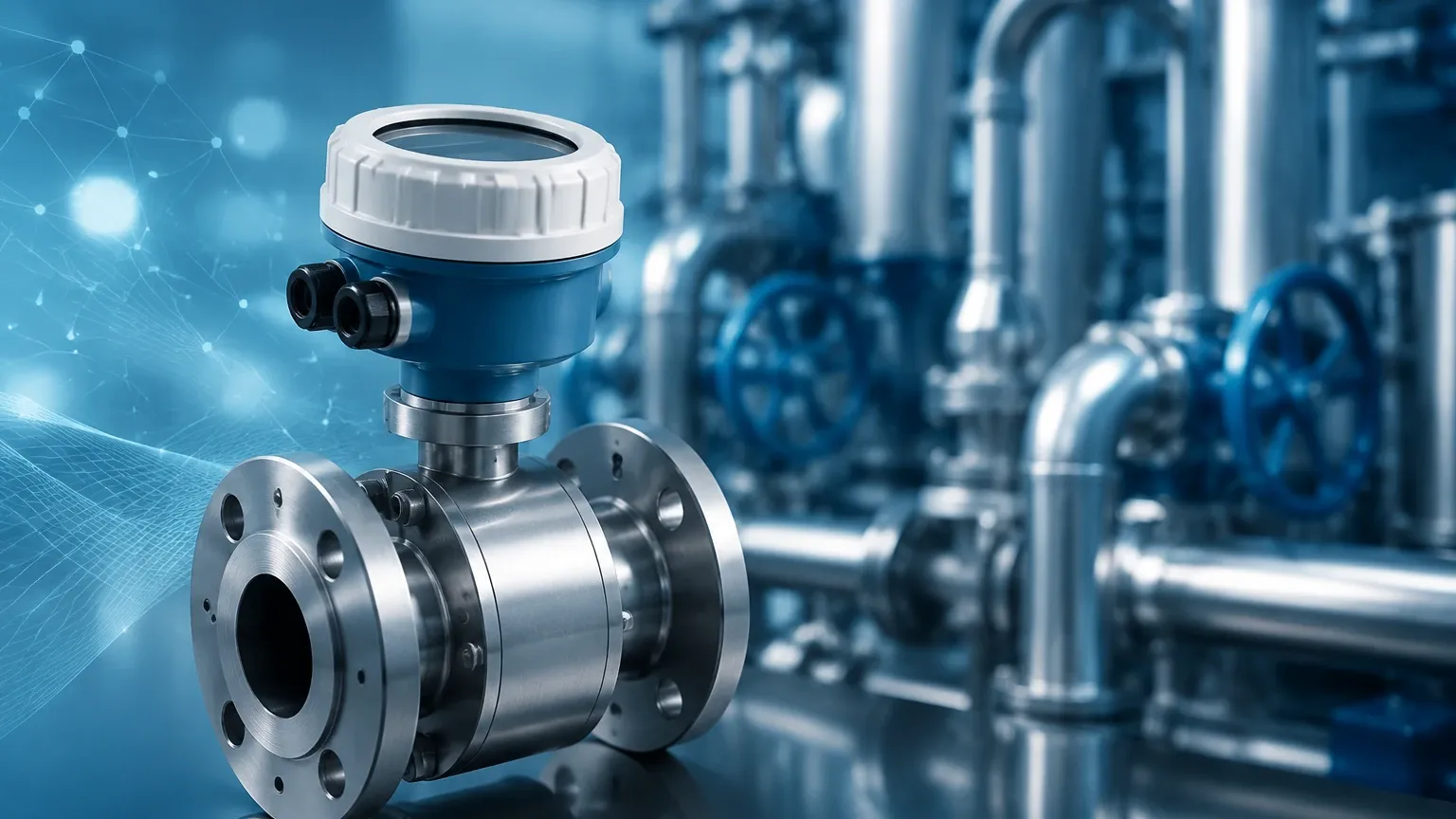
Picomag Flow Meter
Picomag Flow Meter
In the landscape of modern industrial automation, the requirement for compact, reliable, and multi-variable sensors has led to the widespread adoption of electromagnetic flow meters designed specifically for utility applications. The Picomag flow meter represents a significant shift in process instrumentation, moving away from bulky, traditional electromagnetic meters toward streamlined, high-integration devices. This article provides a technical overview of the Picomag’s operating principles, selection criteria, and practical installation requirements for engineering professionals.
Measurement Principle: Electromagnetic Induction
Before selecting or installing a Picomag flow meter, it is essential to understand the underlying physics that govern its operation. Like all electromagnetic flow meters (often referred to as "magmeters"), the Picomag operates based on Faraday’s Law of Induction.
Faraday’s Law
Faraday’s Law states that a voltage is induced when a conductive medium moves through a magnetic field. In the context of the Picomag flow meter, the device generates a controlled magnetic field across the measuring tube. As a conductive liquid (such as water or chemicals) flows through this tube, it acts as a moving conductor. The formula for the induced voltage ($U$) is expressed as:
$$U = B \cdot L \cdot v$$
Where:
* $B$ is the magnetic field strength.
* $L$ is the distance between the electrodes (the diameter of the pipe).
* $v$ is the velocity of the liquid.
Because the magnetic field ($B$) and the distance between electrodes ($L$) are constant, the induced voltage is directly proportional to the flow velocity ($v$). The Picomag’s internal electronics measure this voltage via two stainless steel electrodes and convert it into a volumetric flow rate.
Conductivity Requirements
A critical limitation of this principle is the requirement for electrical conductivity. The Picomag cannot measure the flow of non-conductive fluids like hydrocarbons (oils, fuels) or demineralized water with extremely low ion content. Typically, the medium must have a minimum conductivity of 20 μS/cm (microsiemens per centimeter) to ensure a stable and accurate signal.
Key Features and Technical Capabilities
The Picomag flow meter is distinguished by its ability to measure more than just flow. It is a multivariable sensor that provides data on flow rate, medium temperature, and electrical conductivity simultaneously. This integration is particularly valuable in secondary loops, such as cooling water systems or cleaning-in-place (CIP) processes.
Digital Communication and IO-Link
One of the primary drivers for adopting the Picomag in Industry 4.0 environments is its native support for IO-Link. This digital communication protocol allows for seamless integration into existing automation architectures. Through IO-Link, users can access comprehensive diagnostics, change parameters remotely, and receive digital data without the signal degradation associated with traditional 4-20mA analog loops. Additionally, the device often features Bluetooth connectivity, enabling field technicians to configure the meter via a smartphone or tablet without opening a control cabinet.
Construction Materials
The measuring tube of a Picomag is typically constructed from high-performance plastics like PEEK (polyether ether ketone), which offers excellent chemical resistance and mechanical stability. The electrodes are generally made from 316L stainless steel, ensuring compatibility with a wide range of industrial fluids and cleaning agents.
Practical Selection Guide
Choosing the correct Picomag flow meter requires an analysis of the pipe size, expected flow velocity, and the physical properties of the fluid. Selecting a meter that is too large can result in poor accuracy at low flow rates, while a meter that is too small will induce a significant pressure drop across the system.
Selection Table: Flow Ranges and Dimensions
| Nominal Diameter (DN) | Pipe Size (Inches) | Flow Range (Min – Max) | Max Pressure Rating | Temperature Range |
| :— | :— | :— | :— | :— |
| DN 15 | 1/2" | 0.4 to 25 l/min | 16 bar (232 psi) | -10°C to +70°C |
| DN 20 | 3/4" | 0.75 to 50 l/min | 16 bar (232 psi) | -10°C to +70°C |
| DN 25 | 1" | 1.2 to 100 l/min | 16 bar (232 psi) | -10°C to +70°C |
| DN 50 | 2" | 5.0 to 750 l/min | 16 bar (232 psi) | -10°C to +70°C |
*Note: Extended temperature versions may be available for specific applications up to 85°C for short durations (e.g., during CIP cycles).*
Evaluation Criteria
When evaluating a Picomag flow meter for a specific project, engineers should confirm the following:
1. Fluid Conductivity: Is the medium >20 μS/cm?
2. Process Connection: Does the meter use G-threads or other standard industrial fittings compatible with existing piping?
3. Output Requirements: Is the control system equipped for IO-Link, or are traditional 4-20mA/pulse outputs required?
4. Space Constraints: The Picomag is designed for tight spaces; however, minimum straight pipe runs are still recommended for optimal accuracy.
Installation Considerations
While electromagnetic flow meters are relatively robust, the accuracy of a Picomag flow meter is heavily dependent on the installation environment. Flow profile disturbances are the most common cause of measurement error.
Inlet and Outlet Runs
To ensure a fully developed flow profile reaches the electrodes, the meter should be installed with a minimum length of straight pipe before and after the device.
* Inlet Run: A minimum of 5 x DN (nominal diameter) of straight pipe is recommended upstream of the meter.
* Outlet Run: A minimum of 2 x DN of straight pipe is recommended downstream.
If the installation occurs after a pump or a complex series of bends, the inlet run should be increased to 10 x DN to mitigate turbulence.
Orientation and Air Bubbles
The Picomag should be installed in a position where the measuring tube is always completely filled with liquid.
* Vertical Installation: The preferred orientation is in a vertical pipe with the flow moving upward. This ensures that the tube remains full and that any air bubbles rise out of the sensor area.
* Horizontal Installation: If installed horizontally, the meter should not be placed at the highest point of a piping system, as air can trap in the tube. Similarly, it should not be placed in a free-falling pipe (downward flow) where the tube might not remain full.
Grounding
Since the Picomag measures small voltages, it is sensitive to electrical noise. Proper grounding of the fluid to the sensor body is essential. In plastic piping systems, grounding rings or specific grounding electrodes must be used to ensure the fluid is at the same electrical potential as the meter.
Limitations and Common Risks
Despite its versatility, the Picomag flow meter is not a universal solution for every application. Engineers must be aware of its factual boundaries:
1. Conductivity Dependency: As mentioned, it will not work with oils, alcohols, or pure water. If the conductivity drops below the threshold, the meter will report an error or provide erratic readings.
2. Temperature Sensitivity: The electronics are integrated directly into the sensor head. This compact design means the device is more sensitive to high process temperatures than remote-mounted magmeters. Operating consistently above 70°C can significantly shorten the lifespan of the internal components.
3. Solids Content: While magmeters can handle some suspended solids, large or abrasive particles can damage the PEEK lining or coat the electrodes, leading to signal loss.
4. Pressure Drop: Although the Picomag has a full-bore design, the transition from larger process piping to the meter’s nominal diameter can create a minor pressure drop that must be accounted for in pump head calculations.
Integrating Flow and Level Measurement
In many industrial processes, flow measurement is only one part of the equation. For comprehensive automation, flow data is often paired with level measurement to manage tank inventories, prevent overflows, and calculate mass balances. For example, in a water treatment facility, the Picomag might measure the flow of chemicals into a tank, while a radar or ultrasonic sensor monitors the liquid level within that tank.
For engineers looking to source reliable level measurement instruments that complement flow technology, reviewing advanced sensor options is a critical step. You can explore a wide range of industrial solutions, including radar and hydrostatic transmitters, on the Main Page of Welk's professional measurement catalog. Integrating high-quality level sensors with flow meters like the Picomag ensures a robust and redundant control system.
Frequently Asked Questions (FAQ)
Q: Can the Picomag flow meter measure flow in both directions?
A: Yes, most electromagnetic flow meters, including the Picomag, are capable of bidirectional measurement. The direction of flow can be configured in the device settings via IO-Link or Bluetooth.
Q: What maintenance is required for a Picomag?
A: Because the Picomag has no moving parts, it requires very little maintenance. The primary concern is electrode fouling. If the medium is prone to scaling or coating, the electrodes may need periodic cleaning with a soft cloth or appropriate chemical agent.
Q: How does the Picomag handle air bubbles?
A: Air bubbles are non-conductive. If a large bubble passes through the magnetic field, it interrupts the circuit and causes a "partial pipe" or "empty pipe" alarm. Small, entrained bubbles can cause the meter to over-read the volume flow.
Q: Is a display necessary for operation?
A: While the Picomag features a high-contrast display for local monitoring of flow and temperature, it is not strictly necessary for operation in an automated system. All data can be transmitted digitally to a PLC or SCADA system.
Q: What is the typical accuracy of a Picomag?
A: For water-like fluids, the Picomag typically offers an accuracy of ±0.5% of the measured value, provided the installation guidelines regarding straight pipe runs and fluid conductivity are met.
By adhering to these technical guidelines and understanding the physical constraints of electromagnetic measurement, process engineers can successfully implement the Picomag flow meter to improve the efficiency and transparency of their industrial utility systems.