Pro Mass
Pro Mass
In the landscape of industrial process control and inventory management, the transition from simple level monitoring to sophisticated mass measurement represents a significant leap in operational accuracy. While volume-based measurements are common, they are inherently susceptible to errors caused by temperature fluctuations, pressure changes, and the thermal expansion of both the liquid and the vessel. A professional mass measurement strategy—often referred to in engineering circles as a "pro mass" approach—focuses on determining the actual quantity of matter within a tank or vessel, independent of environmental variables.
For industries such as chemical processing, oil and gas, and food production, mass is the primary variable for billing, recipe formulation, and safety. This guide explores the principles, technologies, and engineering considerations for implementing professional-grade mass measurement systems using modern level instrumentation.
Principles of Mass Measurement in Industrial Vessels
To understand the "pro mass" approach, one must first distinguish between volume and mass. Volume is the space occupied by a substance, measured in liters ($L$) or cubic meters ($m^3$). Mass is the amount of matter, measured in kilograms ($kg$) or pounds ($lb$). In a closed system, mass remains constant regardless of temperature, whereas volume changes as the liquid expands or contracts.
There are two primary methods for deriving mass from level measurement instruments: the hydrostatic method and the hybrid method.
The Hydrostatic Principle
Hydrostatic mass measurement is based on Pascal’s Law. The pressure ($P$) exerted by a liquid column is directly proportional to its height ($h$) and its density ($\rho$). Specifically, the pressure at the bottom of a tank is the weight of the liquid column divided by the cross-sectional area ($A$).
The formula for mass ($m$) in a vertical vessel with a uniform cross-section is:
$$m = \frac{P \times A}{g}$$
Where:
* $P$ is the measured hydrostatic pressure.
* $A$ is the surface area of the tank.
* $g$ is the acceleration due to gravity ($9.81 m/s^2$).
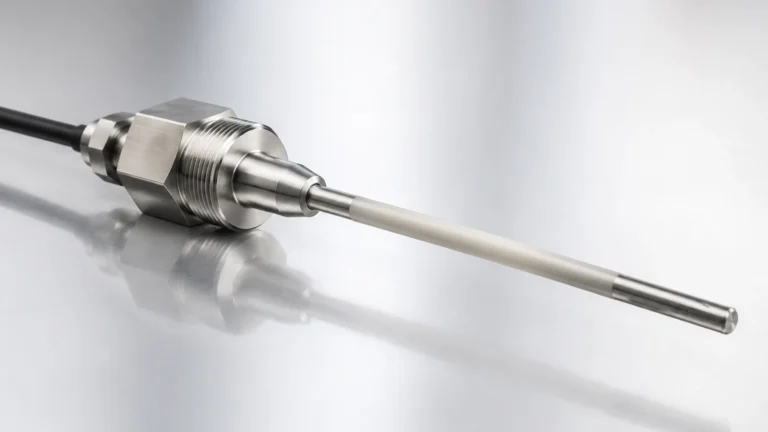
In this setup, a high-precision hydrostatic pressure transmitter is installed at the bottom of the tank. Because the pressure sensor measures the "weight" of the liquid above it, the resulting mass calculation is independent of temperature-induced density changes. If the temperature rises and the liquid expands, the height increases, but the pressure at the base remains the same because the total mass has not changed.
The Hybrid Method (Level + Density)
The hybrid method uses a radar level meter to determine the volume and a secondary sensor (or manual input) to determine density.
$$m = V \times \rho$$
By using a high-frequency radar (such as 80GHz models) to find the exact level, the system calculates volume ($V$) based on a pre-programmed tank strapping table. When combined with a real-time density measurement—often derived from a second pressure transmitter located at a fixed distance above the first—the system provides a highly accurate mass reading.
Technologies for Professional Mass Assessment
Selecting the right hardware is critical for a "pro mass" installation. The choice depends on the vessel shape, the media properties, and the required precision.
1. Hydrostatic Level Transmitters
For many stationary storage applications, hydrostatic transmitters are the most cost-effective solution for mass measurement. These sensors must be highly stable and offer excellent repeatability. In pressurized tanks, a differential pressure (DP) transmitter is used to subtract the head pressure (gas phase) from the total pressure at the bottom, isolating the liquid's weight.
2. Radar Level Meters
Radar technology, particularly non-contacting FMCW (Frequency Modulated Continuous Wave) radar, is the gold standard for volume measurement. When the goal is mass measurement in tanks with complex geometries or where the media is highly corrosive, radar provides the volume component of the equation without touching the liquid. For more information on radar and other measurement technologies, you can visit the Main Page of our technical resource center.
3. Multi-Variable Systems
Modern "pro mass" systems often integrate multiple sensors into a single digital ecosystem. This may include:
* Primary Level Sensor: Radar or Ultrasonic.
* Pressure Sensors: For density calculation.
* Multipoint Temperature Probes: To account for thermal expansion of the vessel walls (tank shell compensation).
Selection Criteria and Technology Comparison
Choosing between a purely hydrostatic system and a hybrid radar-based system requires an evaluation of the process environment. The following table provides a comparison for engineering selection.
| Feature | Hydrostatic Mass System | Hybrid (Radar + Pressure) | Load Cells (Gravimetric) |
| :— | :— | :— | :— |
| Primary Measurement | Pressure (Weight) | Level (Volume) + Pressure | Weight |
| Accuracy | 0.1% to 0.5% | 0.05% to 0.2% | 0.02% to 0.1% |
| Installation Ease | High (Side/Bottom mount) | Moderate (Top + Side mount) | Low (Requires lifting tank) |
| Media Influence | Density changes don't affect mass | Requires density tracking | No media contact |
| Tank Geometry | Must be known for volume | Critical for volume | Irrelevant |
| Cost | Low to Moderate | Moderate to High | High |
Key Evaluation Factors
1. Vessel Type: Is the tank vented or pressurized? Pressurized tanks require differential pressure sensors.
2. Media Consistency: Does the density vary significantly? If so, a single-sensor hydrostatic approach is superior for mass, but a dual-sensor approach is needed if you also require accurate level/volume.
3. Maintenance Access: Can the tank be emptied for sensor maintenance? Non-contact radar is often preferred for hazardous chemicals to reduce maintenance exposure.

Installation and Engineering Considerations
To achieve professional-grade accuracy in mass measurement, the physical installation must be executed with precision. Errors in sensor placement or tank calibration are the most common causes of system failure.
Sensor Positioning
For hydrostatic sensors, the transmitter must be located at a point where it is always submerged, ideally near the tank floor. However, it should be high enough to avoid being buried by sediment or sludge. If the sensor is mounted $100 mm$ ($4 inches$) above the actual floor, the "unmeasurable" mass below the sensor must be added as a constant in the control system.
Tank Strapping Tables
In hybrid systems, the accuracy of the mass calculation is only as good as the tank strapping table. This table maps the level (height) to a specific volume. For horizontal cylindrical tanks or tanks with conical bottoms, the relationship between height and volume is non-linear. Engineers should use laser-calibrated strapping tables for high-value inventory.
Atmospheric Compensation
In vented tanks, the sensor measures gauge pressure (relative to atmosphere). If the tank is sealed, an absolute pressure sensor or a differential pressure setup is required. Failure to compensate for changes in the vapor space pressure will result in significant mass calculation errors.
Temperature Compensation
While the mass of the liquid doesn't change with temperature, the tank itself does. A steel tank will expand as it gets hotter, slightly increasing its diameter and volume. For "pro mass" systems requiring accuracy better than 0.1%, the PLC or flow computer must include a tank shell expansion coefficient in its algorithm.
Limitations and Practical Challenges
No measurement technology is universal. Understanding the limitations of mass-based level systems is essential for avoiding operational errors.
* Aerated Liquids: If a liquid contains significant entrained air or bubbles (common in fermentation or high-speed mixing), the effective density changes. While a hydrostatic sensor still measures the total weight correctly, the level reading will be higher than expected. Conversely, radar will measure the top of the foam, not the liquid level.
* Agitation and Turbulence: In vessels with high-speed agitators, the centrifugal force can create a vortex, causing pressure fluctuations at the tank wall. In these cases, sensors should be installed in stilling wells or bypass pipes to ensure a stable reading.
* Density Stratification: In very large crude oil tanks or chemical mixing vats, the liquid may stratify into layers of different densities. A single pressure sensor at the bottom will still give the total mass, but the volume and level calculations will be skewed unless multiple density points are sampled.
* Vessel Deformation: Large thin-walled tanks can "bulge" when full. This change in shape alters the area ($A$) used in the mass calculation formula, leading to errors. This is why rigid vessel design or compensation algorithms are necessary for professional applications.
Frequently Asked Questions (FAQs)
Q: Why choose mass measurement over volume measurement?
A: Mass is a more reliable metric for inventory and billing because it is not affected by temperature. A liter of oil at $10°C$ contains more energy and more molecules than a liter of oil at $40°C$, but a kilogram remains a kilogram.
Q: Can I use a standard level transmitter for mass measurement?
A: Yes, provided the transmitter has the required accuracy and your control system (PLC/DCS) can perform the necessary math ($m = P imes A / g$). However, for pressurized tanks, you must use a differential pressure transmitter.
Q: How often should "pro mass" sensors be calibrated?
A: For critical custody transfer or high-value chemical processing, annual calibration is standard. For general process monitoring, every 2 to 3 years is typically sufficient, provided the sensors show no significant drift.
Q: Does the shape of the tank bottom affect hydrostatic mass measurement?
A: No. The beauty of the hydrostatic principle is that the pressure at the bottom depends only on the total weight of the liquid above it and the area of the sensor. However, the shape *does* affect how you translate that mass into a level or volume reading.
Q: What is the impact of specific gravity on these systems?
A: In a purely hydrostatic mass measurement system, changes in specific gravity (density) do not affect the mass reading. This is the primary advantage of the technology. If the density decreases, the level rises, but the pressure (weight) stays the same.
By following these engineering guidelines and selecting high-performance instrumentation, facilities can implement a robust "pro mass" strategy that ensures precision, safety, and efficiency in their liquid handling processes. For assistance in selecting specific sensors for your application, consult technical documentation or visit the Main Page for detailed product specifications.