Prosonic Flow P 500
Prosonic Flow P 500
In the landscape of industrial process automation, the ability to measure fluid movement without breaching the integrity of the piping system has become a critical requirement. The Prosonic Flow P 500 represents a sophisticated class of ultrasonic clamp-on flowmeters designed to provide high-accuracy measurements across various industries, including water treatment, chemical processing, and oil and gas. Unlike traditional inline meters that require cutting pipes and halting production, clamp-on technology offers a non-invasive alternative that simplifies both installation and maintenance.
Understanding the technical nuances of the Prosonic Flow P 500 requires a foundational grasp of ultrasonic measurement principles, as well as an appreciation for how these systems integrate with broader process monitoring tools, such as the level measurement solutions found on the Main Page of industrial instrumentation providers like Welk.
Measurement Principles: The Transit-Time Method
The Prosonic Flow P 500 operates primarily on the ultrasonic transit-time difference principle. This method relies on the fact that the speed of an ultrasonic signal is affected by the velocity of the medium through which it travels.
How Transit-Time Works
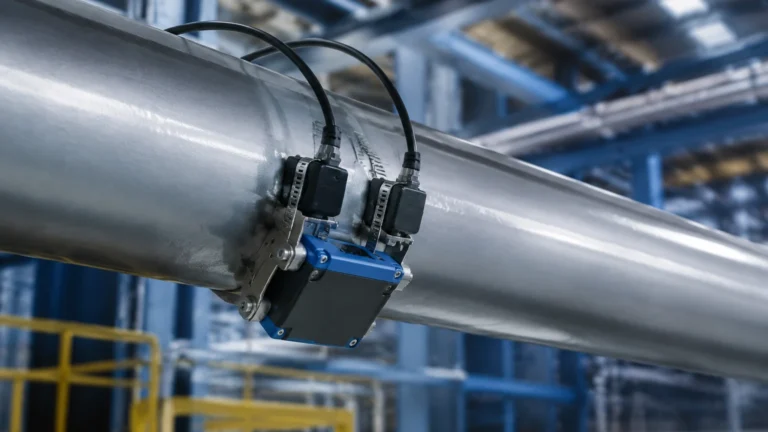
Two ultrasonic transducers are mounted on the exterior of the pipe. These sensors act as both transmitters and receivers. They send ultrasonic pulses back and forth through the fluid at an angle.
1. Downstream Signal: The signal traveling with the flow moves faster.
2. Upstream Signal: The signal traveling against the flow moves slower.
By measuring the difference in time (delta-t) between these two signals with nanosecond precision, the flowmeter calculates the flow velocity. When combined with the known cross-sectional area of the pipe (entered during configuration), the device determines the volumetric flow rate.
This principle differs significantly from the "Time of Flight" method used in ultrasonic level sensors. While level sensors measure the time it takes for a pulse to bounce off a surface and return to a single sensor to determine distance, the P 500 uses the differential speed between two sensors to determine fluid movement.
Key Features of the Prosonic Flow P 500
The P 500 is engineered for versatility and long-term stability. Its design focuses on overcoming the traditional hurdles of clamp-on measurement, such as signal attenuation and installation errors.
* Non-Invasive Installation: The sensors are strapped to the outside of the pipe. This is ideal for applications involving corrosive fluids, high-pressure lines, or sterile environments where contact with the medium must be avoided.
* FlowDC Function: One of the advanced features of the P 500 series is the ability to compensate for disturbed flow profiles. In many industrial layouts, there is insufficient straight pipe run to allow for a fully developed flow profile. The FlowDC software helps maintain accuracy even when the meter is installed close to pipe bends or obstructions.
* Integrated Web Server: Modern industrial B2B operations require remote access. The P 500 often includes an integrated web server, allowing engineers to perform diagnostics, configuration, and data retrieval without specialized software.
* Maintenance-Free Operation: Since there are no moving parts and the sensors do not come into contact with the fluid, there is no wear and tear or risk of clogging, which is a common issue with mechanical meters.
Practical Selection Table
When evaluating measurement technologies for a facility, it is essential to compare the capabilities of ultrasonic flowmeters with other common industrial instruments. The following table provides a comparison based on typical application requirements.
| Feature | Prosonic Flow P 500 (Ultrasonic Flow) | Ultrasonic Level Sensor (e.g., Welk Series) | Radar Level Meter | Hydrostatic Transmitter |
| :— | :— | :— | :— | :— |
| Primary Measurement | Fluid Velocity / Flow Rate | Liquid Level / Distance | Liquid/Solid Level | Liquid Level / Pressure |
| Installation Type | External (Clamp-on) | Top-mounted (Non-contact) | Top-mounted (Non-contact) | Submerged or Side-mount |
| Process Interruption | None | Minimal | Minimal | Required (for side-mount) |
| Accuracy | ±0.5% to 2.0% of rate | ±0.25% of range | ±1mm to 5mm | ±0.1% to 0.5% of span |
| Media Constraints | Requires clean or slightly dirty liquids | Affected by foam/heavy vapor | High immunity to vapor/dust | Affected by density changes |
| Pipe/Tank Size | 15mm to 4000mm (0.5" to 160") | Up to 15m (50ft) depth | Up to 100m (328ft) height | Dependent on probe length |
Installation Considerations
To achieve the specified accuracy of the prosonic flow p 500, precise installation is paramount. Unlike level sensors that primarily require a clear vertical path, clamp-on flowmeters are highly sensitive to the geometry of the piping system.
1. Pipe Surface Preparation
The exterior of the pipe must be cleaned of rust, loose paint, or insulation. A coupling acoustic grease or pad is applied between the sensor and the pipe wall to eliminate air gaps, which would otherwise block the ultrasonic signal.
2. Straight Pipe Runs
For a stable flow profile, the standard recommendation is a straight run of at least 5 to 10 times the pipe diameter (D) upstream of the sensors and 2 to 5 times the diameter downstream. If these conditions cannot be met, the FlowDC compensation features must be activated.
3. Mounting Positions
Sensors should ideally be mounted on a horizontal pipe at the "3 o'clock" and "9 o'clock" positions. This prevents interference from air bubbles (which collect at the top of the pipe) or sediment (which settles at the bottom).
4. Pipe Material and Liners
The P 500 works on most metal and plastic pipes (Carbon steel, Stainless steel, PVC, PE, etc.). However, if the pipe has a liner (e.g., cement or rubber), the liner must be soundly bonded to the pipe wall. Any air gap between the liner and the pipe will prevent the signal from passing through.

Limitations and Common Risks
While the Prosonic Flow P 500 is a robust instrument, certain conditions can compromise its performance:
* High Gas/Solid Content: Transit-time ultrasonic meters require a relatively clean medium. If the fluid contains more than 1% to 5% gas bubbles or suspended solids by volume, the signal may be scattered or absorbed, leading to measurement failure.
* Extreme Temperatures: While the sensors are designed for a wide range, extremely high temperatures may require specialized mounting hardware or high-temperature coupling gels to protect the piezoelectric elements.
* Acoustic Short Circuits: In some thin-walled metal pipes, the ultrasonic signal may travel through the pipe wall faster than through the fluid. Advanced signal processing in the P 500 is designed to filter this out, but it remains a factor in extremely small pipe diameters.
Integration with Level Measurement Systems
In most industrial B2B environments, flow measurement does not exist in isolation. For instance, in a chemical storage facility, the Prosonic Flow P 500 might measure the rate at which a reagent is pumped into a mixing tank, while a Welk radar level meter monitors the total volume within that tank.
Combining these data points allows for "Mass Balance" calculations, which are essential for leak detection and inventory management. If the flowmeter indicates that 500 liters have been pumped, but the level meter shows an increase of only 450 liters, the system can immediately flag a potential leak or a calibration error. For comprehensive details on selecting the right level instruments to pair with your flow systems, refer to the product options on the Main Page.
Frequently Asked Questions (FAQ)
Q: Can the Prosonic Flow P 500 measure flow in both directions?
A: Yes, the transit-time principle inherently supports bi-directional flow measurement. The device will indicate both the direction and the magnitude of the flow.
Q: How often does the coupling grease need to be reapplied?
A: In most indoor, stable-temperature environments, the coupling grease can last for several years. For outdoor installations or high-vibration areas, it is recommended to inspect the signal strength annually and reapply if a significant drop is noticed.
Q: Does the P 500 require recalibration if moved to a different pipe?
A: While the electronics do not need recalibration, the device must be reconfigured with the new pipe’s parameters (diameter, wall thickness, material). A zero-point adjustment is also recommended after any re-installation.
Q: Can it measure steam flow?
A: No, the Prosonic Flow P 500 is designed for liquid applications. Steam flow typically requires vortex meters or specialized high-temperature ultrasonic meters designed for gas phases.
Conclusion
The Prosonic Flow P 500 is a premier choice for engineers seeking a balance between high-performance measurement and operational convenience. By leveraging non-invasive ultrasonic technology, it eliminates the risks associated with pipe penetration while providing the data necessary for complex process control. When integrated with reliable level measurement hardware, it forms the backbone of an efficient, automated industrial system.