Radar Water Level Sensor
Radar Water Level Sensor
In modern industrial and municipal water management, the requirement for precision, reliability, and low maintenance has driven a significant shift toward non-contact measurement technologies. The radar water level sensor has emerged as the gold standard for monitoring liquid levels in diverse environments, ranging from wastewater treatment plants and open-channel flow systems to high-pressure chemical storage tanks. Unlike traditional mechanical or pressure-based systems, radar technology offers a robust solution that remains unaffected by changes in air temperature, pressure, or the presence of vapors.
Selecting the appropriate instrumentation requires a deep understanding of the underlying physics and the specific environmental constraints of the application. For engineers and procurement specialists, evaluating the Main Page of a manufacturer’s technical catalog is often the first step in identifying a solution that balances accuracy with cost-effectiveness.
Measurement Principles of Radar Technology
Radar water level sensors operate on the principle of Time-of-Flight (ToF). The sensor emits high-frequency electromagnetic waves (microwaves) toward the surface of the water. These waves travel at the speed of light. When they encounter the water surface, a portion of the energy is reflected back to the sensor’s antenna. The instrument then calculates the distance to the liquid surface based on the time interval between transmission and reception.
There are two primary methods used in industrial radar level measurement:
Pulse Radar
Pulse radar sensors emit microwave pulses in short bursts and measure the time it takes for the pulse to return. This method is often used in battery-powered or loop-powered devices because it consumes less energy. However, it may have lower resolution compared to continuous wave systems in complex environments.
Frequency Modulated Continuous Wave (FMCW)
FMCW radar is the preferred technology for high-precision applications. Instead of pulses, the sensor emits a continuous signal with a frequency that changes over time (a frequency sweep). The reflection from the water surface is received while the transmitter is still emitting a signal at a slightly different frequency. The difference between the transmitted and received frequencies is directly proportional to the distance. FMCW radar offers superior signal-to-noise ratios, allowing it to filter out interference from agitators, internal tank structures, or surface turbulence more effectively.
Key Technical Specifications for Selection
When specifying a radar water level sensor, several technical parameters dictate the performance of the unit in the field. Understanding these factors is critical for ensuring long-term operational stability.
Frequency Bands (26GHz vs. 80GHz)
The frequency of the radar signal determines the beam angle and the ability of the sensor to handle narrow spaces or steam.
* 26GHz Radar: This is a versatile frequency often used for general-purpose liquid level measurement. It has a wider beam angle, which can be advantageous in some open-water applications but may struggle in narrow tanks with many internal obstructions.
* 80GHz Radar: High-frequency 80GHz sensors offer a much narrower beam angle (often as small as 3 degrees). This narrow focus allows the sensor to be installed in small-diameter nozzles or tanks with internal pipes and ladders without receiving false echoes. Additionally, 80GHz signals are better at penetrating heavy condensation or foam.
Dielectric Constant ($ε_r$)
Radar measurement relies on the difference in the dielectric constant between the air (approximately 1.0) and the process medium. Water has a high dielectric constant (approximately 80 at 20°C), making it an excellent reflector for radar waves. This high reflectivity ensures a strong signal return even at long distances, such as in deep reservoirs or tall storage silos.
Practical Selection Table
| Feature | 26GHz Radar | 80GHz Radar | Guided Wave Radar (GWR) |
| :— | :— | :— | :— |
| Measurement Type | Non-contact | Non-contact | Contact (Probe-based) |
| Beam Angle | 8° to 20° | 3° to 6° | N/A (signal follows probe) |
| Max Range | Up to 30m | Up to 120m | Up to 30m – 75m |
| Accuracy | ±3mm to ±5mm | ±1mm | ±2mm |
| Best Use Case | Large tanks, open basins | Narrow tanks, high precision | Low dielectric liquids, foam |
| Obstruction Tolerance | Moderate | High | Excellent |
Installation Considerations and Best Practices
Proper installation is the most significant factor in the accuracy of a radar water level sensor. Even the most advanced 80GHz FMCW radar will fail if the mounting geometry is incorrect.
Positioning and Orientation
1. Distance from Wall: The sensor should not be mounted too close to the tank wall. A general rule of thumb is to maintain a distance of at least 1/6th of the tank diameter from the wall to avoid interference from wall reflections.
2. Avoiding the Center: In cylindrical tanks with domed tops, mounting the sensor in the exact center can lead to multiple reflections (parabolic effect), which confuses the signal processor. Off-center mounting is usually recommended.
3. Inlet Interference: The sensor should never be mounted directly above the liquid inlet. Falling water or turbulence at the entry point will scatter the radar signal and cause erratic readings.
Nozzle Design
If the sensor is mounted on a nozzle, the height and diameter of the nozzle must be considered. For 26GHz sensors, the nozzle should be as short as possible to prevent the beam from hitting the nozzle edges. 80GHz sensors are more forgiving due to their narrow beam, but the antenna should still ideally extend slightly beyond the bottom of the nozzle into the tank space.
Dead Zones (Blocking Distance)
Every radar sensor has a "dead zone" or blocking distance near the antenna where measurement is not possible. For most modern sensors, this is between 50mm and 200mm. Engineers must ensure that the maximum possible water level does not enter this dead zone, or the sensor will lose the signal or report an error.
Comparison with Alternative Technologies
While radar is highly effective, it is often compared to ultrasonic and hydrostatic sensors. Understanding the limitations of these alternatives clarifies why radar is often the preferred B2B solution.
Radar vs. Ultrasonic
Ultrasonic sensors use sound waves, which require a medium (air) to travel. Changes in air temperature, humidity, or pressure significantly alter the speed of sound, necessitating temperature compensation. Furthermore, ultrasonic signals are easily absorbed by foam or scattered by heavy vapor. Radar, being an electromagnetic wave, travels through vacuum and air at a constant speed regardless of atmospheric conditions, making it far more reliable in outdoor or volatile environments.
Radar vs. Hydrostatic
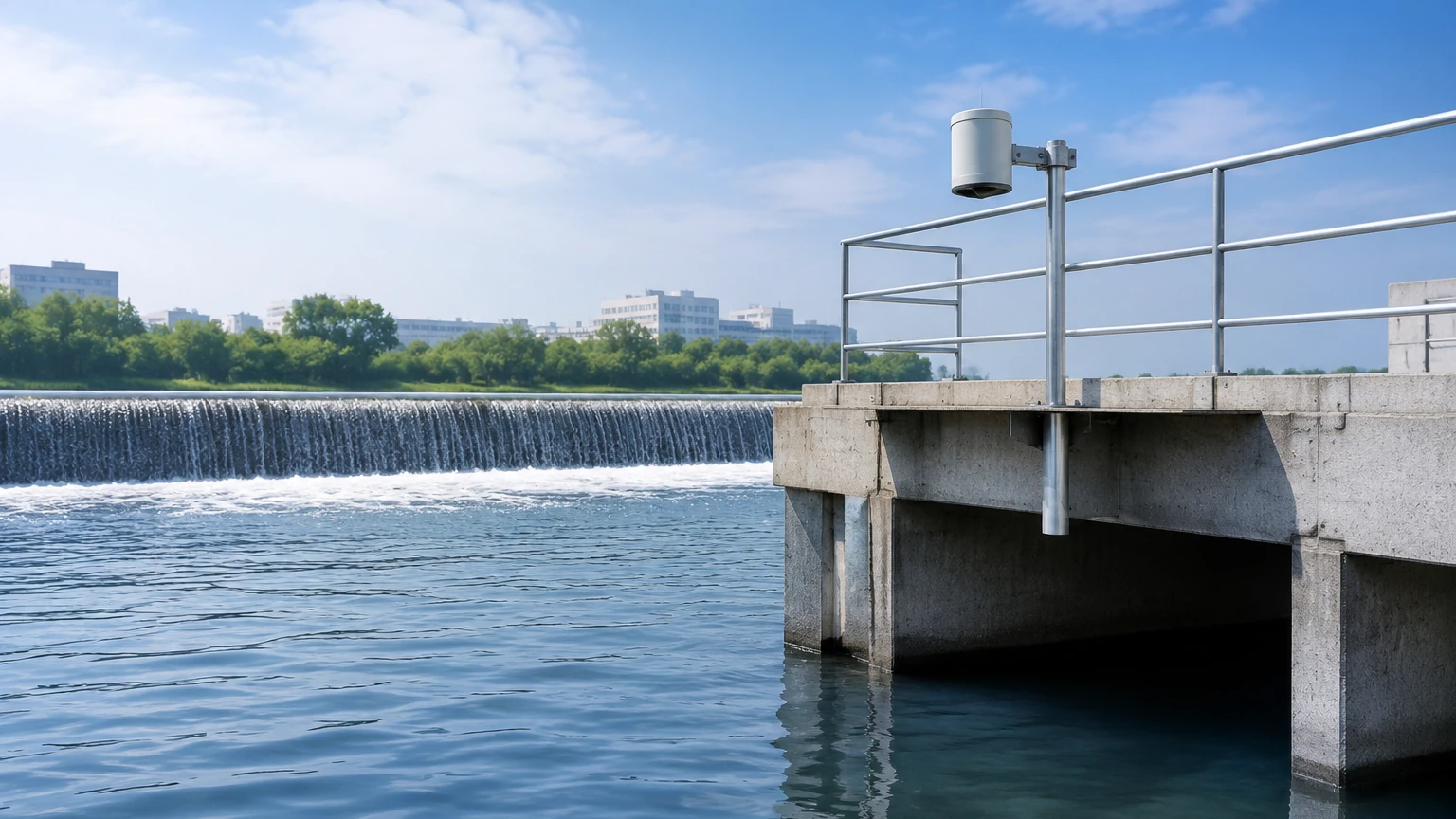
Hydrostatic transmitters measure the pressure exerted by the liquid column. While accurate, they are contact-based and subject to drift if the density of the liquid changes (e.g., due to temperature shifts or chemical additives). Radar is non-contact, meaning there is no risk of sensor corrosion or clogging from debris in the water, which is a common issue in wastewater applications.
Limitations and Environmental Risks
Despite its versatility, radar technology has specific limitations that must be managed during the design phase:
* Heavy Foam: While radar can penetrate light foam, extremely thick or dense foam (especially in chemical processing or aeration tanks) can absorb the radar signal. In such cases, Guided Wave Radar (GWR) or specialized low-frequency radar may be required.
* Turbulence: Extreme surface turbulence or waves can scatter the radar signal. Most modern sensors use software algorithms (damping) to average these fluctuations, but significant turbulence can reduce the effective range of the device.
* Condensation on Antenna: Heavy condensation on the antenna face can attenuate the signal. Many high-end radar sensors feature PTFE or PEEK enclosures and drip-off designs to minimize the impact of moisture buildup.
Frequently Asked Questions (FAQ)
Q: Can a radar water level sensor measure through a plastic tank lid?
A: Yes. Because plastic has a low dielectric constant, radar waves can often penetrate plastic or fiberglass tank tops. This allows for "non-intrusive" measurement where the sensor is mounted outside the tank, looking through the lid at the water inside.
Q: Does the color or transparency of the water affect the measurement?
A: No. Radar is an electromagnetic technology and is entirely unaffected by the optical properties of the liquid. It works equally well on clear water, muddy water, or opaque chemicals.
Q: What is the typical lifespan of a radar level sensor?
A: Because there are no moving parts and the sensor does not typically come into contact with the process medium, a high-quality radar sensor can last 10 to 15 years with minimal maintenance.
Q: Is radar safe for use in explosive environments?
A: Yes, most industrial radar sensors are available with ATEX, IECEx, or FM certifications for use in hazardous areas. Since the power output of the microwave signal is extremely low, it does not pose an ignition risk when properly installed with intrinsic safety barriers.
Conclusion
The adoption of radar water level sensors represents a move toward more sustainable and lower-maintenance industrial infrastructure. By eliminating the need for regular recalibration and avoiding the mechanical failures associated with contact-based sensors, facilities can achieve higher operational uptime. When selecting a system, it is vital to match the frequency and mounting configuration to the specific geometry of the site. For those in the planning stages of a water management project, consulting technical resources and reviewing professional product ranges at the Main Page ensures that the chosen instrumentation will provide the precision required for modern process automation.