Raman Analyser
Raman Analyser
In the landscape of modern industrial process control, the ability to monitor chemical composition in real-time is as critical as measuring physical parameters like pressure, temperature, or liquid level. A Raman analyser serves as a sophisticated spectroscopic tool that provides qualitative and quantitative molecular information without the need for manual sampling or destructive testing. By utilizing the principles of light scattering, these instruments allow engineers to "see" into chemical reactions, ensuring product consistency and process safety.
For industrial operators who rely on precise instrumentation—such as the radar and ultrasonic sensors found on the Main Page—integrating chemical analysis with physical level measurement creates a comprehensive automation strategy. This guide explores the technical foundations, selection criteria, and industrial applications of Raman analysers.
Measurement Principles of Raman Spectroscopy
Raman spectroscopy is based on the inelastic scattering of monochromatic light, typically from a laser source. When laser light interacts with molecular vibrations, phonons, or other excitations in a system, the energy of the laser photons is shifted up or down.
The Raman Effect
When a substance is illuminated, the vast majority of photons are scattered elastically, meaning they retain the same energy and wavelength as the incident light. This is known as Rayleigh scattering. However, approximately one in every million photons undergoes inelastic scattering, where energy is transferred between the photon and the molecule. This shift in energy provides a unique spectral "fingerprint" of the substance.
* Stokes Scattering: The photon loses energy to the molecule, resulting in a scattered photon with a longer wavelength (lower frequency).
* Anti-Stokes Scattering: The photon gains energy from a molecule already in an excited vibrational state, resulting in a shorter wavelength (higher frequency).
Industrial Raman analysers primarily measure Stokes scattering because, at room temperature, most molecules reside in the ground vibrational state. The resulting Raman spectrum plots the intensity of scattered light against the "Raman shift," measured in wavenumbers (cm⁻¹), which corresponds directly to specific molecular bonds (e.g., C-H, O-H, C=C).
Components of an Industrial Raman Analyser
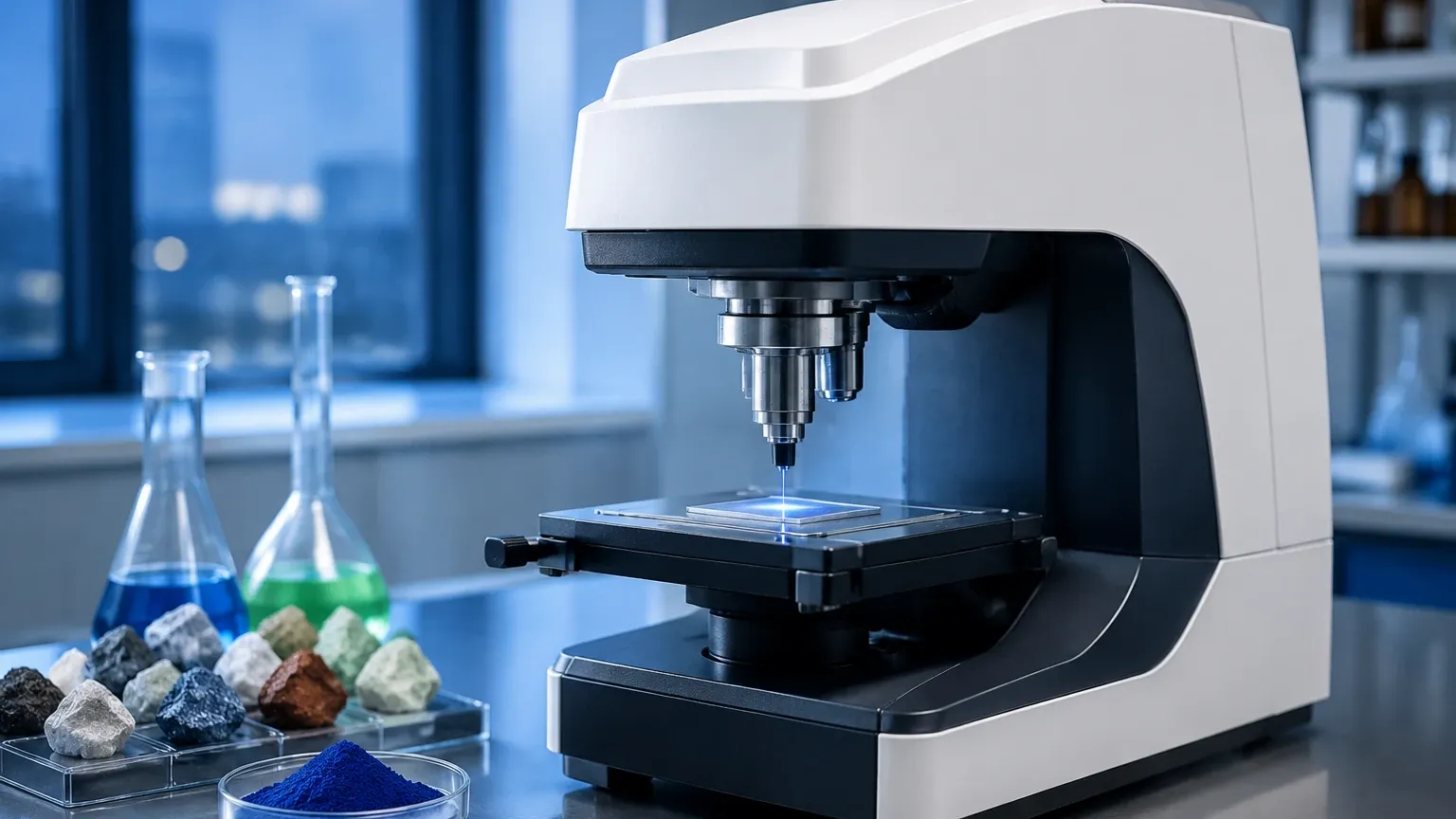
Unlike laboratory spectrometers, an industrial-grade Raman analyser is designed for durability, long-term stability, and integration into hazardous environments. The system typically consists of four primary modules:
1. Laser Source: Provides the monochromatic excitation light. Common wavelengths include 532 nm, 785 nm, and 1064 nm. The choice of wavelength is a balance between signal strength (higher at shorter wavelengths) and background fluorescence (lower at longer wavelengths).
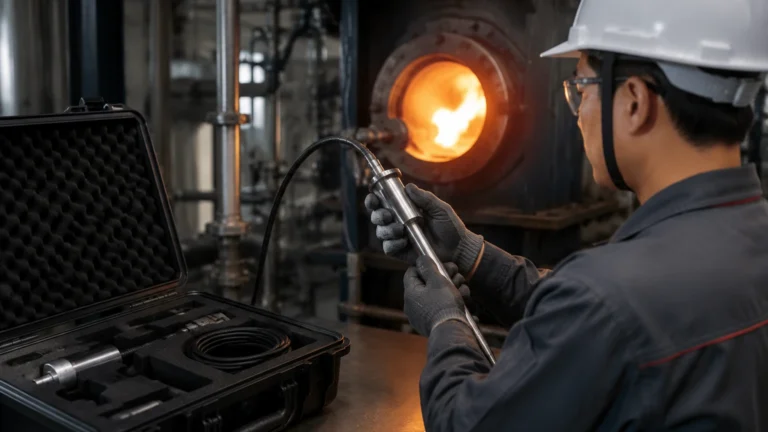
2. Sample Interface (Probes): These are the "eyes" of the instrument. In industrial settings, immersion probes are used for direct contact with liquids in reactors or pipes, while non-contact optics allow for measurement through sight glasses or transparent packaging.
3. Spectrometer: This component separates the scattered light into its constituent wavelengths using a diffraction grating. High-resolution gratings are essential for distinguishing between chemically similar compounds.
4. Detector: Usually a Charge-Coupled Device (CCD) or an Indium Gallium Arsenide (InGaAs) array for near-infrared wavelengths. These detectors convert the optical signal into digital data for processing.
Key Applications in Process Industries
Raman analysers are deployed across various sectors where real-time molecular data is required to optimize yields and ensure safety.
Chemical and Petrochemical
In large-scale chemical manufacturing, Raman spectroscopy is used to monitor polymerization reactions, solvent recovery, and the blending of fuels. Because Raman can distinguish between isomers and different chain lengths, it provides more granular data than simple refractive index or density measurements.
Pharmaceutical Manufacturing
In the pharmaceutical industry, Raman is a cornerstone of Process Analytical Technology (PAT). It is used for raw material identification, monitoring crystallization processes, and ensuring the uniformity of active pharmaceutical ingredients (APIs) in tablet manufacturing.
Water and Wastewater Treatment
While level sensors are used to manage tank volumes, Raman analysers can be employed to detect specific contaminants or monitor the concentration of treatment chemicals in real-time, ensuring compliance with environmental regulations.
Technical Selection Criteria
Choosing the right Raman analyser requires an understanding of the chemical environment and the physical constraints of the installation site. The following table outlines the primary evaluation criteria for industrial deployment.
| Feature | Specification/Option | Engineering Consideration |
| :— | :— | :— |
| Laser Wavelength | 785 nm | Most common; balances sensitivity and fluorescence. |
| | 1064 nm | Best for highly fluorescent or dark-colored samples. |
| Spectral Range | 100 to 3500 cm⁻¹ | Must cover the specific molecular bonds of interest. |
| Probe Type | Immersion / Extractive | Must withstand process pressure (up to 300 bar) and temperature. |
| Fiber Optic Length | 10 m to 200 m | Allows the analyser to be placed in a safe zone while the probe is in a hazardous zone. |
| Communication | Modbus, OPC UA, 4-20mA | Necessary for integration into DCS or SCADA systems. |
Installation and Engineering Considerations
Successful deployment of a Raman analyser involves more than just plugging in the device. Engineers must consider the physical and safety requirements of the facility.
Laser Safety
Industrial Raman systems often use Class 3B or Class 4 lasers. While the laser light is contained within fiber optic cables and probes during normal operation, maintenance procedures require strict safety protocols, including the use of interlocks and specialized eyewear.
Fiber Optic Management
Fiber optic cables are the lifeline of the system. They must be protected by armored conduit to prevent physical damage. Furthermore, the bend radius of the fiber must be maintained to avoid signal loss or cable breakage. In large-scale plants, the ability to run fibers over 100 meters allows the sensitive electronics of the analyser to be housed in a climate-controlled rack room, far from the corrosive or explosive environment of the process line.
Sample Conditioning
While Raman is often performed *in-situ*, some applications require sample conditioning. If the process fluid is extremely turbid or contains high levels of suspended solids, a bypass loop with a filtration system may be necessary to ensure the laser can penetrate the sample sufficiently.
Comparison with Alternative Analytical Techniques
Engineers often weigh Raman spectroscopy against Near-Infrared (NIR) spectroscopy and Gas Chromatography (GC).
* Raman vs. NIR: Raman generally offers sharper, more distinct peaks than NIR, making it better for identifying specific chemical species in complex mixtures. Additionally, Raman is relatively insensitive to water, making it ideal for aqueous solutions where NIR signals are often overwhelmed by water absorption.
* Raman vs. GC: While GC provides absolute quantification, it is a discrete sampling technique that requires minutes or hours for a single analysis. Raman provides continuous, real-time data, allowing for immediate process adjustments.
Limitations and Operational Risks
Despite its versatility, the Raman analyser has specific limitations that must be managed:
1. Fluorescence Interference: Some materials emit fluorescence when struck by laser light, which can be orders of magnitude stronger than the Raman signal, effectively "drowning out" the data. This is often mitigated by shifting to a longer wavelength laser (e.g., 1064 nm).
2. Sample Heating: High-power lasers can locally heat the sample at the probe tip. In volatile or heat-sensitive environments, this requires careful management of laser power density.
3. Cost of Ownership: Raman systems represent a significant capital investment. However, the reduction in laboratory testing costs and the improvement in process yield typically provide a rapid return on investment (ROI).
Integration with Level Measurement Systems
In modern "Smart Factories," data from a Raman analyser is rarely used in isolation. It is frequently paired with physical sensors to provide a holistic view of a vessel's contents. For example, in a mixing tank, an ultrasonic or radar level transmitter—details of which are available on the Main Page—monitors the total volume, while the Raman analyser monitors the concentration of the reactants.
This integration allows for automated mass-balance calculations. If the Raman analyser detects that a reaction has reached completion, the control system can trigger the discharge pump, with the level sensor ensuring the tank is emptied safely without cavitation. This synergy between chemical and physical measurement is essential for high-efficiency industrial automation.
Frequently Asked Questions (FAQ)
Q: Can Raman analysers measure gases?
A: Yes, Raman can measure gases, but because gas molecules are much less dense than liquids or solids, the signal is significantly weaker. Specialized high-pressure cells or long-pathlength optics are often required.
Q: How often does a Raman analyser need calibration?
A: Most industrial Raman systems are factory-calibrated and include internal reference standards (like a neon lamp or a silicon wafer) to perform automated frequency checks. Full chemical recalibration is typically only required if the process chemistry changes significantly.
Q: Is Raman spectroscopy destructive?
A: No. Raman is a non-destructive, non-contact technique. The laser light interacts with the molecules without changing their chemical structure, provided the laser power is kept within safe limits for the specific material.
Q: How does ambient light affect the measurement?
A: Industrial probes are designed to exclude ambient light. For non-contact measurements, the system usually employs optical filters or modulated laser signals to distinguish the Raman scattering from background light.
By understanding these technical parameters and the relationship between chemical analysis and physical process monitoring, engineering teams can better implement Raman technology to enhance their production capabilities.