Remote Tank Monitoring
Remote Tank Monitoring
In modern industrial environments, the ability to track inventory, ensure process safety, and optimize logistics depends heavily on precise level measurement. Remote tank monitoring refers to the integrated system of sensors, transmitters, and communication gateways that allow operators to monitor liquid or solid levels from a centralized control room or a mobile device. For industries such as water treatment, chemical processing, and oil and gas, transitioning from manual inspections to automated remote systems reduces operational risk and enhances data-driven decision-making.
Implementing an effective monitoring solution requires a deep understanding of the underlying measurement physics. Before selecting hardware, engineers must evaluate the chemical properties of the media, the physical constraints of the vessel, and the required data transmission frequency.
Core Technologies and Measurement Principles
To establish a reliable remote tank monitoring system, the primary sensor must be matched to the application. Welk provides several distinct technologies, each operating on different physical principles.
Radar Level Measurement (Non-Contact)
Radar level meters utilize Time-of-Flight (ToF) technology. The sensor emits high-frequency microwave pulses (typically in the 26 GHz or 80 GHz range) that travel at the speed of light. When these pulses hit the surface of the medium, they are reflected back to the antenna. The instrument measures the time interval between emission and reception to calculate the distance.
* Advantages: Radar is unaffected by temperature fluctuations, vacuum conditions, or high pressure. It is ideal for corrosive media because the sensor does not touch the liquid.
* Key Consideration: The dielectric constant (εr) of the material determines the strength of the reflection. Low-dielectric materials like oils reflect less energy than water-based liquids.
Ultrasonic Level Sensors
Ultrasonic sensors also use ToF principles but rely on sound waves rather than electromagnetic waves. The transducer emits an ultrasonic pulse that bounces off the surface of the medium. The time taken for the echo to return is proportional to the distance.
* Advantages: Highly cost-effective for standard water and wastewater applications.
* Key Consideration: Sound velocity is affected by air temperature. Most high-quality ultrasonic sensors include integrated temperature compensation to maintain accuracy.
Hydrostatic Level Transmitters
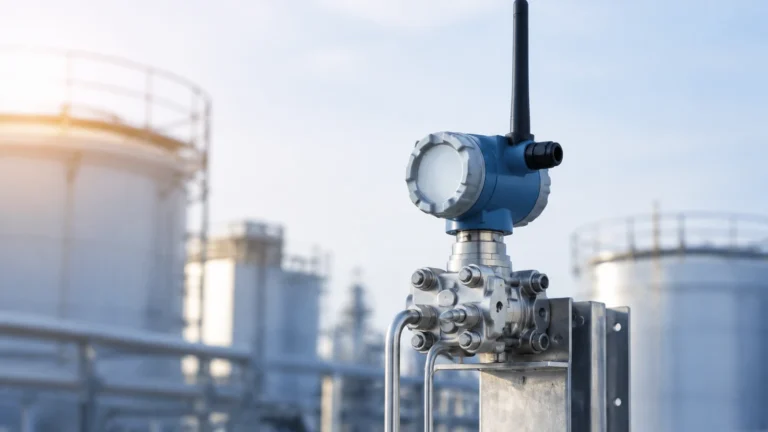
Hydrostatic measurement is based on the principle that the pressure at a specific depth is proportional to the weight of the liquid column above it. The formula used is $P = \rho \cdot g \cdot h$, where $P$ is pressure, $\rho$ is density, $g$ is gravity, and $h$ is the height of the liquid.
* Advantages: Simple installation (submersible or externally mounted) and highly reliable for vented tanks.
* Key Consideration: If the tank is pressurized, a differential pressure transmitter is required to subtract the headspace pressure from the total pressure.
Magnetic Level Gauges and Switches
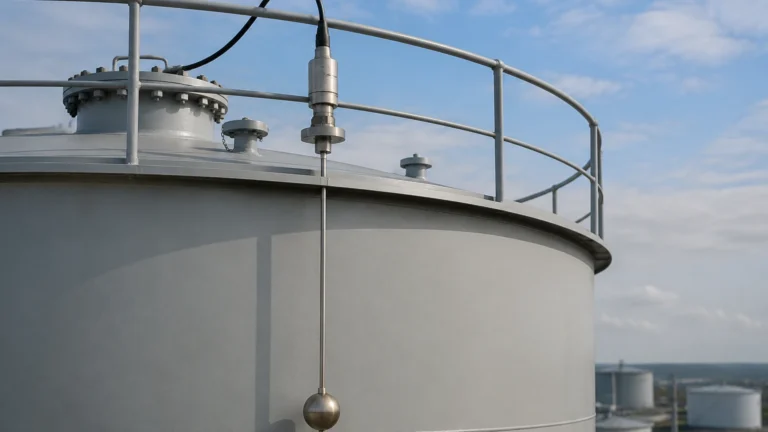
Magnetic gauges utilize a float containing a permanent magnet that moves with the liquid level. This float interacts with an external indicator or a reed-switch-based transmitter. For remote monitoring, a magnetostrictive probe is often added to provide a continuous 4-20mA or digital signal.
Architectural Components of a Remote System
A complete remote tank monitoring setup consists of three primary layers:
1. The Sensing Layer: This includes the radar, ultrasonic, or hydrostatic sensors described above. These devices convert physical levels into electrical signals.
2. The Transmission Layer: In a local setup, sensors use 4-20mA (HART), Modbus RTU, or Foundation Fieldbus. For truly remote monitoring (e.g., across a large facility or in different geographic regions), these signals are fed into an IoT gateway. Common protocols include LoRaWAN, NB-IoT, or cellular (4G/5G) links.
3. The Data Layer: The transmitted data is hosted on a cloud platform or a local SCADA system. Here, the raw distance measurements are converted into volume (liters/gallons) based on tank strapping tables and presented via dashboards.
Selection Criteria: Matching Technology to Application
Choosing the wrong sensor is the most common cause of system failure in remote tank monitoring. Use the following table as a preliminary guide for selection:
| Application | Recommended Technology | Temperature Range | Pressure Range | Key Limitation |
| :— | :— | :— | :— | :— |
| Wastewater Sumps | Ultrasonic | -40°C to 80°C | Atmospheric | Foam can absorb sound waves |
| Corrosive Chemicals | Radar (PTFE Coated) | -40°C to 200°C | Up to 40 bar | High cost compared to others |
| Fuel/Oil Storage | Hydrostatic / Radar | -20°C to 70°C | Atmospheric | Density changes affect accuracy |
| High-Pressure Boilers | Magnetic Gauge | Up to 400°C | Up to 160 bar | Mechanical moving parts |
| Small Dosing Tanks | Radar (80 GHz) | -40°C to 150°C | Up to 20 bar | Minimum blocking distance |
For a comprehensive view of available instrumentation and to consult with technical specialists on specific project requirements, professionals can visit the Main Page to review product options and application support.
Installation Best Practices and Engineering Considerations
To ensure the accuracy of a remote monitoring system, installation must follow strict engineering guidelines. Even the most advanced radar or ultrasonic sensor will provide erratic data if incorrectly positioned.
1. Avoiding Obstructions
For non-contact sensors (Radar and Ultrasonic), the signal beam spreads as it travels. Any internal tank structures, such as ladders, agitators, or heating coils, can create "false echoes." Sensors should be installed at a distance from the tank wall—typically at least 200mm (approx. 8 inches)—to prevent wall interference.
2. Nozzle Geometry
If the sensor is mounted on a nozzle, the nozzle's height and diameter must be considered. If a nozzle is too long and narrow, the sensor may detect the edge of the nozzle rather than the liquid level. This is particularly critical for ultrasonic sensors, which have a "dead zone" (or blocking distance) near the transducer face where measurements are impossible.
3. Turbulence and Foam
In tanks with heavy agitation, the surface may be turbulent, causing signal scattering. In such cases, a stilling well (a vertical pipe installed inside the tank) can be used to provide a calm surface for the sensor to measure. Similarly, heavy foam can absorb ultrasonic pulses; radar is generally more effective in foaming applications, though signal attenuation still occurs.
4. Hydrostatic Venting
For submersible hydrostatic sensors, the cable usually contains a small vent tube. This tube allows the sensor to compensate for changes in atmospheric pressure. If this tube becomes kinked or blocked by moisture, the level reading will drift as the weather changes.

Operational Limitations and Risk Management
While remote tank monitoring significantly improves efficiency, engineers must be aware of certain operational risks:
* Signal Latency: In wireless IoT setups, data may only be transmitted every 15 to 60 minutes to save battery life. This is unsuitable for high-speed filling processes where overfill prevention is critical. For safety-critical loops, hardwired sensors with real-time 4-20mA output are required.
* Power Supply: Remote locations may lack mains power. While low-power sensors can run on batteries or solar panels, the power consumption of the communication gateway must be factored into the system's autonomy calculations.
* Media Build-up: In sticky or crystallizing media, material can build up on the sensor face. While radar is somewhat resistant to this, significant buildup will eventually cause signal loss. Periodic inspection and the use of self-cleaning or non-stick (PTFE) faces are recommended.
Frequently Asked Questions
Q: Can I use one sensor for different liquids?
A: It depends on the technology. Radar and ultrasonic sensors measure distance, so they are generally independent of liquid density. However, hydrostatic sensors measure weight; if you switch from water to a heavier chemical without recalibrating the density setting, the level reading will be incorrect.
Q: How far can the remote signal travel?
A: If using a hardwired 4-20mA signal, the limit is typically 1,000 meters (approx. 3,280 feet) depending on cable quality and interference. Wireless LoRaWAN systems can reach 2-5 km in industrial environments and up to 15 km in open areas.
Q: What is the "Dead Zone" in level measurement?
A: The dead zone, or blocking distance, is the area immediately below the sensor where it cannot accurately measure. For ultrasonic sensors, this is usually 0.25m to 0.5m. If the liquid enters this zone, the sensor may report an error or a full-tank reading regardless of the actual level.
Q: Is radar better than ultrasonic for all applications?
A: Not necessarily. While radar is more versatile (handling steam, dust, and vacuum), ultrasonic sensors are significantly more affordable and perfectly adequate for simple water tank monitoring or open channel flow applications.
Conclusion
Successful remote tank monitoring is built on a foundation of correct sensor selection and disciplined installation. By understanding the measurement principles of radar, ultrasonic, and hydrostatic technologies, engineers can design systems that provide reliable data even in the most challenging industrial environments. Integrating these sensors with modern communication gateways allows for a level of oversight that was previously impossible, driving safety and efficiency across the enterprise.